Lena Vasquez never expected to find her future in a town that was dying. But that is exactly what happened on a sweltering July afternoon in 2024, when she pulled her rusted Honda Civic into a town called Oak Springs, Texas — population 847, and shrinking.
She was twenty-five years old, a graduate of the Rhode Island School of Design with a degree in fine arts and a portfolio full of promise that had led exactly nowhere. For two years after graduation, she had bounced between temp jobs and studio apartments, from Providence to Brooklyn to Austin, chasing commissions that never materialized and relationships that fell apart. The last one — a photographer named Derek who had told her she was "too intense" — had ended with her standing in a parking lot in Austin, holding a box of her belongings, watching his taillights disappear into the Texas night.
She had been driving west with no destination when her car overheated outside Oak Springs. The town was the kind of place that time had forgotten — a single main street lined with brick buildings that had been beautiful in the 1920s but were now faded and empty. A hardware store with a CLOSED sign that had been hanging in the window for so long it had bleached to white. A diner that was still open, barely. A Feed & Seed that had been converted into a thrift store. And at the end of the block, the Crown Theater — a once-magnificent movie palace with a marquee that had not lit up in fifteen years.
Lena sat on the hood of her car, waiting for the engine to cool, and she looked at the Crown Theater. The facade was crumbling. The windows were boarded. But the proportions were perfect — the arched entrance, the ornamental cornice, the ghost of a neon sign that had once spelled out the names of films in glowing letters. It was a building that had been loved once, and it was dying alone.
She did not know why she started sketching. Her sketchbook was in the back seat, buried under a pile of clothes and regret. But she pulled it out, and she sat on the hood of her Civic in the hundred-degree heat, and she drew the Crown Theater the way it must have looked in 1947, when the marquee was blazing and the lobby was full of people in their Sunday best. She drew it with the phoenix she would later paint on its side wall — a bird rising from flames, wings spread, ready to take flight.
"That's beautiful."
The voice came from behind her. Lena turned to find an elderly man standing on the sidewalk, wearing overalls and a John Deere cap, holding a coffee cup. He was maybe seventy-eight, with a face that had been weathered by decades of Texas sun and the kind of quiet that comes from living alone.
"I'm sorry," Lena said, closing her sketchbook. "I didn't mean to trespass. My car overheated."
"You didn't trespass," the man said. "You just sat on the street and drew a picture of a dead building. That's not a crime. Not yet, anyway." He smiled, a slow, warm smile that crinkled the corners of his eyes. "My name is Gus. Gus Patterson. I own the hardware store — the one that's been closed for three years."
"Lena," she said. "I'm just passing through."
"No, you're not," Gus said. "Your car is broken. And you drew a phoenix on a building that's been dead for fifteen years. That's not the work of someone who's just passing through."
He was right. She did not know it yet, but he was right.
Gus Patterson had been the owner of Patterson Hardware on Main Street for fifty-two years. He had opened the store in 1972, when Oak Springs was still alive — when the feed store was full of farmers, and the diner was full of laughter, and the Crown Theater showed a different movie every weekend. He had watched his town die slowly, the way small towns die all across America — one closed business at a time, one family moving away, one For Sale sign that never came down.
His wife, Eleanor, had passed away in 2018. They had been married for fifty-four years. She had been the town's librarian, and she had believed, with a stubbornness that Gus had always admired, that Oak Springs was worth saving. She had started a community garden. She had organized a farmers market. She had written letters to the county commissioners, begging them to invest in Main Street revitalization. And when she died, the garden died with her, and the market fizzled out, and the letters stopped coming.
Gus had spent the past six years watching the Crown Theater crumble, watching the For Sale signs rust, watching the town he loved fade into a ghost of itself. He had not painted a sign in twenty years, not since the day he closed the hardware store. But he had kept his brushes. He had kept his paints. He had kept them in a box under his bed, next to the letters Eleanor had written that she never sent.
"I used to be a sign painter," Gus told Lena that first evening, as they sat on the bench outside the diner, eating burgers that were better than they had any right to be. "Before the vinyl cutters took over. Before everything became digital. I painted the sign for the Crown Theater in 1975, when they renovated the marquee. I painted the sign for the diner. I painted the signs for half the businesses in this town."
"Why did you stop?" Lena asked.
Gus was quiet for a long moment. "Because there was no one left to paint for. The businesses closed. The owners moved away. And I realized that I was painting signs for empty buildings. Signs that no one would read."
Lena looked at the Crown Theater, standing at the end of the block like a monument to a lost era. She thought about the phoenix she had drawn. She thought about the sketches in her portfolio, the ones that had won her awards in college but had never found a home in the real world. She thought about Derek's taillights disappearing into the night, and the feeling of being adrift in a world that had no use for someone who only knew how to make things beautiful.
"What if," she said slowly, "we painted it anyway?"
Gus looked at her. "Painted what?"
"The theater. The side wall. The one that faces the highway. Everyone who drives past this town sees that wall. They see a dead building and they keep driving. But what if they saw something else? What if they saw a phoenix?"
Gus stared at her for a long time. Then he stood up, walked to his truck, and came back with a worn leather notebook. He opened it. Inside were sketches — page after page of signs he had never painted, designs he had never executed, dreams he had never acted on. And on the last page, dated 2019, the year after Eleanor died, was a drawing of a phoenix rising from the flames, with the words "Oak Springs: We Will Rise Again" written beneath it in elegant script.
"I've been carrying this for five years," Gus said, his voice barely above a whisper. "I never had the courage to paint it."
Lena looked at the drawing, then at the old man, then at the crumbling theater at the end of the street. "You have the courage now," she said. "Because you're not alone anymore."
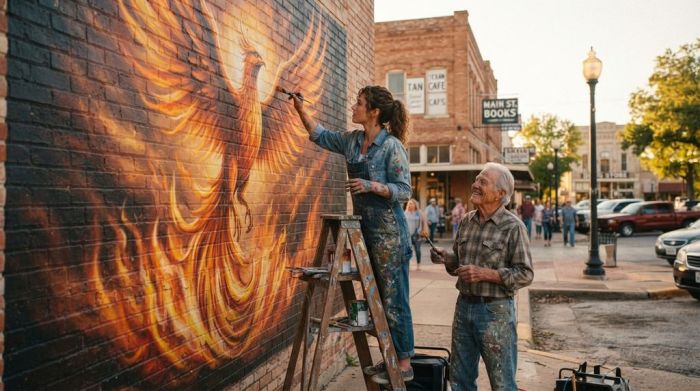
That was the beginning of something neither of them could have predicted. The mural took three weeks to complete. Lena and Gus worked from dawn until dusk, standing on scaffolding that Gus had built from scrap lumber, mixing colors that Gus had been storing in his garage for twenty years. The townspeople watched from a distance at first, curious but hesitant. Then they started bringing food. Mrs. Delgado from the diner brought lemonade and sandwiches. Mr. Kowalski, the retired postman, brought a cooler of ice water. The teenagers who had been hanging around the parking lot with nothing to do started sweeping the sidewalk and handing up brushes.
And the mural grew. The phoenix took shape under Lena's hands — its wings stretching across the entire wall, its feathers blending from deep red to gold to the bright orange of a Texas sunset. Above it, Gus painted the words in his careful, elegant script: "Oak Springs: We Will Rise Again."
On the day they finished, a highway patrolman stopped to look at the mural. He took a photograph and posted it on social media. Within a week, the photograph had been shared over fifty thousand times. People started driving to Oak Springs just to see the phoenix. They stopped at the diner. They browsed the thrift store. They asked about the town, about the mural, about the old man and the young woman who had painted hope onto a dying wall.
Something shifted. A developer who had been planning to demolish the Crown Theater changed his mind and offered to sell it to the town for a dollar. A young couple from Dallas bought the abandoned hardware store and started renovating it. The county commissioners, who had ignored Eleanor's letters for years, approved a grant for Main Street revitalization.
And Gus Patterson, who had not picked up a paintbrush in twenty years, started taking commissions again. He painted a sign for the new coffee shop. He painted a sign for the bed and breakfast that was opening in the old Victorian on Elm Street. He painted a sign for the community garden, which a group of high school students had resurrected in Eleanor's honor.
Lena stayed in Oak Springs. She rented a room above the diner, and she started a small art studio in the back of the hardware store. She taught painting classes to children and adults. She designed murals for other small towns, traveling across Texas, spreading the story of the phoenix on Main Street. But she always came back to Oak Springs, because Oak Springs was where she had stopped running.
Last spring, the Crown Theater reopened for the first time in sixteen years. They showed "The Wizard of Oz" — the same film that had played on opening night in 1947. The marquee blazed with light, and the lobby was full of people in their Sunday best, and Gus stood at the entrance, holding Eleanor's photograph, tears streaming down his face.
Lena stood beside him, her arm around his shoulders. "She would have loved this," she said.
Gus nodded, unable to speak. After a long moment, he found his voice. "She would have loved you," he said. "She would have said that you were the answer to a prayer she never stopped praying."
Lena hugged him, the way she had hugged him a hundred times since that first evening on the bench outside the diner. "You were the answer to mine," she said. "I was lost, Gus. I was driving away from a life that had broken me, and I ended up in a town that was broken too. And we fixed each other."
That is the truth about the mural on Main Street. It is not just a painting on a wall. It is a testament to the power of showing up, of staying, of believing that even the most broken things can be made beautiful again. It is the story of a young woman who stopped running and found her purpose. It is the story of an old man who picked up his brushes after twenty years and remembered how to paint hope. And it is the story of a town that refused to die, because two people — one just starting her journey, one nearing the end of his — decided to create something beautiful together.
If you ever find yourself driving through Texas, take the exit for Oak Springs. The phoenix is still there, blazing on the side of the Crown Theater, its wings spread wide against the endless Texas sky. The marquee is lit again. The diner is full of laughter. And on the bench outside, an old man and a young woman sit together, watching the sunset, knowing that they built something that will outlast them both.
Because that is what art does. It does not save the world. But it saves the people who make it, and the people who see it, and sometimes — just sometimes — it saves the towns that are brave enough to believe in it.
The phoenix on Main Street rises every day, made of paint and hope and the stubborn love of a young woman who learned that the best thing you can do with a broken heart is to paint something beautiful with the pieces.