Cora Mitchell had been serving lunches at Jefferson Elementary in Des Moines, Iowa, for eighteen years, and in all that time, she had learned that the children who needed her the most never asked for seconds.
They were the ones who came through the line with their eyes fixed on their trays, who took the smallest portions without complaint, who sat at the farthest tables with their backs to the room. They were the ones who had learned, far too young, that asking for things only led to disappointment.
Cora knew them because she had been one of them.
She was forty-two years old now, a woman with a round, kind face and hands that had served over a million meals. She had started working at Jefferson when her own son, Christopher, was in kindergarten. The job was supposed to be temporary — a way to make extra money while her husband, a mechanic named Tom, kept the family afloat. But eighteen years later, Christopher had graduated high school and moved to Ames for college, and Cora was still here, standing behind the steam table, ladling out mac and cheese and green beans and trying to pretend that her heart wasn't breaking.
Her youngest, a daughter named Emma, had left for college in August. The house on Elm Street, which had once been filled with the chaos of two children and a husband and a golden retriever named Duke, was now quiet in a way that Cora had not been prepared for. Tom still came home at six, ate dinner, and fell asleep in front of the television. The dog had died two years ago. And Cora had discovered, to her surprise and shame, that she did not know what to do with herself.
She had spent twenty-three years being a mother. She had packed lunches, sewn Halloween costumes, driven to soccer practice, stayed up late helping with science projects, and sat in the bleachers through countless basketball games. She had defined herself by the needs of her children. And now that they were gone, she felt like a woman standing at the edge of an empty room, not sure if she was supposed to stay or leave.
But every morning, she put on her hairnet and her apron, and she walked into the kitchen of Jefferson Elementary. She peeled potatoes, mixed meatloaf, and set out the little cartons of milk that had not changed in size or design since she was a student herself. The routine was familiar. The routine was safe. And the routine, she was beginning to realize, was the only thing holding her together.
The boy appeared in September, two weeks into the school year. He was small for his age, with dark hair that fell across his forehead and eyes that seemed to look past everything, as if he was searching for something in the distance that no one else could see. He walked through the lunch line with his tray held close to his chest, and when he reached Cora's station, he looked up at her with a politeness that felt rehearsed.
"Just a little, please," he said, when she offered him the mac and cheese.
She gave him a normal portion anyway. He looked too thin.
He sat alone at the farthest table, the one by the emergency exit. He did not eat. He pushed the food around his tray with his fork, staring at it the way you stare at something you know you should consume but cannot find the energy to touch. Cora watched him from behind the counter, the way she had watched a hundred other children over eighteen years. But something about this boy made her chest ache in a way she had not felt since Emma left for college.
She asked Mrs. Kowalski, the third-grade teacher, about him. "The new boy," Cora said, wiping down the counter. "Dark hair. Sits alone at the farthest table."
"That's Lucas," Mrs. Kowalski said, lowering her voice. "Lucas Patterson. His father was deployed to Kuwait in July. His mother is... struggling. I've called home three times. She says everything is fine. But Lucas hasn't turned in a homework assignment in two weeks, and he falls asleep in class every afternoon."
Cora nodded. She had seen this before. Military families. The ones who carried the weight of service in ways that had nothing to do with uniforms.
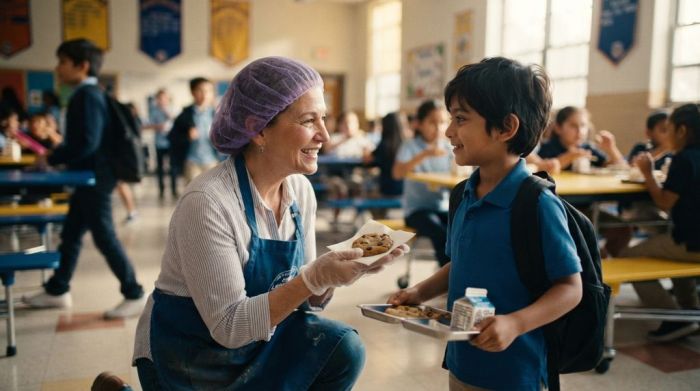
The next day, when Lucas came through the line, Cora did something she had done a thousand times before. She slipped an extra cookie onto his tray — a chocolate chip cookie, still warm from the oven. She did not say anything. She did not make eye contact. She simply placed it there, the way she had placed extra food on the trays of children she suspected were hungry, year after year, without ever being asked.
Lucas looked at the cookie. He looked at Cora. And then, for the first time since she had noticed him, something flickered in his eyes. It was not quite a smile. But it was close.
He ate the cookie. He ate it in small, careful bites, as if he was trying to make it last as long as possible. And when he finished, he folded the wrapper into a neat square and put it in his pocket.
Cora started leaving him notes. Small things, written on napkins, tucked under the edge of his tray. "You are doing a good job." "Your dad would be proud of you." "It is okay to be sad."
She never signed them. She never acknowledged them. But Lucas started eating his lunch. He started with the cookie, then the main course, then the vegetables, the way a child eats when they finally feel safe enough to be hungry.
One afternoon in October, Cora was cleaning the kitchen after the last lunch period. The din of children had faded, replaced by the hum of the dishwasher and the distant sound of a lawnmower outside. She was scraping trays into the garbage when she heard footsteps behind her. She turned. Lucas was standing in the doorway, holding a folded piece of paper.
"I drew this for you," he said. His voice was quiet, the voice of a child who had learned not to take up too much space. "For the cookies. And the notes."
Cora took the paper. She unfolded it. It was a drawing of a woman with a hairnet and a smile, standing behind a counter. Above her head, in wobbly crayon letters, it said: "The best lunch lady in the whole world."
Cora felt her eyes sting. She blinked hard, the way you blink when you are determined not to cry in front of an eight-year-old. "This is the most beautiful thing anyone has ever given me," she said. "Can I hang it on my refrigerator?"
Lucas nodded. He looked at her for a moment longer, and then he said something that Cora would carry in her heart for the rest of her life.
"My mom used to smile like you. Before Dad left. She doesn't smile anymore."
Cora knelt down so she was at his eye level. "Your mom is doing the hardest job in the world right now, Lucas. She is holding everything together while your dad is gone. And sometimes, when people are holding that much, they forget how to smile. But it does not mean she loves you any less."
He nodded, a small, solemn nod. "I know. I just miss her smile."
"Then you should tell her that. Tell her that you miss her smile. It might remind her that it is still there."
Lucas thought about this. Then he nodded again, turned, and walked back to his classroom.
That night, Cora called Emma at college. They talked for forty-five minutes — about classes, about friends, about the boy who had been eating alone in the dining hall and whether she should sit with him. Cora listened to her daughter's voice, the voice that had once filled the house on Elm Street with laughter and arguments and the particular music of a child growing up. And she realized, sitting there in the quiet kitchen, that she had been wrong about the empty room.
She was not standing at the edge of nothing. She was standing at the edge of something new.
Cora called the school counselor, a young woman named Ms. Rivera, and asked if there was a support group for military families in the area. There was — a group that met at the community center on Tuesday nights. Cora drove to the Patterson house on a Thursday afternoon, stood on the porch, and knocked. Lucas's mother answered. Her name was Sarah. She looked tired in a way that went beyond physical exhaustion.
"Hi," Cora said. "I'm the lunch lady at Jefferson. I don't know if Lucas has mentioned me. I bring him cookies sometimes."
Sarah's face softened. "He talks about you all the time. He drew a picture of you last week. Said you have the kindest smile he has ever seen."
Cora told her about the support group. Sarah stared at her for a long moment. And then she started to cry. She cried the way people cry when they have been holding everything together for too long and someone finally gives them permission to let go.
"Thank you," Sarah whispered. "No one has noticed. No one has asked. I have been so alone."
"You are not alone," Cora said. "You have Lucas. And now you have me."
Sarah started attending the support group. Lucas started coming out of his shell. His grades improved. He made a friend — a boy named Marcus who also had a parent deployed overseas. They sat together at lunch now, at the table by the window, and they laughed the way eight-year-olds are supposed to laugh.
In December, Lucas's father came home for two weeks of leave. He came to the school on a Friday morning, in uniform, and stood in the cafeteria doorway. Cora saw him before Lucas did — a tall man with tired eyes and a chest full of medals. He walked to Cora's station and extended his hand.
"You're the lunch lady," he said. "My wife told me about you. My son drew me a picture of you and asked if we could invite you to dinner."
Cora shook his hand, her heart full. "I just gave him cookies."
"No," he said, his voice thick. "You gave him hope. You gave my wife hope. And that is more than cookies."
Cora Mitchell is forty-four now. She still works at Jefferson Elementary. She still serves mac and cheese and green beans and little cartons of milk. But she does something else now, something she started after Lucas's father came home. She keeps a stack of blank cards in her apron pocket. And whenever she sees a child who looks like they need to be seen — a child eating alone, a child with circles under their eyes, a child who has learned not to ask for what they need — she writes a note and slips it onto their tray.
"You are doing a good job."
"It is okay to be sad."
"Someone is proud of you."
She never signs them. She never tells anyone. But the children know. They know because they come back the next day, and the next, and they look for her face in the lunch line. They know because the cookies are always warm, and the portions are always generous, and the smile behind the steam table never wavers.
Cora's children are grown. Her house is still quiet. But she has discovered that the empty room was never really empty. It was full of children she had not met yet — children like Lucas, who needed someone to see them, to feed them, to remind them that they were not invisible.
And Cora Mitchell, lunch lady at Jefferson Elementary, has learned that the most important meals she serves are not the ones on the trays. They are the ones that come with a side of kindness, served quietly, without expectation, one napkin note at a time.