Maya Chen never expected to learn the most important lesson of her motherhood from a cardboard lemonade stand. But that is exactly what happened on a warm May afternoon in Burlington, Vermont, when her eight-year-old son Elliot taught her that generosity has nothing to do with how much you have — and everything to do with how much you care.
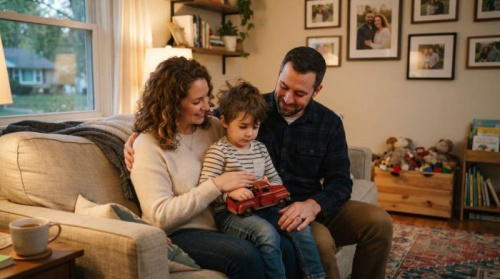
Maya was thirty-four years old, a paralegal at a small law firm downtown. She had been a single mother for five years, ever since her ex-husband decided that fatherhood was not a commitment he wanted to keep. She did not talk about him anymore. There was nothing to say. She woke up at six every morning, made Elliot his breakfast — usually oatmeal with sliced bananas, the only thing he would eat without complaint — walked him to the bus stop, and went to work. She picked him up at five, made dinner, helped with homework, and collapsed into bed by ten. It was not a glamorous life. But it was theirs, and she was grateful for it.
Elliot was the kind of kid who noticed things. He noticed when Mrs. Kowalski next door had trouble carrying her groceries. He noticed when his classmate Lily had been wearing the same jacket every day for three weeks, even as the weather warmed. He noticed when someone was sad, and he always tried to do something about it. Maya had noticed this about him since he was three years old, bringing her his blanket when she was sick, drawing pictures for friends who had a bad day. She had always thought of it as just who he was — a sensitive boy with a big heart. She did not realize, until that May afternoon, just how big that heart really was.
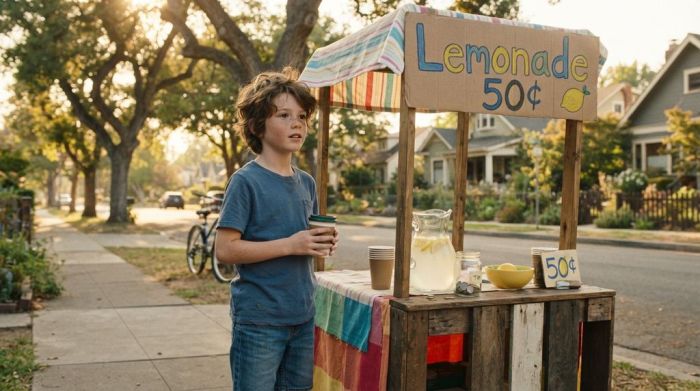
The lemonade stand appeared on a Saturday morning, constructed from a cardboard box and a piece of plywood Elliot had found in the garage. The sign was hand-painted in wobbly blue letters: "Lemonade 50¢. All profits go to a good cause." Maya had smiled when she saw it, assuming the "good cause" was a new video game or the Lego set he had been eyeing at the toy store.
"That's a great sign, buddy," she said, handing him a pitcher of lemonade. "What's the good cause?"
Elliot shrugged, a little too casually. "You'll see."
Maya did not push. She had learned that Elliot would tell her things when he was ready. She went inside to do the laundry, watching him through the kitchen window as he set up his stand at the end of the driveway. He sat on a small stool, arranging the cups with the precision of a museum curator, adjusting the sign three times until it was perfectly straight.
The first customer was Mrs. Patterson, the retired schoolteacher who lived three houses down. She bought two cups and left a five-dollar bill. The second was the mailman, who bought a cup and refused to take the change. By noon, Elliot had sold out. He counted his money on the kitchen table — eighteen dollars and fifty cents — with the intensity of a banker closing a major deal.
"Good first day?" Maya asked.
"Good first day," Elliot said, but his voice was quiet, and he was looking at the money with an expression Maya could not quite read.
The lemonade stand became a daily ritual. Every afternoon, as soon as Elliot finished his homework, he would drag the cardboard table to the end of the driveway and set up shop. He experimented with recipes — adding a splash of strawberry syrup one day, a slice of lemon the next. He made a new sign that said "Elliot's Famous Lemonade — Try It, You'll Like It!" with a drawing of a smiling sun. The neighbors started looking forward to his stand. Mr. Kowalski from two doors down stopped by every single day. The teenage girl who babysat for the family across the street bought three cups at a time.
Maya watched her son pour his heart into that lemonade stand, and she felt a swell of pride that she could not quite put into words. But she also noticed something else. Every evening, after the stand was packed away and the dishes were washed, Elliot would retreat to his room with a small notebook. He was not playing video games. He was not reading comic books. He was writing something, with the same focused intensity he brought to everything else.
On the tenth day, Maya's curiosity got the better of her. She knocked on his door and found him sitting cross-legged on his bed, the notebook open in front of him, a small jar of money beside him.
"Can I ask what you're working on?" she said, sitting down beside him.
Elliot hesitated. Then he handed her the notebook.
It was a list — a careful, detailed list of every customer who had bought lemonade, how many cups they had bought, and how much they had paid. At the bottom, he had written a running total: eighty-seven dollars and twenty-five cents.
"That's a lot of lemonade," Maya said. "You've been working really hard."
Elliot nodded. He looked at the jar of money, then at Maya, and then he said something that made her heart stop.
"Mom, do you remember Lily? From my class?"
Maya nodded. Lily was a quiet girl with pigtails who sometimes came over for playdates. Maya knew her mother, a single mom like herself, who worked at the hospital as a receptionist.
"Her dad lost his job," Elliot said, his voice small. "Lily told me at recess. She said they can't afford a new coat for her for next winter. She's been wearing the same one since first grade, and it's too small now." He looked up at Maya with eyes that held a wisdom far beyond his eight years. "I want to buy her a coat. A really warm one. So she won't be cold when winter comes."
Maya felt the tears coming before she could stop them. She pulled Elliot into her arms and held him, the way she had held him when he was a baby, when he was small enough to fit in the crook of her arm. She thought about all the mornings she had rushed him through breakfast, all the evenings she had been too tired to play, all the moments she had worried that she was not doing enough, not being enough, not giving him everything he needed.
And here he was, her eight-year-old son, running a lemonade stand to buy a winter coat for a classmate whose family was struggling.
"Elliot," she whispered, her voice thick, "do you know how proud I am of you?"
He pulled back, looking confused. "I didn't do anything special, Mom. I just sold lemonade."
"No," she said, cupping his face in her hands. "You saw someone who needed help, and you decided to do something about it. That is the most special thing a person can do."
The next morning, Maya called Lily's mother, a woman named Rachel. She told her about Elliot's lemonade stand, about the notebook, about the eighty-seven dollars. Rachel was silent for a long moment, and then she began to cry.
"I didn't know she told anyone," Rachel said, her voice breaking. "I didn't know she was worried about the coat. She never said anything to me."
"Kids notice more than we think," Maya said. "And sometimes, they find their own way to help."
That Saturday, Maya helped Elliot set up his biggest lemonade stand yet. She made three pitchers of lemonade, baked a batch of cookies, and put up a new sign: "All proceeds buy winter coats for kids who need them." Within an hour, the street was crowded with neighbors. Mrs. Patterson brought a tray of brownies. Mr. Kowalski donated twenty dollars and stayed to help pour lemonade. The mailman stopped by with a bag of ice.
By the end of the day, the jar held two hundred and forty-three dollars.
Elliot counted the money three times, his eyes wide, his smile stretching from ear to ear. "Mom," he said, "we can buy more than one coat. We can buy a lot of coats."
And they did. The next weekend, Maya took Elliot to the department store, and he picked out five winter coats — warm, puffy ones with hoods — in different sizes. He chose them the way he did everything, with careful consideration, holding each one up, imagining which child it might fit. When they brought the coats to Lily's school the following Monday, the principal called Elliot to the front of the morning assembly. She told the whole school what he had done. Elliot stood there, clutching the bags of coats, his face turning red as the entire student body applauded.
After the assembly, Lily ran up to him. She was wearing her too-small coat, the one she had worn since first grade. Her mother stood behind her, crying openly. Elliot handed Lily a bright pink coat — her favorite color — and said, "I hope this one fits better."
Lily put it on. It fit perfectly. She hugged Elliot so hard that he stumbled backward, and they both laughed, two eight-year-olds who had just learned something profound about kindness and friendship.
That was two months ago. The lemonade stand is still there, at the end of the driveway on Elm Street. Elliot runs it every Saturday, and the neighbors still come. He has raised over six hundred dollars now. He bought coats for twelve children in his school. The local newspaper wrote a story about him. A charity in Burlington asked if he would be their youth ambassador. But when Maya asks him if he is proud of what he has done, Elliot just shrugs and says, "I just sold lemonade, Mom."
And that is the most beautiful thing about it. To Elliot, it was never a grand gesture. It was just a boy who noticed that someone needed help, and decided to do something about it, the only way he knew how — one cup of lemonade at a time.
Maya Chen is still a paralegal. She still wakes up at six every morning and makes oatmeal with bananas. But she looks at her son differently now. She sees the man he is becoming — a man who notices, who cares, who acts. And she knows, with a certainty that settles into her bones like warmth, that he is going to be okay. More than okay. He is going to make the world a better place.
There is a photograph on Maya's refrigerator. It shows Elliot standing behind his lemonade stand, holding up a pink winter coat, grinning at the camera with a missing front tooth. The sign behind him says "Elliot's Famous Lemonade" and there is a jar overflowing with dollar bills.
But the real treasure is not in the jar. It is in the heart of a boy who looked at a friend in need and did not look away. It is in the thousands of small, invisible acts of kindness that will shape the rest of his life. It is in the mother who watched her son teach her the meaning of generosity, and learned that the greatest gifts are not the ones you buy — they are the ones you give without expecting anything in return.
The lemonade stand on Elm Street is still open. The lemonade is always cold, the cookies are always warm, and the boy behind the counter is always smiling. If you are ever in Burlington, Vermont, stop by. Buy a cup. Tell him he is doing a good job. And remember that the people who change the world are not always the ones with power or money. Sometimes, they are eight-year-old boys with cardboard signs and hearts too big for their small chests.