Ethan Porter never expected to save his marriage with a hammer and a pile of two-by-fours. But that is exactly what happened on a humid June morning in 2024, when he pulled his pickup truck into the overgrown driveway of a crumbling farmhouse in rural Ohio and realized that the only way forward was to tear everything down and start building again, one nail at a time.
He was thirty-two years old, a project manager at a construction firm in Columbus, and he was a man who had learned to control everything in his life except the one thing that mattered most: the anger that lived inside him like a wild animal, waiting for the smallest provocation to break free.
Maya was thirty-one, a pediatric nurse at Nationwide Children's Hospital, and she had been married to Ethan for eight years. She had spent the last two of those years walking on eggshells, never knowing which version of her husband she would come home to — the kind, funny man she had fallen in love with, or the stranger whose jaw tightened at the slightest inconvenience, whose voice rose at the smallest mistake, whose hands had never touched her in anger but whose words had left bruises that lasted far longer.
The farmhouse belonged to Ethan's grandmother, Ruth Porter, who had passed away at the age of ninety-two. She had lived in that house for sixty-seven years, outliving two husbands and raising four children within its walls. She had been a quiet woman, the kind who kept her secrets close and her heart closer. When the lawyer read her will, Ethan inherited the house. It was the only thing she had left him — a dilapidated, century-old farmhouse thirty miles outside of Columbus, with a leaking roof, a sagging porch, and seventy years of dust and memories.
Ethan had planned to sell it. He had planned to sign the papers, hire a realtor, and never look back. But Maya had other plans.
"I want to fix it," she said one evening, as they sat across from each other at the kitchen table in their small apartment in the suburbs. She said it quietly, the way you say things when you are not sure how they will be received. "I want us to fix it together."
Ethan stared at her. "Fix it? Maya, the place is falling apart. It would take months. It would take thousands of dollars we don't have."
"Your grandmother lived there for sixty-seven years," Maya said. "She raised your father there. She buried two husbands from that house. It has more history in its walls than we have in our entire marriage." She paused, and when she spoke again, her voice was softer, more fragile. "And I think we need something to work on together. Something that isn't us."
That was the first crack in the wall between them. The first admission, spoken aloud, that they had been drifting apart for years.
Ethan had always been a fixer. It was what he did for a living — managing construction projects, solving problems, making things right. But he had never learned how to fix the things that really mattered. He had never learned how to fix the damage his words caused, the way he could turn a small disagreement into a battlefield, the way he would retreat into silence for days after an argument, leaving Maya to wonder if he still loved her.
The first week at the farmhouse was a disaster. They arrived on a Saturday morning, armed with tool belts and optimism that evaporated within hours. The roof was worse than Ethan had estimated. The plumbing was shot. The kitchen floor had rotted through in three places. And the heat — the Ohio summer had arrived with a vengeance, turning the farmhouse into a brick oven that none of the windows could cure.
They worked in silence that first day, the way they had been working in silence for months. Ethan tore out the damaged drywall in the living room while Maya scraped wallpaper in the kitchen. They did not talk. They did not need to. The air between them was thick with everything they were not saying.
By evening, Ethan was exhausted and frustrated. He had cut his hand on a piece of broken glass, he had failed to fix the water heater, and he had discovered that the wiring in the attic was a fire hazard. He sat on the front porch, his head in his hands, and felt the familiar rage building in his chest — the rage at the house, at the heat, at himself for believing that this could work.
Maya came out and sat beside him. She did not say anything. She just sat there, the way she used to sit beside him in the early years of their marriage, when silence had been comfortable instead of painful.
"I can't do this," Ethan said. His voice was flat, defeated. "I can't fix this house. I can't fix us. I don't know how."
Maya was quiet for a long moment. Then she said, "Your grandmother fixed this house. She raised four children here. She buried two husbands. She lived through the Depression, through wars, through everything life threw at her. And she never gave up. Not once."
"She was stronger than me."
"No," Maya said. "She was just more patient. And she had someone who believed in her."
Ethan looked at her. In the fading light, the anger on his face softened into something else — something that looked almost like hope.
"She left you that house for a reason, Ethan. She knew you. She knew you would want to tear it down and start over. And she also knew that the best things in life are not built from scratch. They are restored. They are saved from falling apart, piece by piece, by people who refuse to let them go."
The next morning, Ethan found the box.
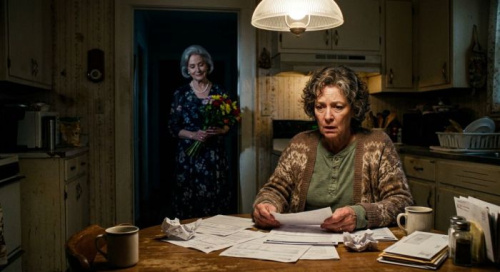
It was in the attic, buried under a stack of old blankets and forgotten Christmas decorations. A small wooden box, hand-carved, with a faded brass latch. He carried it downstairs, set it on the kitchen table, and opened it with Maya watching over his shoulder.
Inside were letters. Dozens of them, tied with a faded ribbon. They were addressed to Ruth Porter, postmarked from various cities across Ohio, all dated between 1952 and 1955. Ethan opened the first one, his hands trembling.
It was from a man named Frank — not Ruth's first husband, but a man Ethan had never heard of. The letters told a story that Ruth had never shared with anyone. She had been married once, before she married Ethan's grandfather. Her first husband had been a violent man. She had left him in the middle of the night in 1952, taking nothing but her children and a single suitcase. She had moved to the farmhouse that had been left to her by her own mother, and she had spent three years hiding from a man who had promised to find her.
Frank was a sheriff's deputy who had been assigned to her case. He had fallen in love with her during those years — not in the way movies portray, with grand gestures and sweeping romance, but in the quiet way that love happens when two people are fighting for the same thing. He had stood between her and her ex-husband more than once. He had taught her how to fire a gun. He had taught her that she was stronger than she knew.
Ethan read the letters aloud to Maya as they sat at the kitchen table, the Ohio sun streaming through the dusty windows. He read about a woman he had never known — his grandmother, who had been a quiet, gentle presence in his childhood, who had never raised her voice or spoken ill of anyone. He read about her escape, her fear, her determination. He read about the night Frank had proposed, and the letter she had written back, accepting.
Ethan's grandfather had not been his biological grandfather. The man he had known as Grandpa Porter was actually Frank — the deputy who had fallen in love with a woman running from a violent past. He had adopted Ethan's father. He had raised him as his own. And Ruth had carried the secret of her first marriage to her grave.
Ethan closed the last letter and set it down. His hands were shaking. He looked at Maya, and he saw that she was crying, silent tears streaming down her face.
"She was running from someone like me," Ethan whispered. The words came out before he could stop them. "Someone who couldn't control his anger. Someone who made the people he loved afraid."
Maya reached across the table and took his hand. "No," she said. "She was running from someone who refused to change. That's different."
"But what if I can't change?"
"The fact that you're afraid of that — the fact that you're sitting here, holding these letters, seeing yourself in them — that's already change. That's the first step."
That was the turning point. Ethan started going to therapy that summer — not because Maya asked him to, but because Ruth's letters had shown him something he had never seen before: the shape of the man he was becoming. The anger he carried was not a birthright. It was a wound, inherited from a father who had never learned to heal, passed down like a family heirloom no one wanted. And he had the power to break the cycle.
They spent the rest of the summer working on the farmhouse. But something had shifted. They were not just fixing a building anymore. They were building a new foundation — for the house, and for themselves. Ethan learned to ask for help. Maya learned to speak up when something bothered her, instead of swallowing it down. They argued, but the arguments no longer felt like battles. They felt like conversations — messy, imperfect, but ultimately moving toward understanding.
In August, they found a hidden compartment behind a loose board in the kitchen pantry. Inside was a small leather journal, its pages yellowed with age. It was Ruth's diary from 1952 — the year she fled her first husband. On the last page, written in careful, elegant handwriting, was a note addressed to whoever found it.
"To whoever reads this: I hope you never have to know what it feels like to be afraid of the person who promised to love you. But if you do, I want you to know that you are stronger than you think. There is no shame in leaving. There is no shame in starting over. And there is no shame in asking for help.
The house on Maple Street has seen a lot of tears. But it has also seen a lot of healing. The walls have held secrets and sorrows, but they have also held laughter and love. That is the thing about old houses — they remember everything. And they remind us that the most broken things can be made beautiful again.
Build something new. Not with wood and nails, but with patience and forgiveness. That is the only renovation that truly matters."
Ethan framed that page and hung it in the living room of the farmhouse, right above the fireplace that he had rebuilt with his own hands. He looks at it every morning when he drinks his coffee, and it reminds him of the man he is choosing to become.
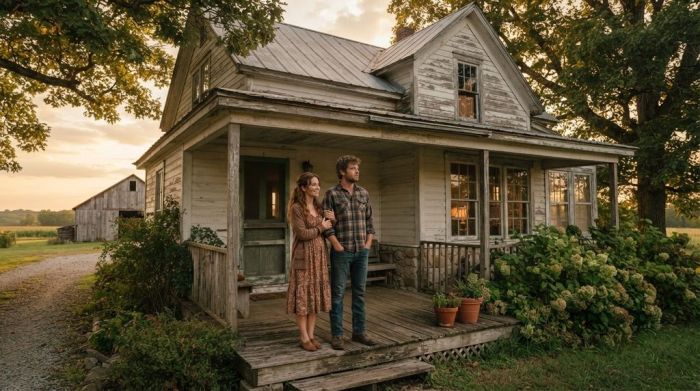
That was two years ago. Ethan and Maya still live in the farmhouse on Maple Street. The roof is fixed. The plumbing works. The kitchen floor has been replaced with reclaimed wood from a barn that was built in 1880. The porch no longer sags. And on summer evenings, they sit on it together, watching the fireflies rise from the meadow, talking about the day they almost let each other go — and the grandmother who saved them, even from beyond the grave.
Ethan is thirty-four now. He still works in construction, but he has started a small side business renovating old houses. He calls it Porter Restoration, and he tells every client the same thing: "The best renovations are not about making something look new. They are about remembering what made it beautiful in the first place."
Maya is thirty-three. She is still a pediatric nurse. She comes home every evening to a house that smells like sawdust and possibility. She passes Ruth's framed journal page in the living room, and she thinks about the woman she never met who taught her that love is not about staying — it is about choosing to stay, every single day, even when it would be easier to leave.
Last spring, they adopted a rescue dog, a golden retriever mix with one floppy ear and a tail that never stops wagging. They named her Ruth. She sleeps on the porch on warm nights, guarding the house that was saved by the courage of a woman who ran away from violence and the stubborn love of a couple who refused to let each other go.
Somewhere in rural Ohio, there is a white farmhouse with a wraparound porch and a garden full of wildflowers. The woman who planted those flowers is long gone. But her legacy lives on in the walls she built, the secrets she kept, and the grandson who finally learned that the only thing worth renovating is the human heart.