The knock came at 7:10 on a Tuesday morning, and Ray Callahan knew before he opened the door that his life was about to change. Police officers did not come to a quiet street in Des Moines at breakfast time to talk about the weather. Two of them stood on his porch with the patient, careful faces of men about to deliver news that could never be taken back. Across the street, his neighbor Margaret pretended to water her roses while watching.
"Mr. Callahan?" the older officer said. "I'm Detective Freeman. This is Officer Ruiz. We need to talk about your grandson, Cole."
Ray's knees went weak. His first thought was the one every grandparent prays they will never think. Please, not the highway. Cole was six years old. He lived with his mother, Darla, twelve minutes away, and he spent every Tuesday with Ray while she worked. Tuesday was bread-and-muffins day. Tuesday was the best day of Ray's week, and he would have defended it to his dying breath.
"Is he okay?" Ray asked.
"He's fine," the detective said. "But there's a bruise on his forearm. A handprint-sized bruise. His pediatrician's office flagged it this morning, and we're required to follow up."
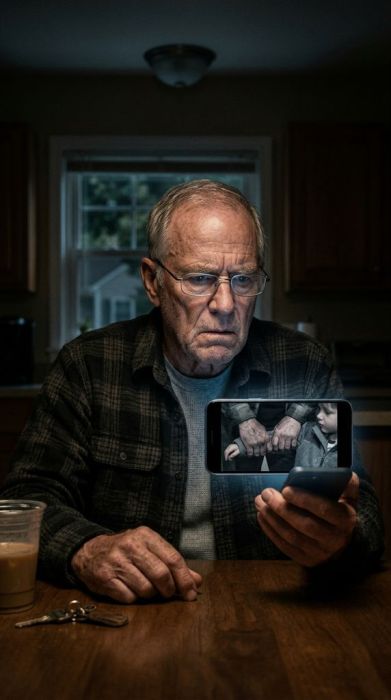
Ray looked down at his own hands. Calloused. Stained at the knuckles even now, three years after he'd sold the shop. He'd been a diesel mechanic for thirty-six years. These hands had rebuilt engines, changed tires, and lifted three sons and a daughter onto his shoulders at the fireworks show every July. These hands had never struck a soul, and he said exactly that, a little too loudly, a little too fast.
Nobody said he had.
Detective Freeman asked if he could come inside. Ray said yes because refusing looks like guilt, and Ray Callahan had spent sixty-eight years believing the truth had a way of winning. He made a pot of coffee. He answered every question in order. Yes, Cole was with him every Tuesday. Yes, they baked, and played catch, and worked on the old Chevelle that still wouldn't start. No, Cole never cried. No, Cole never said he was afraid. No, Ray had never, not once, laid a hand on that boy harder than a pat on the back.
The detective wrote things in a small notebook. Officer Ruiz photographed the living room, the back stairs, the hallway. Ray felt like a stranger in his own house. Twenty minutes later they left with the same polite faces, and Ray stood in the doorway watching their cruiser pull away, and that was when the phone rang.
It was his son, Ethan.
"What did you do to my son, Dad?"
The words came out flat and cold, like they'd been rehearsed. Ray opened his mouth, but nothing came out, and in that silence he heard his son make a sound that wasn't quite a breath. It was the sound of a door closing.
"The doctor saw the bruise," Ethan said. "Darla texted me the photo. Cole has a handprint on his arm, Dad. His whole little arm is bruised. And you're the only one who had him that day."
Ray wanted to say the bruise wasn't there when Cole left. He wanted to say it with the shaking certainty of a man who had buttoned Cole's jacket himself at five o'clock and waved from the porch while Darla's car pulled away. He wanted to say it, but Ethan had already hung up.
That Tuesday had been perfect. That was the cruelest part. Ray and Cole had made banana bread with the walnuts on top that Cole always picked off and ate first. They'd put new air in the tires of the Chevelle, or pretended to, which is the same thing when you're six. Cole had drawn a picture of Ray with a big wrench and a bigger smile, and it was taped to the refrigerator right now, where Ray could see it while the officers walked through his house. A kid drawing his grandfather with a wrench and a smile doesn't spend his day being hurt. Ray told himself that over and over, the way you repeat a number you're afraid of forgetting.
The bruise, as it turned out, had appeared that night. Darla had taken the photo Wednesday morning, before daycare, when Cole rolled up his sleeve at the kitchen table. She'd called the pediatrician first, then the police. By Thursday, two social workers had interviewed Cole at school, and Ray had been formally contacted by the Iowa Department of Human Services. By Friday, Darla had filed for a restraining order, and Ethan's lawyer had sent a letter demanding that Ray stay away from the family.
Family. The word tasted like ash.
Here is what nobody tells you about being falsely accused: the accusation doesn't just take your reputation, it takes your routines. Ray stopped going to the diner on Saturday mornings, because the waitress there was Darla's cousin. He stopped waving at Margaret, because her eyes had gone careful and kind in a way that made his stomach turn. He stopped answering the phone entirely, because every call was either a reporter who'd gotten his number or a neighbor offering the kind of sympathy that felt like a verdict.
The worst part was Cole's silence. When the social workers allowed Ray one supervised conversation, Cole sat across from him in a fluorescent office and would not look up from the table. Ray asked about the Chevelle. Nothing. Ray asked about banana bread. A small shake of the head. Ray asked him, softly, if anyone had hurt him, and Cole's chin trembled, and the social worker ended the visit, and Ray walked out into the parking lot and cried for the first time since his wife, Laura, had died two years before.
He thought about Laura constantly. Laura had been a second-grade teacher, and she had known children the way Ray knew engines. She would have seen something. She would have listened. But Laura was gone, and Ray was alone with the worst thought a grandfather can have: that he would never hold Cole again, and that a part of him might not want to, because what if the boy looked at him like everyone else did now?
It was Ethan, of all people, who brought the first crack of light. Ethan called on a Thursday night, the second week, and his voice was different. Tired. Less certain.
"I need to ask you something, Dad, and I need you to not get angry."
"Okay."
"Darla says Derek picked Cole up from your place that Tuesday. She says you usually bring Cole home, but that day Derek came to get him."
Ray had forgotten. In the storm of accusations, he had forgotten that detail completely. Yes. Derek Voss, Darla's boyfriend, the car salesman with the expensive watch and the quick smile, had pulled into Ray's driveway at five o'clock that evening. Cole had been in the middle of a game and hadn't wanted to go. There had been a moment at the front door, a yank, a cry that cut off fast. Ray remembered it now, the way you remember a blur in the corner of a photograph, and his blood turned to ice.
"I remember," Ray said. "Cole didn't want to leave. Derek grabbed his arm to get him moving. Cole cried out, and Derek laughed and said something about being a big boy."
Silence on the line. Then Ethan said, very quietly, "Darla says Cole told her you grabbed him, Dad."
"He never said that. Derek told her that. Or she decided it herself. Either way, it's a lie."
"She believes Derek."
"Then ask Cole. Not a social worker. Just you and him, in a room, with no Derek and no Darla."
Ethan didn't say yes. He didn't say no. He said he'd think about it, and Ray hung up with his heart pounding, because he had finally remembered the one thing that could save him, if it still existed.
The camera.
Two Halloweens ago, after a string of porch-package thefts on his block, Ray had bought a cheap indoor security camera for the front hallway. He'd aimed it at the front door, and then Laura had gotten sick, and the whole project had been forgotten. The camera had been recording to a memory card for nearly two years without anyone ever looking at it. Ray had never once thought about it again until that Thursday night.
He found it in the hall closet, behind the vacuum cleaner, plugged into the same outlet it had occupied since he'd installed it. A little white wedge with a blinking light he had walked past thousands of times. Ray unplugged it, carried it to the kitchen, and sat down at the table where Cole drew pictures, and he did not allow himself to hope.
The memory card was nearly full. Ray fast-forwarded through weeks of footage, days of an empty hallway, the front door opening for the mailman, Margaret returning a casserole dish, Ethan bringing Cole over on a Sunday. And then he reached that Tuesday, and he watched, frozen, as Cole jumped off the stairs at five o'clock and Derek Voss stepped through the front door.
The footage was grainy and the audio was thin, but it was enough. Ray watched his grandson run for the living room, watched Derek call his name, watched the boy hesitate on the edge of the frame. He watched Derek close the distance, reach down, and take Cole's arm. He watched Cole pull away. He watched Derek's face twist into something that was not a smile, and he watched him yank, hard, and he heard Cole's cry, sharp and short, and he heard Derek's voice, low and bright and cheerful, exactly the voice he had used at the door: "Big boys don't cry, buddy."
Ray played it four times. Then he sat in the dark kitchen, with the light of the dying phone battery on his face and the sound of his own breathing loud in the room, and he understood that the truth had been sitting in his closet the whole time, recording faithfully, waiting for him to remember it.
He called Ethan at nine o'clock that night. He did not explain. He said, "Come over. Alone. Don't tell Darla." And he hung up before Ethan could argue.
Ethan came. Ethan sat at the kitchen table and watched the footage with his father, and when Derek Voss's hand closed around Cole's arm on the screen, Ethan's coffee cup rattled against the table and his face went white. When Cole's cry came through the tinny speaker, Ethan covered his mouth with both hands. And when the clip ended, he sat in silence for a long time, and then he said the only words that mattered.
"I'm sorry, Dad. I'm so sorry."
The confrontation happened two days later, on a Sunday, in the living room of the house Darla rented on the other side of town. Ethan had called her and said they needed to talk about Cole, face to face, no lawyers, no social workers. Derek was there, stretched out on the couch in a polo shirt, scrolling his phone, looking exactly like the man from the video. Darla was in the kitchen doorway with her arms crossed, wearing the armor of a mother protecting her child.
Ethan didn't argue. Ethan didn't even raise his voice. He set his laptop on the coffee table, pressed play, and stepped back.
The sound of Cole's cry filled the room. Derek's face did something complicated, somewhere between a sneer and a wince, and then he was standing, and then he was talking fast, telling everyone the kid was clumsy, the kid fell off the porch, you people are crazy. And Darla, who had seen her son flinch around Derek for a year, who had told herself it was just a phase, who had blamed Ray because Derek was easy to believe and Ray was easier to blame — Darla looked at the frozen frame on the laptop and then looked at Derek, and the armor cracked.
"Get out," she said. "Get out of my house."
Derek laughed. Derek told her she was being dramatic. Derek didn't see the two police officers who had arrived at the curb five minutes earlier, because Ethan had called them before he knocked. They came through the front door with their hands on their belts while Derek was still laughing, and the laughter stopped, and Derek Voss was arrested that Sunday afternoon for child endangerment and assault.
The bruise on Cole's arm had faded by then. Ray had almost forgotten what it looked like, the pale yellow-green ghost of it, the handprint that had nearly cost him his family. But he never forgot the moment Cole climbed into his lap at the police station, hours later, and whispered that he was sorry for not telling, and that Derek had said Grampa would be the one who got in trouble if he talked.
"Nobody is in trouble, buddy," Ray said, and he held Cole the way he had held his own children, the way Laura would have held them, and he let himself cry into the boy's hair where nobody could see.
It took months for the family to find its footing again. Darla ended things with Derek for good, went to counseling with Cole, and eventually — on a gray November afternoon that Ray would never forget — she brought Cole to Ray's house herself, stayed for coffee, and let him go to the garage to look at the Chevelle. She didn't apologize with words. She apologized by bringing him back.
Ethan apologized with a hammer. They spent a Saturday repairing the porch railing that had gone loose, two grown men not saying the important things out loud, which is how the Callahan men had always said them. And when they finished, Ethan sat on the steps with a bottle of water, and he said, "I should have asked Cole myself. I should have believed you first."
"You believed what you saw," Ray said. "A bruise is loud. Love is quiet. That's the whole problem."
Ray still has the camera. He moved it to the garage, aimed at the Chevelle, because some small, superstitious part of him wants it watching over the good things. But every Tuesday, when Cole comes over and they bake banana bread with the walnuts on top, Ray finds himself glancing at the boy's arms the way he once checked the oil pressure on an engine. Not because he doesn't trust Cole. Because he knows now that the truth is not always the loudest thing in the room, and that a grandfather's hands can be judged guilty in a photograph they never appear in.
The lesson is not that cameras save families, though sometimes they do. It is that Cole's bruise could have been anything. A fall. A tangle with a swing set. A hand that grabbed too hard in someone else's doorway. It was one of those things, and the difference between them was a single memory card and a man who refused to stop believing in his own hands.
Ray never pressed charges against the state or the social workers. Some people in town told him he should have — that the accusation should cost someone. But Ray had learned something in that fluorescent office where Cole wouldn't look at him. Accusing is fast, and believing is slow, and the two of them together can tear a family apart faster than any lie. So he tells his story gently, to anyone who will listen, the way Laura used to read to her students: not to frighten them, but to help them see.
The bruise healed. The family healed slower. Cole is eight now, and last week he drew a new picture for the refrigerator. It's Ray, holding a wrench, with the Chevelle finally running and blue smoke puffing out of the hood. Underneath, in wobbly first-grade letters, it says: "My grampa did not do it."
Ray cried again. He's not ashamed of it. He is sixty-eight years old, and he has learned that the truth is worth crying over, and that the little piece of plastic with the blinking light, forgotten in a closet for two years, is the reason he still has a refrigerator to tape drawings to at all.