Sarah Mitchell never expected to find a ghost at Union Station. Not the kind made of sheets and chains, but the kind that leaves paw prints on cold concrete and stares at passing trains with eyes that have forgotten how to hope.
The call came in on a Tuesday afternoon in November, just as the last of the autumn light was bleeding out of the Portland sky. Sarah was twenty-eight years old, a veterinary technician at the Willamette Animal Clinic, and she had been in the middle of cleaning out a kennel when her phone buzzed.
"Sarah, I need you at Union Station," said Dr. Patterson, her boss. "Animal control found a dog on the platform. He's been there for three days. They can't get near him, and the shelter is full."
She grabbed her kit and drove the ten minutes to the station, her mind racing through possibilities. Stray dog. Scared. Possibly injured. She had dealt with this a hundred times before. But nothing could have prepared her for what she found.
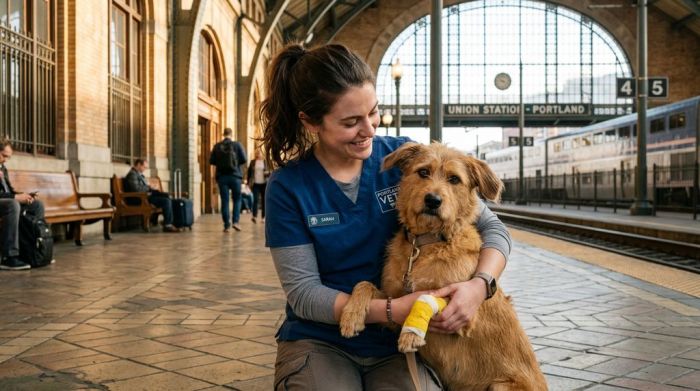
The dog was sitting on Platform 7, directly beneath the departure board, his body positioned toward the tracks as if he was waiting for someone to step off a train. He was a mutt, some kind of shepherd mix with golden-brown fur that was matted and dirty. His ribs showed through his coat. One ear stood straight up while the other flopped down at a crooked angle. There was a deep gash on his front leg, still fresh, still bleeding through the makeshift bandage someone had tried to apply.
But it was his eyes that stopped Sarah cold. They were fixed on the train tracks with an intensity that bordered on desperation. He was not pacing. He was not barking. He was simply waiting, with the patient, broken hope of a creature who had been waiting for a very long time.
Sarah approached slowly, the way you approach anything that might shatter if you move too fast. She knelt down about twenty feet away, keeping her body low, her hands visible. "Hey there, buddy," she said softly. "What are you doing out here?"
The dog did not look at her. His eyes stayed fixed on the tracks.
She sat down on the cold concrete. She did not rush. She did not reach for him. She simply sat, the way she had learned to sit with frightened animals, letting them decide when to trust. The station bustled around them — commuters rushing to catch trains, families dragging suitcases, the tinny announcements echoing off the high ceilings. But the dog and Sarah existed in a bubble of stillness, two creatures separated by species but united by something Sarah could not yet name.
Forty-seven minutes later, the dog turned his head and looked at her.
It was not a friendly look. It was not a trusting look. It was the look of an animal who had been holding onto something for so long that he had forgotten why, and was now too tired to hold it any longer. His eyes met hers, and Sarah felt something crack open in her chest.
"I'm not going to hurt you," she whispered. "I just want to help."
She extended her hand, palm up, fingers loose. The dog stared at it for a long, agonizing moment. And then, slowly, he lowered his head and pressed his nose against her palm.
Sarah did not cry. Not yet. She had a job to do. She gently slipped a leash around his neck, and he followed her without resistance, as if he had been waiting for someone to finally see him.
At the clinic, they cleaned his wound, gave him antibiotics, and scanned him for a microchip. The chip was there, registered to a man named Frank Kowalski, with an address in southeast Portland and an emergency contact listed as "Jennifer Walsh — daughter."
Sarah called the number. A woman answered on the third ring.
"Hello?"
"Is this Jennifer Walsh?"
"Yes. Who is this?"
"My name is Sarah Mitchell. I'm a veterinary technician in Portland. We found a dog today with a microchip registered to Frank Kowalski. I'm calling to let you know he's safe."
There was a long silence on the other end of the line. Sarah heard a sharp intake of breath. And then, in a voice that was thick with tears, Jennifer said, "My father passed away six months ago. I didn't know what to do with Chester. I surrendered him to a shelter in July. I thought... I thought he would find a new home."
Chester. The dog had a name.
"He was found at Union Station," Sarah said. "He was waiting on the platform. He had been there for three days."
Jennifer let out a sob. "Oh my God. He was waiting for my father. Dad took the train to work every morning for thirty years. He worked at a print shop downtown. He would leave at 6:47 AM and come home at 5:23 PM. Every single day. And Chester would be waiting for him on Platform 7 when he got back."
Sarah closed her eyes. The dog had been waiting. For six months. His owner had died, he had been surrendered to a shelter, he had escaped — and he had gone back to the last place he had seen Frank alive. He had sat on that platform, day after day, watching the trains, waiting for a man who was never coming home.
"I should have kept him," Jennifer whispered. "I should have taken him. But I was so lost after Dad died. I couldn't take care of myself, let alone a dog. I thought I was doing the right thing."
"You did what you could," Sarah said gently. "The important thing is that Chester is safe now."
Jennifer paused. "Are you going to keep him?"
Sarah looked at Chester, lying on the examination table, his head resting on his paws, his eyes finally closed in something that looked like trust. She thought about her own grandfather, who had passed away a year ago, and the empty chair in her living room where he used to sit when he visited. She thought about the way grief could hollow you out, leaving spaces that nothing seemed to fill.
"Yes," she said. "If no one else wants him, I'll keep him."
"He's a good dog," Jennifer said. "Dad loved him more than anything. He used to say Chester was the only reason he smiled after Mom died."
Sarah adopted Chester that week. She brought him home to her small apartment in northeast Portland, and she watched him explore every corner with the caution of someone who had been hurt too many times. He did not wag his tail. He did not play with the toys she bought him. He slept most of the day, curled into a tight ball on the rug by the door, as if he was ready to leave at any moment.
But every evening, at exactly 5:23 PM, Chester would walk to the front door. He would sit. And he would wait.
Sarah started taking him to Union Station on Saturday afternoons. Not to the platform — just to the parking lot, where he could see the trains come and go. At first, he would tremble, his body shaking with a fear that seemed to come from somewhere deep and ancient. But over time, the trembling eased. He started walking with his head up. He started sniffing the air, the way dogs do when they are finally beginning to feel at home.
The first time Chester wagged his tail was on a cold morning in December. Sarah had taken him for a walk along the Willamette River, and they had stopped to watch a train crossing the Steel Bridge. Chester sat down, his eyes fixed on the passing cars, and his tail started to move. A slow, tentative wag. Sarah knelt beside him and wrapped her arms around his neck.
"I know," she whispered. "I miss him too."
The healing was slow, the way all true healing is. Chester started eating regularly. He started sleeping on the bed instead of by the door. He started bringing Sarah his toys, dropping them at her feet with a look that said, "I am trying to trust you. Please do not prove me wrong."
Sarah found herself talking to him the way she used to talk to her grandfather — about her day, about her fears, about the small, ordinary moments that made up a life. She told him about the foster care system she had grown up in, about the grandparents who had taken her in when she was twelve, about the grandfather she had lost. Chester listened the way dogs listen — with complete, unconditional attention.
One evening in January, Sarah received a package in the mail. It was from Jennifer Walsh. Inside was a photograph of Frank Kowalski — an elderly man with a kind face and a gap-toothed grin, sitting on a porch with a younger Chester on his lap. Tucked behind the photograph was a handwritten note.
Dear Sarah,
I found this photo while I was cleaning out Dad's things. I thought you and Chester should have it. I want you to know that I am grateful — more than I can say — for what you did. You gave my father's dog a home. But more than that, you gave me peace. I know now that Chester is where he is supposed to be.
Dad used to say that dogs are not just animals. They are love with fur and four legs. He was right. Chester loved my father with every fiber of his being. And I believe, with all my heart, that my father sent him to you.
Take care of him. And let him take care of you.
With gratitude,
Jennifer
Sarah framed the photograph and hung it on the wall above her desk. Now, Chester sleeps on her bed every night, curled against her legs, his head resting on her feet. He still sits by the door at 5:23 PM — some habits are too deep to break. But these days, he stays for only a few minutes before wandering back to Sarah, nudging her hand with his nose, asking for a scratch behind the ears.
She still takes him to Union Station sometimes. They sit in the parking lot and watch the trains. Chester no longer trembles. He watches with a quiet dignity, as if he is finally at peace with the waiting. As if he understands that the man he was waiting for is never coming back, but that does not mean the waiting was meaningless.
Because love, real love, does not stop when someone dies. It changes shape. It becomes a dog sitting on a platform, waiting for a train that will never arrive. It becomes a young woman kneeling on cold concrete, extending her hand to a stranger. It becomes a photograph on a wall, a framed memory of a man who loved his dog enough to take him everywhere, even if only in spirit.
Sarah Mitchell is thirty-one now. She still works at the Willamette Animal Clinic. She still comes home to a dog who waits by the door at 5:23 PM, just in case. And every time she sees him sitting there, patient and hopeful, she remembers that grief is not a sign of weakness. It is proof that we loved someone worth grieving.
Chester is old now. His muzzle is gray, his steps are slower. But his eyes — those same eyes that stared at passing trains with desperate hope — are peaceful. He found his way home. Not to the man he lost, but to a woman who needed him as much as he needed her.
Somewhere in Portland, there is a train station where a dog once waited for six months. The station still hums with the rhythm of arrivals and departures. Commuters rush past. Families drag suitcases. Life goes on. But if you look closely, on quiet afternoons, you might see a young woman and an old dog sitting in the parking lot, watching the trains. They are not waiting for anyone. They are simply reminding themselves that the greatest act of love is not letting go. It is learning to stay — even when the one you loved has gone.
Chester stayed. And Sarah stayed with him.
That is the whole story. That is everything that matters.