Ruby Campbell was sixteen years old when she found the letter.
She was not looking for it. She was helping her mother pack boxes, the way she had done every Saturday for the past three weeks, preparing to leave the only home she had ever known. The house on Cedar Street in Oak Valley, Iowa, was being sold. The FOR SALE sign had been in the front yard since April, and a young couple from Des Moines was coming to see it next weekend. Her mother, Sarah, had decided it was time to downsize. Time to move on. Time to stop living in a museum of memories.
Ruby understood. She did. But understanding did not make it hurt any less.
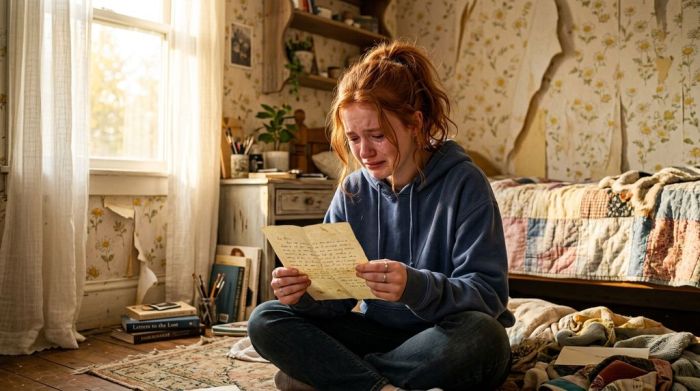
She was in her old bedroom, stripping the wallpaper she had chosen when she was nine years old — a pattern of yellow daisies that she had loved then and now found embarrassingly childish. The wallpaper was old and brittle, coming off in strips that left a residue of glue and memories. She had almost finished the west wall when she noticed a bump behind the paper. A small, raised rectangle that did not match the rest of the surface.
She peeled the paper back carefully, and there it was. An envelope, taped to the wall, yellowed with age.
Her name was on the front. Written in her father's handwriting.
Ruby's hands started shaking. Her father, David Campbell, had been a firefighter with the Oak Valley Fire Department. He had died five years ago, responding to a house fire on the outskirts of town. A collapsing roof. A hero's funeral. Three hundred people at the service. She had been eleven years old, and she had watched her mother crumble into a version of herself that Ruby still did not fully recognize.
She opened the envelope with the care of someone handling something sacred. Inside was a single sheet of paper, folded into thirds, covered in her father's familiar handwriting.
Dear Ruby,
If you are reading this, I am gone. I do not know how long it has been. A year. Five years. Ten. But I am writing this because I need you to know something.
I am not afraid of dying. I have been a firefighter long enough to make peace with the risks. But I am afraid of you not knowing your mother. Not the real her — the one who existed before grief changed her.
Your mother is the bravest person I have ever known. She gave up her dream of becoming a nurse to stay home with you when you were born. Did you know that? She was one semester away from graduating. She never told you because she did not want you to feel guilty. She said it was her choice, and it was the best choice she ever made.
When I worked the night shift, she used to drive to the station at 2 AM, just to bring me coffee and sit with me for fifteen minutes. She never complained about the sleepless nights. She never complained about anything.
After I am gone, she is going to try to carry everything alone. That is what she does. She is going to work double shifts, skip meals, and pretend she is fine. She is going to hide her pain because she thinks that is what strength looks like.
But strength is not hiding. Strength is letting people help you. Strength is letting yourself be loved.
So here is my list. Five things your mother needs you to know. Five missions I am giving you, from beyond.
One: Ask her about the summer of 1998. She will know what you mean. And she will cry. Let her.
Two: Tell her that I told you about the nursing degree. Tell her that I never stopped being proud of her. And tell her it is not too late.
Three: On the anniversary of my death, do not bring flowers to my grave. Take her to get ice cream instead. We used to go to Dairy Queen every Friday night after my shift. She will remember.
Four: She hums when she is nervous. She has been doing it her whole life. When you hear it, take her hand. That is all. Just hold it.
Five: Tell her I loved her. Tell her I knew, every single day, how lucky I was. Tell her I am still watching, and I am still cheering for both of you.
I love you, Ruby-Bug. You were the best thing I ever did. Take care of your mother for me.
All my love,
Dad
Ruby read the letter four times. She sat on the floor of her childhood bedroom, surrounded by strips of daisy wallpaper, holding a piece of paper that contained her father's last words to her, and she let herself feel the grief she had been pushing down for five years.
The Missions Begin
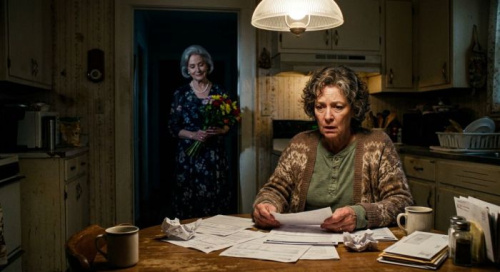
Ruby found her mother in the kitchen, packing dishes into a cardboard box. Sarah Campbell was forty-four years old, and she looked at least ten years older. Her hair had gone gray in the years since David's death. Her hands were rough from the cleaning products she used at the hospital, where she worked as a housekeeper because it paid better than the nursing assistant jobs and did not require the degree she had never finished.
"Mom," Ruby said, her voice still thick from crying. "I found something."
Sarah looked up. When she saw the letter in Ruby's hands, she went pale. "What is that?"
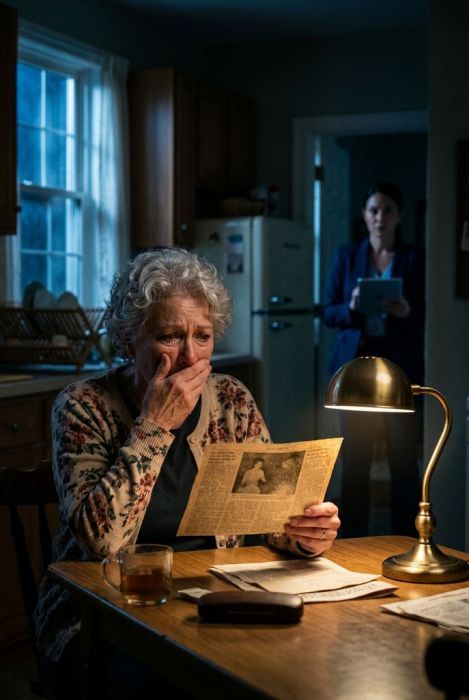
Ruby handed it to her. Sarah read it standing at the kitchen counter, the same counter where David had eaten breakfast every morning for eighteen years. And when she finished, she did exactly what the letter had predicted. She cried.
"The summer of 1998," Ruby said softly, wrapping her arms around her mother. "What happened the summer of 1998?"
Sarah laughed through her tears. "That is when we got engaged. Your father took me to the county fair and won me a stuffed bear at the ring-toss game. He was so proud of himself. He carried that bear around for the rest of the night, telling everyone I was his girl." She paused, her voice catching. "He was such a silly man. I miss him so much."
"I know, Mom. I miss him too."
The Healing
Over the next two weeks, Ruby completed her father's missions. She asked about the summer of 1998, and her mother cried, and Ruby held her. She told her mother about the nursing degree, and Sarah stared at the wall for a long time before whispering, "He told you about that?"
On the fifth anniversary of David's death, Ruby drove her mother to Dairy Queen, and they sat in the car eating chocolate-dipped cones in the parking lot, not saying much, but not needing to.
And on the last Saturday before the move, as Sarah was packing the final box in the kitchen, Ruby heard it. The humming. Soft, unconscious, a tune Ruby did not recognize. She walked over to her mother, took her hand, and held it.
Sarah stopped humming. She looked at their joined hands, then at Ruby's face. "You read that letter so many times you memorized it, did you not?"
"Pretty much."
"Your father always knew what to say." She squeezed Ruby's hand. "He was always smarter than me."
"He was not smarter, Mom. He just loved us. And he wanted to make sure we would be okay."
Sarah pulled her daughter into a hug, and they stood together in the empty kitchen, two people who had spent five years grieving separately, finally grieving together.
A New Beginning
The house on Cedar Street was sold in June. Ruby and Sarah moved into a small apartment on the other side of town. It was not the house on Cedar Street. But it was theirs.
A month after the move, Sarah came home with an envelope. She set it on the kitchen table and sat down across from Ruby.
"I registered for classes," she said. "At the community college. Nursing program. It will take two years, maybe three with my work schedule."
Ruby stared at her. "You are doing it? You are actually doing it?"
"Your father believed in me. And you believed in me. I figured it was time I started believing in myself."
Ruby threw her arms around her mother, and they laughed and cried together, the way they had learned to do over the past month — openly, freely, without apology.
Epilogue
The letter from Ruby's father hangs framed on the wall of their apartment. It sits next to a photograph of David Campbell in his firefighter uniform, smiling that crooked smile that Ruby had inherited. On the frame, Ruby has attached a small metal tag that reads: "Mission Complete."
Ruby is seventeen now. She is a senior in high school, and she is writing her college application essay about the summer she found a letter behind the wallpaper and learned that love does not end when someone dies. It just changes shape. It becomes a list of things to do. A hand to hold. An ice cream cone shared in a Dairy Queen parking lot.
Her mother is halfway through nursing school. She comes home exhausted, her textbooks spread across the kitchen table, her scrubs still smelling of the hospital. She hums when she studies, and Ruby smiles every time she hears it. She reaches over and takes her mother's hand, just for a moment, just to remind her.
They are okay. They are more than okay. They are learning, together, that grief and hope can live in the same house. That the people we lose never really leave us — they leave us letters, and missions, and the strength to carry on.
Ruby Campbell found a letter behind the wallpaper on a Saturday morning in May. She thought she was packing boxes, closing a chapter, saying goodbye.
Instead, she found her father's voice. And she learned that some goodbyes are really just hellos in disguise. Hello to a mother who was learning to live again. Hello to a future that had been waiting for them all along. Hello to the summer of 2025, when a girl and her mother finally understood that love does not end.
It just changes form. It becomes a letter, taped to a wall, waiting to be found. It becomes a hand to hold. It becomes the courage to start again.