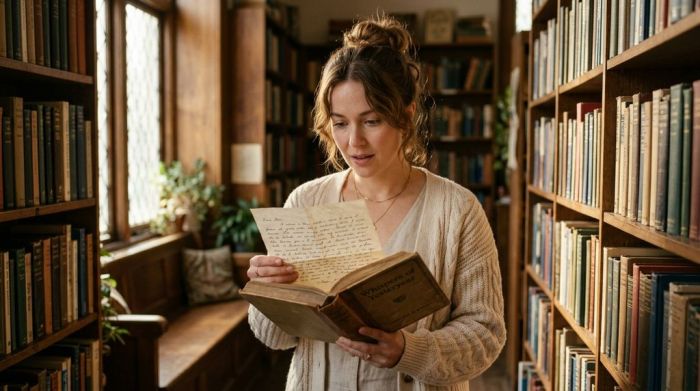
Claire Mitchell had been the head librarian at the Greenfield Public Library in Vermont for six years, and she had learned that books had a way of finding the people who needed them most. It was a Tuesday afternoon in October when she found the note — a crisp white envelope tucked inside the pages of a worn copy of "The Notebook" by Nicholas Sparks, left in the return slot by an anonymous patron. The envelope was unsealed, and written on the front in careful, masculine handwriting were the words: "To whoever finds this."
Claire almost put it in the lost and found. Library policy dictated that personal items left in books should be held for thirty days. But something about the envelope — the way it was addressed to no one in particular, the deliberate neatness of the handwriting — made her pause. She sat down at her desk, the afternoon light slanting through the tall windows of the reading room, and opened the envelope.
Inside was a single sheet of lined paper, folded into thirds. The letter was dated three weeks earlier.
Dear Whoever Finds This,
My wife Sarah loved this book. She read it every year on our anniversary, and she always cried at the same part — the ending, when Noah reads to Allie. She said it reminded her that love, real love, never gives up. She passed away eight months ago. Cancer. We were married for fourteen years.
I am not sure why I am writing this. Maybe I just needed someone to know that this book meant something to someone. Maybe I needed to believe that the world is full of people who still read love stories and believe in happy endings. Whoever you are, I hope you read this book. I hope it makes you believe in love the way it made Sarah believe.
If you are reading this, thank you for picking it up. Somewhere out there, a woman who loved books and thunderstorms and the smell of fresh bread is smiling because you opened this page.
Take care of yourself.
— Tom
Claire read the letter twice. Then a third time. She looked at the book — the battered cover, the yellowed pages, the faint smell of coffee and vanilla that clung to it like a ghost. She did not know who Tom was, or where he lived, or why he had chosen this particular library to leave his letter. But she knew, with a certainty that surprised her, that she was going to read this book.
She took it home that night. She read it in two sittings, curled up on her couch with a cup of tea, and she cried at the end the way she had cried the first time she read it, fifteen years ago. The next morning, she wrote a letter of her own.
She did not know if it would reach him. She did not know his last name, or his address, or anything about him except that his wife had loved books and thunderstorms and the smell of fresh bread. But she wrote from her heart, the way she had learned to write in the private journal she kept under her bed.
Dear Tom,
I found your letter. I read the book. I cried at the end, just like your wife did. I think she would have been happy to know that a stranger in a small library in Vermont picked up her favorite book and felt the same things she felt.
I work at the library where you left the book. I do not know if you will ever read this, but I wanted to say thank you. Thank you for reminding me that love stories are worth believing in. Thank you for sharing your wife's love with a stranger.
I hope you are doing okay. Grief is a heavy thing to carry alone.
— Claire
She folded the letter, slipped it into an envelope, and addressed it to "Tom" — the only name she had. She tucked it into the same copy of "The Notebook" and placed it on the new arrivals shelf, where someone might find it. She did not expect a reply. She did not even know if he would ever come back to the library.
But three weeks later, the book reappeared in the return slot. And inside was another letter.
Dear Claire,
I cannot believe you wrote back. I left that letter months ago, and I had convinced myself that it was a silly thing to do — leaving a piece of my heart in a book for a stranger to find. But then I came back to the library today, just to check, and there it was. Your letter.
I do not know how to explain what I felt when I read it. Relief, maybe. Or hope. Sarah used to tell me that the universe had a way of connecting people who needed to find each other. I never believed her until now.
I am doing okay. Some days are harder than others. My son Leo — he is six years old — he asked me the other day if Mommy was reading books in heaven. I told him I hoped so. I told him that if there were libraries in heaven, she was probably the happiest person there.
Thank you for writing back. You have no idea what it means to me.
— Tom
And so it began. A correspondence conducted entirely through the pages of library books. Tom would leave a letter in a book, return it to the library, and Claire would find it, read it, and leave her reply in another book. They never saw each other. They never exchanged phone numbers or email addresses. They wrote about their lives, their losses, their small joys, their quiet hopes.
Claire learned that Tom was a carpenter, that he had built their house with his own hands, that Sarah had planted a garden full of peonies and lavender that he still tended even though it broke his heart every time he looked at it. She learned that Leo was in kindergarten, that he had his mother's laugh and his father's stubbornness, that he drew pictures of his family that included his mother as an angel with enormous wings.
Tom learned that Claire had moved to Vermont after a painful breakup, that she had built a life around the quiet sanctuary of the library, that she had stopped believing in love stories until she found his letter. He learned that she had a cat named Hemingway who sat on her keyboard while she tried to work, and that she made the best chocolate chip cookies in Bennington County.
The letters became the highlight of both their weeks. Claire found herself checking the return slot every morning, her heart racing, hoping to find a new envelope. Tom started bringing Leo to the library on Saturday mornings, though he never went inside — he would drop the book in the return slot from the driver's side window, too nervous to walk through the doors and meet the woman he had been writing to for months.
But Leo, curious and adventurous, wandered into the library one Saturday while his father was parked outside. He found his way to the children's section, where Claire was reading story time to a circle of preschoolers. She looked up and saw a small boy with his father's eyes standing in the doorway, watching her with a mixture of shyness and wonder.
"Are you the lady who writes letters to my dad?" he asked.
Claire's heart stopped. She looked at the boy — his dark hair, his earnest expression, the way he tilted his head when he spoke — and she knew, with a certainty that came from somewhere deeper than logic, that this was Leo. This was Tom's son. This was the boy who drew angels with enormous wings.
"I am," she said, her voice barely above a whisper. "What is your name?"
"Leo. My dad is in the car. He is too scared to come in. He said you are probably really pretty and he would say something stupid."
Claire laughed, the kind of laugh that came from somewhere deep and genuine. She had not laughed like that in months. "Your dad is not going to say anything stupid. Do you want to sit down and listen to the story? I am reading about a bear who loses his hat."
Leo sat down cross-legged on the carpet, and Claire continued reading. But her mind was elsewhere. She was thinking about the man in the car, the man who had been writing to her for four months, the man who had built a house with his own hands and still tended his dead wife's garden. She was thinking about the courage it took to leave a letter in a book, and the courage it took to come back.
When story time ended, Leo ran back to the car. Claire watched him go, her heart pounding. She walked to the front window of the library and saw an old blue pickup truck parked on the street. She could see a silhouette behind the wheel — a man, his hands gripping the steering wheel, his head bowed.
She made a decision. She grabbed the book she had been holding — a copy of "The Notebook" that she had bought with her own money, not from the library — and walked outside. The November air was cold, carrying the first hint of winter. She crossed the street and approached the driver's side of the truck.
The window rolled down. And Tom looked up at her.
He was not what she had expected. He was in his late thirties, with kind eyes and a beard that was more gray than brown. He had a carpenter's hands — strong, calloused, capable. And he was crying. He was sitting in his truck, crying, because he had driven his son to the library and watched him walk inside and knew that the woman he had been writing to for four months was real and beautiful and standing in front of him.
"Hi," Claire said softly.
"Hi," Tom said, his voice rough. "I am sorry. I am not very good at this."
"At what?"
"At meeting people. At hoping. At believing that something good could happen again."
Claire held out the book. "I bought this for you. It is the same edition Sarah loved. I thought you might want to keep it."
Tom took the book, his hands trembling. He looked at the cover, at the familiar title, and the tears came freely. "I left that first letter months ago," he said. "I did not think anyone would find it. I did not think anyone would care."
"I found it," Claire said. "And I cared."
That was two years ago. Tom and Claire were married last spring, in a small ceremony at the Greenfield Public Library, surrounded by books and the people they loved. Leo was the ring bearer. He wore a tiny suit and carried the rings on a velvet pillow, and he announced to everyone that his new mom was "the lady who reads the best stories."
Claire still works at the library. Tom still builds houses. They live in the house he built for Sarah, the one with the garden full of peonies and lavender. Claire tends the garden now, and she talks to Sarah sometimes, when she is weeding or watering or cutting flowers for the kitchen table. She tells her about Leo's progress in school, about the new books that arrived at the library, about the man she married who still cries at the end of love stories.
And every year, on their anniversary, Tom leaves a letter in a book and returns it to the library. He does not tell Claire which book. He lets her find it, the way she found the first one, on a Tuesday afternoon in October, when she was a librarian who had stopped believing in love stories, and he was a carpenter who had forgotten how to hope.
Because that is the truth about love. It does not always arrive with a grand gesture or a perfect moment. Sometimes it arrives as a letter in a library book, left by a stranger who was brave enough to reach out, and found by a woman brave enough to reach back.
If you ever find yourself in a small library in Vermont, check the return slot. You might find a letter addressed to you. Read it. Believe in it. And if you are brave enough, write back.
You never know where the story might lead.
<|DSML|parameter name="thumb" string="true">/uploads/img/1783905674_f1b872a4b4f193f4.jpg