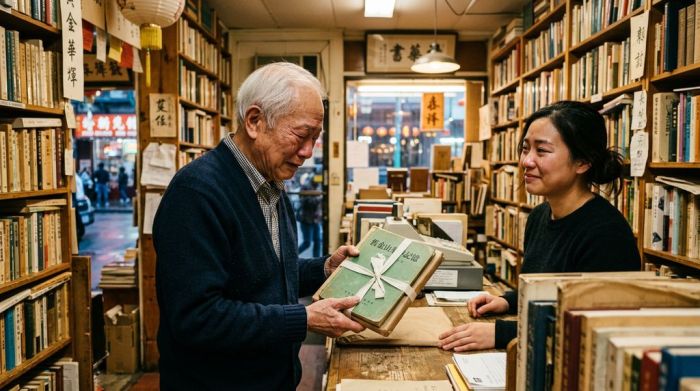
Mei Lin had worked at Golden Pages Bookstore on Grant Avenue in San Francisco's Chinatown for three years, and in all that time, no one had ever walked in and asked for a book that made her heart stop. But on a foggy Tuesday afternoon in March, a man with silver hair and sad eyes did exactly that.
"I'm looking for a book," he said, his voice carrying the soft accent of someone who had grown up speaking Cantonese and learned English later. He was dressed neatly — pressed slacks, a cardigan sweater, polished shoes. His hands were clasped in front of him, and they trembled slightly. "It's a collection of poems. By Li Qingzhao. The title translates to something like 'Jade Qin Zither in the Morning Light.'"
Mei knew the book. She had seen it once, years ago, in a box of donations her uncle had received when he was still running the store. It was a slim volume, published in Hong Kong in the 1970s. Beautiful. Fragile. And almost certainly impossible to find.
"I know it," she said slowly, already feeling the weight of what she was about to say. "But we don't have it in stock. I'm not sure it's still in print."
The man's shoulders dropped. He had been holding hope in his posture, and she had just watched it drain out of him. "I see," he said quietly. "Thank you anyway."
He turned to leave, and Mei watched him go. He moved slowly, the way old men move when they are carrying something heavy that no one else can see. He was almost to the door when Mei heard herself speak.
"I can try to find it."
He stopped. Turned. His eyes, dark and tired, met hers. "You can?"
"I can try," she said again. "It might take some time. And I can't promise anything."
He walked back to the counter, and for the first time since he had entered the store, a small smile crossed his face. "My wife loved that book," he said. "She read it to me when we were first married. Every night, one poem. Her voice was the most beautiful sound I have ever heard." He paused, his eyes growing distant. "She passed away six months ago. And I made her a promise. I told her I would read the poems at her grave on the one-year anniversary. But I can't find the book anywhere."
Mei felt something catch in her throat. "I'll find it," she said, and she meant it with a certainty that surprised her.
His name was Mr. Chen. He was seventy-eight years old, a retired tailor who had worked in a shop on Stockton Street for forty-three years. His wife, Lihua, had been a calligraphy teacher. They had been married for fifty-two years. They had no children. When she died, he became a man adrift, anchored only by the promise he had made to her in her final days.
Mei started her search that evening. She called every bookstore in the Bay Area that specialized in Chinese literature. She emailed rare book dealers in Hong Kong, Taipei, and Vancouver. She scoured online marketplaces, posting requests on forums she had never visited before. The response was the same everywhere: out of print, out of stock, gone.
But she did not give up.
The following week, she took the BART to Oakland to visit an elderly book dealer her uncle had known. The man, Master Wong, was ninety-two years old, blind in one eye, and kept his shop in a cluttered basement that smelled of aged paper and incense. Mei showed him a photograph of the book she had found online — a grainy image of a cover she had never seen in person.
Master Wong studied it for a long time. "I had a copy once," he said. "Twenty years ago. I sold it to a woman. She said it was for her husband's birthday. She was very happy that day." He shook his head. "I don't know where it went after that."
Mei's heart sank. But something Master Wong had said stuck with her. "A woman bought it for her husband's birthday." She thought about Mr. Chen. She thought about Lihua. And she had an idea.
"Do you keep any records?" she asked. "Old receipts? Anything?"
Master Wong laughed, a dry, wheezing sound. "I keep everything, young lady. My wife says I'm a hoarder. I call it being a historian."
They spent three hours digging through boxes of yellowed receipts and ledgers. And at the bottom of the fourth box, wrapped in a plastic bag to protect it from the damp, was a receipt from May 15, 2004. The sale of one copy of "Jade Qin Zither in the Morning Light" by Li Qingzhao. The buyer's name was written in careful Chinese characters: Chen, Lihua.
Mei stared at the receipt, her heart pounding. Lihua had bought the book for Mr. Chen. For his birthday. And he had never known.
She called Mr. Chen that evening. "I haven't found the book yet," she said. "But I found something else. Something I think you should see."
He came to the bookstore the next morning. Mei handed him the receipt, still in its plastic sleeve. He read it slowly, his lips moving silently. And then his hand flew to his mouth, and he began to cry.
"She bought it for me," he whispered. "She bought it for my sixty-fifth birthday. I never knew. She never told me."
Mei waited, giving him space. When he had composed himself, he said, "I'm still looking. I haven't given up."
"I know," he said, wiping his eyes. "But even if you don't find it... you have already given me something precious. You have shown me that my wife's love was even deeper than I knew."
That weekend, Mei received a call from a rare book dealer in Vancouver. He had found a copy. It was in poor condition — water damage, faded pages, the cover barely holding on. But it was the book. The only copy he had ever seen in fifteen years of trading.
"The price is four hundred dollars," he said.
Mei had exactly three hundred and twenty dollars in her savings account. She transferred every cent of it, borrowed the remaining eighty from her grandmother, and had the book shipped overnight.
When it arrived, she held it in her hands like it was made of glass. The cover was a faded green, the gold lettering almost illegible. The pages were brittle and smelled of age. But it was intact. Every poem was there.
She called Mr. Chen. "I found it," she said, and she was crying now, too. "I found your book."
He came to the store an hour later. Mei had wrapped the book in brown paper and tied it with a simple white ribbon. She handed it to him across the counter, the same counter where he had stood three weeks ago, a broken man looking for a miracle.
Mr. Chen took the package with trembling hands. He unwrapped it slowly, carefully, as if he was afraid it might dissolve into dust. And when he saw the faded green cover, the gold lettering, the book that his wife had bought for him and that had traveled across decades and oceans to reach him, he let out a sound that was half laugh, half sob.
"Lihua," he said, holding the book to his chest. "I found it. I kept my promise."
Three months later, on the one-year anniversary of Lihua's passing, Mr. Chen returned to Golden Pages Bookstore. He was dressed in a suit. His shoulders were straight. His eyes, though still sad, held a light that had not been there before.
"I read her all the poems," he said. "Every single one. I sat at her grave from sunrise to sunset, and I read them aloud. I told her about the receipt. I told her that I knew about the birthday gift. And I told her that a young woman in Chinatown had shown me that kindness still exists in this world."
He reached into his jacket and pulled out a small package, wrapped in brown paper. "This is for you."
Mei opened it. Inside was a framed piece of calligraphy — beautiful, flowing Chinese characters brushed onto rice paper. She recognized it as one of Li Qingzhao's poems, the one about a zither and the morning light.
"I asked my nephew to write it for me," Mr. Chen said. "He's a calligrapher, like Lihua was. I wanted you to have something to remember this by."
Mei read the poem. It was about a woman waiting for her beloved to return, knowing that even if he never came, the waiting itself was a form of love.
"This is too much," she said, her voice breaking. "Mr. Chen, I can't —"
"You can," he said gently. "You already did."
He left the store, walking slowly but steadily, a man who had kept his promise. Mei watched him go, the framed poem in her hands, and she understood something she had never fully understood before.
Books are not just paper and ink. They are vessels for love. They carry the voices of people who are no longer here. They connect strangers across time and distance. They are promises, waiting to be kept.
Mei Lin still works at Golden Pages Bookstore. She is twenty-six now, and she has a new mission. She keeps a small notebook behind the counter, and whenever someone walks in looking for a book that seems impossible to find, she writes down the title. She does not stop looking until she finds it.
She has found seven impossible books so far. Each one has a story. Each one has taught her that the smallest acts of kindness can echo across years, connecting people who might otherwise never have found each other.
The framed poem hangs on the wall behind the checkout counter. Customers sometimes ask about it. And Mei tells them the story of Mr. Chen, and Lihua, and the poetry book that traveled across oceans to fulfill a promise.
She tells them that love does not end when someone dies. It just changes form. Sometimes it becomes a receipt hidden in a box. Sometimes it becomes a book, faded and fragile, arriving just in time. Sometimes it becomes a young woman in a Chinatown bookstore, who learned that the most important thing she could do with her life was to help a stranger keep a promise.
Mr. Chen passed away peacefully two years later, at the age of eighty. His nephew found the poetry book on his nightstand, bookmarked at Lihua's favorite poem, with a note tucked inside.
The note said: "Mei — Thank you for showing me that love is not about holding on. It is about passing it on. This book belongs to you now. Keep finding the impossible books. Keep helping people keep their promises. — Mr. Chen"
The book sits on a small shelf behind the counter at Golden Pages Bookstore, next to the framed calligraphy. Mei takes it down sometimes, on quiet afternoons, and reads a poem. She reads it in the voice she imagines Lihua used — soft, warm, full of love. And she thinks about a man with silver hair and sad eyes who walked into her store one day and changed her life.
She still believes in impossible books. She still believes in promises. And she believes, more than anything, that the greatest thing one person can do for another is to help them keep the love they carry in their hearts from fading away.
Somewhere in San Francisco, in a quiet corner of Chinatown, a bookstore stands as a monument to that belief. And every time the door opens, a bell rings, and a new story begins.