By the time Patricia Hensley unlocked the door to the boiler room, she knew she was breaking at least three school district policies. It was a Tuesday evening in March, and she had stayed late to finish budget reports. The hallways were empty, the classrooms dark. She should have been home by now, reheating the lasagna that had been sitting in her refrigerator since Sunday.
But Carol, the school secretary, had mentioned something odd at the end of the day. "Have you noticed," Carol had said, lowering her voice, "that the after-school detention kids have been volunteering to clean the boiler room? They're actually fighting over it."
Patricia had laughed it off. But the more she thought about it, the stranger it seemed. Kids volunteering for extra work? Something was wrong.
She followed the sound. It was faint at first, almost indistinguishable from the hum of the heating system. But as she descended the stairs to the basement level, it grew clearer. A melody. Soft, intricate, achingly beautiful.
She pushed the door open and stopped breathing.
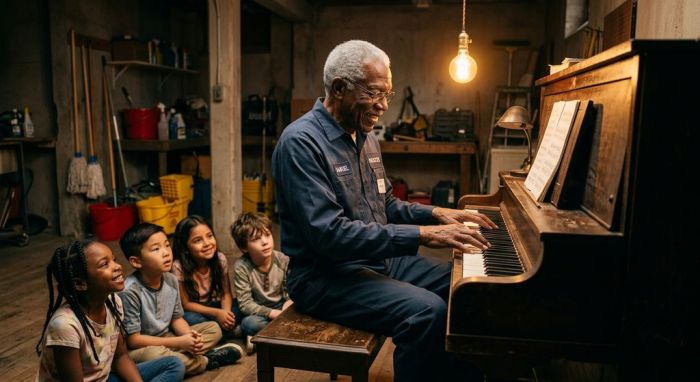
There, in the corner of the room, surrounded by mops and buckets and boxes of floor wax, was an old upright piano. Its finish was chipped, its keys yellowed with age. But the sound it produced was extraordinary. And seated at it, his gnarled fingers moving across the keys with a fluency that seemed impossible for a man his age, was William.
William Bellamy. Sixty-eight years old. Custodian at Westbrook Middle School for twelve years. He had mopped these hallways twice a day, every day, and Patricia had passed him in the corridors a thousand times without really seeing him. He was the quiet man who nodded when you walked by, the invisible hand that kept the school clean, the background presence that no one thought twice about.
He was playing "Misty," and he was playing it like the melody was part of his own bloodstream. His eyes were closed. His body swayed. The piano seemed to sing under his hands, filling the dim boiler room with a warmth that had nothing to do with the heating pipes.
Four students sat cross-legged on the concrete floor around him — Joshua, the eighth-grader who had been suspended twice this year for fighting; Maya, the quiet seventh-grader who never spoke in class; Lucas, who had been caught vaping in the bathroom; and Isabella, whose grades had been slipping since her parents' divorce. They were not scrubbing floors. They were not emptying trash cans. They were watching William's hands move across the keys, their faces lit with something Patricia had never seen in a detention room before.
Wonder.
William finished the song. The last note hung in the air for a long moment before fading into the hum of the furnace. The students started clapping — quietly, respectfully, as if they were in a concert hall instead of a basement storage room.
"Is that jazz, Mr. Bellamy?" Joshua asked.
William opened his eyes. "That was jazz. You want to know the difference between jazz and regular music?"
"Tell us."
William smiled, a slow, warm smile that transformed his face. "Regular music is about playing the right notes. Jazz is about playing the notes that feel right. It's about freedom within structure. It's about making mistakes sound beautiful."
Patricia stepped forward. Her footsteps echoed on the concrete floor. William looked up, and his smile faded into something uncertain, almost fearful.
"Dr. Hensley," he said, standing up quickly. "I can explain."
The students turned to look at her, their faces shifting from wonder to worry. Joshua stood up, his fists clenching instinctively. "He wasn't doing anything wrong," he said. "We volunteered to clean. He just — he plays for us sometimes."
Patricia held up her hand. "It's alright, Joshua. I'm not here to punish anyone." She walked toward the piano, running her hand across its worn surface. "I didn't know this was here."
"It's been in this room since I started," William said quietly. "The previous principal was going to throw it out. I asked if I could keep it. I told him I would use it to... to maintain it. In case the music department ever needed it." He paused. "That wasn't the whole truth."
"Where did you learn to play like that, William?"
He looked down at his hands — thick, calloused hands that had spent decades mopping floors and emptying trash cans. "I used to play professionally. A long time ago."
"'A long time ago' meaning what, exactly?"
William was quiet for a moment. The students were watching him with new eyes, seeing him for the first time not as the janitor, but as someone with a story.
"I was a jazz pianist," he said finally. "From 1978 to 1992. I played at clubs in Chicago, New York, New Orleans. I opened for Wynton Marsalis once. I recorded two albums that nobody bought. People said I was talented. They said I could have made it."
"What happened?"
"My wife got sick. Cancer. She needed treatment, and treatment costs money. Jazz doesn't pay. So I took a job at a school — maintenance work. It paid the bills. It paid for her medicine." His voice dropped. "She passed away in 1994. By then, I had been out of the music scene for two years. I had lost my callouses. I had lost my confidence. I had lost everything except this piano, and the melodies I still carried in my head."
Patricia felt tears burning behind her eyes. She blinked them back. "Why didn't you tell anyone? You could have taught our music classes."
"The music program was cut seven years ago," William said. "I know. I was there when they packed up the instruments. I helped carry them out." He gestured at the students. "These kids told me they wanted to learn. They said there was nowhere to go, no one to teach them. So I offered to teach them what I know. In here. After hours. For free."
Maya, the quiet seventh-grader, raised her hand the way students do in classrooms. "Mr. Bellamy taught me how to play 'Clair de Lune,'" she said. "It's the first thing I've ever been good at."
"He taught me boogie-woogie," Joshua said. "It's the only thing that stops me from wanting to punch walls."
Patricia looked at William — at the man who had spent twelve years invisible, who had carried a gift inside him that no one had ever asked about. She thought about the budget cuts she was currently trying to navigate. The music program had been the first thing to go, seven years ago, and she had accepted it because she thought there was no other choice.
But here, in a boiler room, with a broken piano and a janitor who had once opened for Wynton Marsalis, the music had never stopped. It had just been hiding.
"How long have you been teaching them?" she asked.
"Since October. Five months."
"Five months?" She looked at Joshua. "Play something for me."
Joshua's face went pale. "What? Right now?"
"Right now."
He looked at William, who nodded. Joshua walked to the piano, sat down, and placed his hands on the keys with a reverence that made Patricia's heart ache. He began to play — a blues progression, simple but confident, his fingers finding the notes with the certainty of someone who had been practicing in secret for months.
When he finished, Patricia wiped her eyes with the back of her hand.
"William," she said, "I need you to do something."
"What's that?"
"Forget everything I'm about to say, because I'm going to deny it if anyone asks." She took a breath. "Starting next week, this boiler room is officially the Westbrook Middle School Music Program. I'll find a budget line to buy you a real piano. And I want you to teach these kids — and any other kid who wants to learn — everything you know."
William stared at her. "Dr. Hensley, the district —"
"The district doesn't need to know everything that happens in our boiler room. Sometimes, the best things happen in the places nobody looks."
Three Years Later
The boiler room is not a boiler room anymore. The walls have been painted a deep, warm blue. The mops and buckets have been moved to a closet down the hall. In their place stands a restored upright piano — the same one, refurbished by a local music shop that donated its labor when they heard the story. There are music stands, a small collection of instruments donated by the community, and a sign above the door that reads: "The Bellamy Room."
William Bellamy is seventy-one years old. He still works as a custodian — he refuses to give up the job, says it keeps him grounded. But every afternoon at 3:30, he hangs up his mop, rolls up his sleeves, and becomes something else entirely. He becomes Maestro Bellamy, the jazz pianist who teaches children that mistakes can be beautiful and that it's never too late to start over.
Joshua is a junior in high school now. He plays piano in a jazz band that performs at local events. He no longer gets into fights. Maya is taking AP music theory and wants to study at Berklee College of Music. Lucas started a band with three friends from the boiler room. Isabella's grades have recovered, and she wrote her college admissions essay about the janitor who taught her to play piano in a basement.
What William Wants You to Know
Last week, a reporter from the Springfield News-Leader came to do a story on the program. She interviewed William, asked him what he wanted people to know about what had happened in that boiler room.
William thought about it for a long moment. Then he said: "Tell them that you don't have to be on a big stage to change a life. Tell them that a broken piano and a room full of kids who need somewhere to belong is worth more than any concert hall in the world. Tell them that the music never really stops. It just waits for someone brave enough to listen."
The story ran on the front page of the Sunday edition. The headline read: "The Jazz Man in the Janitor's Closet."
William cut it out and framed it. He hung it on the wall of the Bellamy Room, right above the piano.
And every day at 3:30 PM, when the last bell rings and the hallways empty, the music begins.
This story is a reminder that the people we pass without seeing are often carrying the most extraordinary gifts. A janitor with a mop might have once played for kings. A boiler room might hold a concert hall. And a child who seems lost might just need one person to show them that their mistakes can become something beautiful.
William Bellamy spent thirty years invisible. But the music never left him. It just waited for the right students to find it. And when they did, he gave them everything he had — not because he wanted recognition, but because that is what you do when you have a gift that was meant to be shared.
If you ever pass a custodian in a hallway, look twice. You might be walking past a jazz legend who traded a concert hall for a mop bucket — and found something far more valuable than fame.
He found purpose. He found students who needed him. And he found a way to make the music play on.