Olivia Marchand never expected to find the meaning of motherhood in the blink of a firefly's light. But that is exactly what happened during one summer in the Great Smoky Mountains, when her eight-year-old daughter Emma taught her that the most beautiful things in life are not meant to be held — they are meant to be witnessed.
My name is Olivia. I am thirty-two years old, and I have been a park ranger at the Great Smoky Mountains National Park for seven years. I live in a small cabin at the edge of Gatlinburg, Tennessee, with my daughter Emma and a three-legged tabby cat named Possum who showed up at our door one winter and never left. The cabin is small and imperfect, with a leaky roof and a porch that lists slightly to the left, but it sits at the edge of a meadow that fills with fireflies every summer, and that makes it the most beautiful place in the world.
Emma came into my life when I was twenty-four years old, fresh out of college, working a seasonal job at the park's visitor center. Her father and I had been together for two years, but he was not ready to be a parent, and I was not ready to stop being one. So I raised her alone, in that little cabin, surrounded by mountains and trees and the particular quiet that only a forest can provide. It was not easy. It was never easy. But every time I looked at Emma's face — her round cheeks, her curious brown eyes, the way she tilted her head when she was studying something — I knew I had made the right choice.
Emma was born with asthma. Not the mild kind that you manage with an inhaler before soccer practice, but the serious kind that landed her in the hospital three times before she turned five. We had learned to manage it — a strict medication schedule, a nebulizer by her bedside, and a list of triggers that we checked obsessively. Pollen was bad. Dust was worse. Cold air was the worst. But her doctor, a kind woman named Dr. Patterson who had been treating Emma since she was a baby, always emphasized one thing: Do not let fear keep her from living.
I tried to follow that advice. Some days I succeeded. Some days I failed. But the summer Emma turned eight, I decided that we would not let her asthma define her. We would go on hikes. We would wade in the mountain streams. We would stay up late and watch the stars. And we would catch fireflies.
The fireflies of the Great Smoky Mountains are something you have to see to believe. Every June, as the sun goes down and the last light fades from the sky, the meadows come alive with thousands of blinking yellow lights — a symphony of living sparks that has been playing every summer for millions of years. Scientists call them Photinus carolinus. The locals call them lightning bugs. Emma called them fairy lights, and she had been obsessed with them since she was old enough to point.
"Mama," she would say, pressing her nose against the screen door, "look. The fairies are waking up."
Emma had never caught a firefly. Not once, in all her eight years. She had tried — oh, how she had tried. She would run through the meadow with a mason jar clutched in her small hands, her inhaler tucked into the pocket of her shorts, her braids flying behind her. She would leap and grab and stumble and fall, and every single time, the fireflies would slip through her fingers like tiny, laughing ghosts.
I would watch her from the porch, my heart aching with a love so fierce it sometimes scared me. I wanted to help her. I wanted to catch one for her, to hand it to her in a jar and say, "Look, baby. You did it." But something stopped me. Some voice, deep and quiet, whispered that the lesson she was learning in those failed attempts was more important than the victory of a single catch.
And so I watched. I cheered. I handed her a fresh jar when she dropped the first one. And I told her, every single time, "You will get it, Em. I promise you will."
The summer stretched out before us like a long, golden afternoon. June melted into July. The days grew hot and heavy, the nights soft and alive with the blinking of a million tiny lights. Emma and I developed a ritual: every evening, after dinner, we would walk to the meadow. She would carry her mason jar. I would carry her inhaler, a blanket, and a thermos of iced tea. We would spread the blanket on the grass, and we would watch the fireflies wake up.
It was during one of these evenings that Emma asked the question that changed everything.
"Mama, why do fireflies glow?"
I smiled, lying back on the blanket, looking up at the darkening sky. "That is a very good question, Emma Grace. What do you think?"
She thought about it, her brow furrowed in concentration. "I think they're looking for each other. I think they glow so they can find their family in the dark."
I felt a lump form in my throat. "That is a beautiful way of putting it."
"Is it true?"
"It is. Male fireflies flash to attract females. Each species has its own pattern — its own language of light. They blink in the darkness, hoping someone will blink back."
Emma was quiet for a long moment. Then she said, in a voice so small I almost missed it, "Like me and Daddy."
The words hit me like a punch to the chest. Emma's father had not contacted us in four years. He had moved to Arizona, remarried, started a new life. I had never spoken badly of him — I had made sure of that — but I also had not known how to explain his absence to a child who was smart enough to ask questions and young enough to believe the answers.
I sat up and pulled Emma into my lap. "Yes, baby. Like you and Daddy. You are glowing, every single day, hoping he will blink back. And I am so sorry that he has not figured out how to see your light yet. But I want you to know something."
"What?"
"The people who love you — the real ones — they see your light. I see it. Possum sees it. Mrs. Patterson sees it. And one day, you will find someone who blinks back at you in the exact same pattern, and you will know that they are your firefly."
Emma wrapped her arms around my neck and hugged me tight. "You're my firefly, Mama."
I held her, the tears coming freely now, the fireflies blinking all around us like a congregation of tiny witnesses. "And you are mine, Emma Grace. You will always be mine."
The attack came on a Tuesday afternoon in late July.
Emma had been playing in the meadow, chasing fireflies, when the air turned thick and heavy. A summer storm was rolling in from the west, carrying humidity and pollen and the kind of pressure that settles on your chest like a weight. I saw her stop running. Saw her bend over, her hands on her knees. Saw her reach for the pocket where she kept her inhaler.
I was across the field in seconds. I grabbed the inhaler, shook it, and helped her take two puffs. Her breathing eased slightly, but not enough. Her face was pale, her lips starting to take on a bluish tint that I had learned to recognize with a terror that never faded.
"We need to go to the hospital," I said, scooping her into my arms. She weighed almost nothing — eight years old and barely fifty pounds, a wisp of a child who had been fighting for breath since the day she was born.
"Mama," she whispered, her voice thin and reedy, "I didn't catch one yet."
"We will catch a thousand fireflies, Emma. I promise. But right now, we need to get you breathing."
The drive to the hospital in Gatlinburg took twenty minutes. It felt like twenty hours. Emma sat in the back seat, her nebulizer mask strapped to her face, her eyes fixed on the window, watching the darkening sky. I talked to her the whole time — nonsense, really, stories about the mountains and the wildlife and the time I had to chase a black bear out of the visitor center parking lot. I kept my voice steady because I needed her to stay calm. Inside, I was shattered.
The emergency room staff knew us by name. That is what happens when your child has severe asthma. They took her back immediately, hooked her up to monitors, administered steroids and oxygen. I sat in a plastic chair beside her bed, holding her hand, watching the pulse oximeter climb slowly from 88 to 92 to 95.
Dr. Patterson arrived an hour later. She looked at the chart, listened to Emma's lungs, and sat down beside me with the kind of expression that doctors use when they have bad news they need to deliver gently.
"Olivia, Emma's asthma is getting worse. The triggers are becoming more aggressive. I think we need to consider a different treatment plan."
We talked for twenty minutes about biologics, about allergy shots, about the possibility of a clinical trial at a children's hospital in Nashville. I listened, nodded, asked questions. But all I could think about was the fireflies. All I could think about was Emma's voice, small and desperate: "I didn't catch one yet."
Emma was kept in the hospital for three days. I slept in the chair beside her bed, waking every time she coughed, every time the monitor beeped, every time a nurse came in to check her vitals. On the third day, she was well enough to go home. Dr. Patterson prescribed a new medication regimen and made me promise to bring her back if anything changed.
We drove home in silence. Emma looked out the window at the mountains, her face pale but peaceful. The storm had passed, leaving the air clean and cool. The sun was beginning to set, painting the sky in shades of pink and orange.
When we pulled into the driveway, Emma did not go inside. She stood at the edge of the meadow, looking at the grass where the fireflies would soon begin their nightly dance.
"Mama," she said, "can we try one more time?"
I looked at her — at her small frame, her determined eyes, the way she held her mason jar with both hands, as if it were the most precious thing in the world. I wanted to say no. I wanted to wrap her in bubble wrap and never let her run again. But I heard Dr. Patterson's voice: Do not let fear keep her from living.
"One more time," I said. "But we take it slow. And if you feel even a little tight in your chest, we stop. Deal?"
"Deal."
We walked to the meadow together. The first fireflies were already appearing, tiny sparks of gold against the deepening blue of the evening sky. Emma did not run this time. She stood still, watching them, studying their patterns. And then she did something I had never seen her do before.
She stopped trying to catch them.
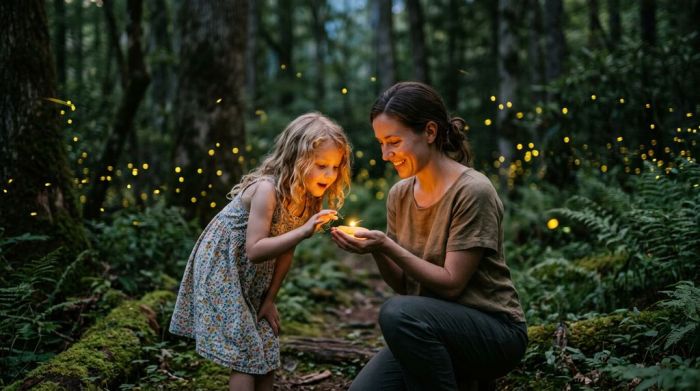
She simply stood in the middle of the meadow, her arms at her sides, her face tilted up toward the sky. The fireflies swirled around her like a galaxy spinning in slow motion. One landed on her shoulder. Another on her hand. She did not grab for them. She let them rest, let them stay, let them be.
"Mama," she whispered, her voice filled with a wonder I had never heard before, "they're not running away."
I walked to her and knelt in the grass beside her. "They know you're not trying to catch them anymore."
"I think I finally understand," she said. "They're not meant to be caught. They're meant to be seen. If I catch them, I take them away from their family. But if I just watch them — if I just let them be — I get to see all of them, all at once, dancing together."
She looked at me, her eyes reflecting the golden light of a hundred blinking fireflies. "That's more beautiful than catching just one."
I felt the tears come — not the panicked tears of the hospital room, but the quiet, grateful tears of a mother who has just watched her child discover something profound. I pulled her into my arms and held her, the fireflies blinking all around us, the mountains watching in their ancient silence.
"You are the wisest eight-year-old I have ever known, Emma Grace."
"I learned it from you, Mama. You let me be free, even when you were scared. You let me chase fireflies even when you wanted to keep me safe in a bubble."
"Because I knew you would figure it out. I knew you would understand that the most beautiful things in life are not meant to be held. They are meant to be witnessed."
That was two summers ago.
Emma is ten now. Her asthma is still there — it will always be there — but we have learned to live with it, to manage it, to not let it define her. She still loves fireflies. Every summer, we spread a blanket in the meadow, and we watch them rise from the grass like tiny prayers ascending to the sky.
She does not carry a mason jar anymore. She does not need to. She has learned that some things are not meant to be captured. They are meant to be admired from a distance, allowed to exist in their own time, in their own way, according to their own mysterious patterns.
Last week, Emma came home from school with a poem she had written. It was called "Firefly Summer," and the last line read: "The things that glow the brightest are the things we never try to hold."
I pinned it to the refrigerator, right next to her third-grade school photo and the crayon drawing of Possum that has been there for four years. And I thought about all the summers we have spent together, all the fireflies we have watched, all the nights I held her in the hospital and prayed for morning.
I thought about the night she let the firefly go. The night she taught me that love is not about holding on. It is about creating a space where the people we love can glow as brightly as they are meant to, without fear of being caged.
Emma is asleep in her room now, her nebulizer humming softly beside her bed, her window open to the summer night. Through the screen, I can see the fireflies beginning their nightly dance, blinking in the darkness, calling out to each other in their ancient language of light.
And I think about the mother I was when I first came to this cabin — twenty-four years old, terrified, alone, holding a baby who could barely breathe. I think about the fear that almost consumed me, the fear that wanted to wrap her in bubble wrap and never let her run. And I am grateful that I listened to a wiser voice. A voice that told me to let her chase fireflies. To let her fall. To let her fail. To let her discover, on her own, that the most beautiful things in life are not meant to be caught.
They are meant to be seen.
And some lights, like the light of a child who has learned to let go, never really fade. They just keep glowing, summer after summer, teaching everyone lucky enough to witness them what it truly means to love without holding on.
If you ever find yourself in the Great Smoky Mountains in June, find a meadow at dusk. Spread a blanket. Watch the fireflies rise. And remember Emma Grace — a little girl with asthma and a mason jar and a heart so full of wonder that she changed the way I see the world.
She never caught a single firefly. But she caught something far more valuable.
She caught the truth.