Dani Chen never expected to find her grandmother's ghost in a 5,000-piece puzzle at a senior center in Bloomington, Minnesota. But that is exactly what happened on a gray Tuesday afternoon in October, when she walked through the doors of Sunnybrook Senior Center with a clipboard, a forced smile, and a heart that had been closed for business for two years.
She was twenty-eight years old, a graduate student in occupational therapy at the University of Minnesota, and she needed one hundred hours of community service to complete her degree. The senior center was the only placement left. Everyone else had grabbed the pediatric clinics and the rehab hospitals. She had drawn the short straw — or so she thought.
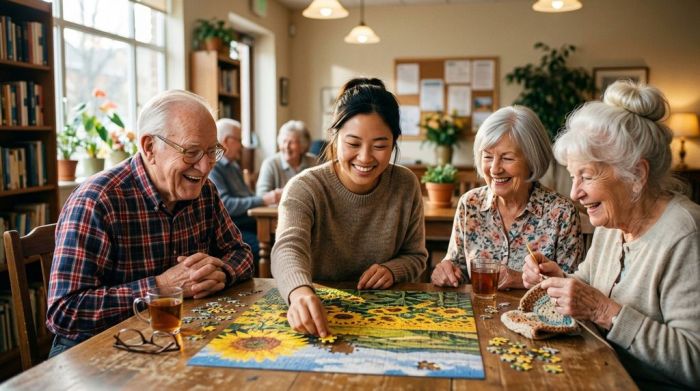
The activity room smelled like instant coffee and old books. Fluorescent lights hummed overhead. A dozen residents sat in a loose circle around a long folding table, their silver heads bent in concentration. And there, in the center of the table, spread across an expanse of green felt like a kingdom waiting to be conquered, was the largest puzzle Dani had ever seen.
She stood in the doorway, counting the pieces with her eyes. Five thousand. Maybe more. The border was mostly complete — a frame of blue sky and green trees that suggested a pastoral landscape. But the interior was chaos. Thousands of tiny cardboard pieces lay scattered like fallen leaves, organized into piles by color, shape, and the particular logic that puzzle people understand and everyone else finds mysterious.
"You must be the new girl," said a voice to her left.
Dani turned. A woman in her eighties sat in an armchair by the window, a crochet hook moving in her hands with the automatic rhythm of decades of practice. She had white hair pinned up in a neat bun, glasses that hung from a chain around her neck, and eyes that missed nothing.
"I'm Dani," she said. ××"I'm here for my community service hours."
"I know who you are, dear. We got a memo." The woman set down her crochet hook and extended a hand that was surprisingly strong. "I'm Rose. I've been coming here for seven years, ever since my Harold passed. And that puzzle over there? That's our pride and joy. We've been working on it for eleven months."
Eleven months. Dani looked at the puzzle with new eyes. "You've been working on the same puzzle for almost a year?"
"We started it last November," Rose said. "We thought we'd finish it in a month. We were very optimistic." She laughed, a warm, crinkly sound. "But then Ed had his hip surgery. Margaret's daughter moved her to assisted living for three months. Frank got shingles. Life kept happening. But the puzzle kept waiting."
She gestured to the table. "Go on. Sit down. They don't bite. Well, Frank might, but he forgot his teeth this morning."
Dani laughed — the first genuine laugh she had produced in months. She set down her clipboard and walked to the table. A man with thick glasses and a plaid shirt looked up at her. "You know anything about puzzles, young lady?"
"Not really," she admitted.
"Good. Neither do we. We're just making it up as we go along. I'm Ed." He pointed to a woman with silver hair and a floral blouse. "That's Margaret. She's in charge of the sky pieces. She's been in charge of the sky pieces for eight months and she's still not done."
Margaret threw a crumpled napkin at him. "The sky is the hardest part, you old fool. All those shades of blue look the same."
Dani sat down at the empty chair at the table. She looked at the piles of pieces — the edge pieces in one bin, the sky in another, the darker colors in a third. She reached out and picked up a piece. It was a small triangle of green, probably part of a tree. She turned it over in her hands, studying the shape, and something in her chest loosened, just slightly.
She had not felt this peaceful in two years.
The hours passed like minutes. Dani learned the rhythm of the puzzle table — the quiet concentration, the occasional triumphant cry when someone found a piece that fit, the gentle teasing that filled the gaps between discoveries. Ed told her about his forty-two years as a mail carrier. Margaret showed her photographs of her grandchildren. Frank, who turned out to be a retired high school chemistry teacher, explained the optimal strategy for sorting puzzle pieces by shape rather than color.
And Rose, the woman with the crochet hook, watched her with knowing eyes.
At four o'clock, the activity director announced that the center was closing. Dani stood up, her back stiff from leaning over the table, and realized with surprise that she had not checked her phone once in four hours. She had not thought about her thesis. She had not thought about her ex-boyfriend, who had left her six months before her grandmother died. She had not thought about anything except the small blue piece she had finally found that connected two clouds in the top left corner of the puzzle.
"You did good work today," Rose said, appearing beside her. "You found seventeen pieces. That's a record for a first-timer."
"You were counting?"
"I always count. It's how I know who's really paying attention."
Dani smiled. "I'll be back tomorrow."
"I know you will, dear. The puzzle always calls you back."
The Second Visit
Dani came back the next day. And the day after that. And the day after that.
She stopped counting her community service hours because she had stopped caring about them. She came to Sunnybrook because the puzzle was waiting. Because Ed would have a new story about his mail route. Because Margaret would show her a new photograph. Because Frank would explain the chemistry of why puzzle pieces stuck together. And because Rose would sit in her armchair by the window, crocheting blankets for her great-grandchildren, watching Dani with those eyes that missed nothing.
She learned the residents' stories in fragments, the way you learn about people when you are not trying to pry. Ed's wife had died of Alzheimer's three years ago. Margaret's daughter lived in California and called every Sunday. Frank had never married but had proposed to a woman in 1968 who had turned him down. Rose had been a nurse for forty years and had delivered over a thousand babies.
And then there was the story Rose told her on a rainy Thursday in November.
"I had a granddaughter once," Rose said, her hands pausing on her crochet hook. The activity room was quieter than usual. The puzzle table was half-empty. Ed was at a doctor's appointment. Margaret was napping in her chair. Frank was reading the newspaper. "Her name was Emily. She was twenty-three years old. She was studying to be a nurse, like I was. She had red hair and a laugh that could fill a whole room."
She paused, her eyes distant. "She died in a car accident. It will be five years ago this spring. Drunk driver. He walked away without a scratch."
Dani felt her throat tighten. "I'm so sorry, Rose."
"I don't tell many people," Rose said quietly. "It's easier to keep it inside. But I see something in you, Dani. I see a grief you're carrying that you haven't let anyone see. I recognize it because I carry the same one."
Dani felt the tears come before she could stop them. She had not cried about her grandmother in two years. She had locked that grief in a box and buried it so deep that she had convinced herself it had disappeared. But it had not disappeared. It had been waiting, patient and hungry, for a moment like this.
"My grandmother raised me," Dani said, her voice cracking. "My parents died when I was six. A car accident. My grandmother took me in. She was sixty-two years old, and she had already raised four children, and she took on a six-year-old granddaughter without a single complaint. She lived until I was twenty-six. She died two years ago. Cancer. I was with her when she passed. I held her hand. And I have not allowed myself to feel anything about it ever since."
Rose set down her crochet hook. She opened her arms, and Dani walked into them, the way she had walked into her grandmother's arms a thousand times. Rose held her the way grandmothers hold — with the full weight of a lifetime of practice, with the knowledge that some things could only be healed by being held.
"She would be proud of you," Rose whispered. "I don't have to know her to know that. Grandmothers are always proud. It's a law of the universe."
Dani laughed through her tears. "She used to say the exact same thing. Word for word."
"Great minds think alike."
The Puzzle's Mystery
Over the following weeks, Dani became part of the puzzle table's inner circle. She learned that the puzzle had a secret — or rather, that the puzzle box had a secret. Ed had found it one afternoon when he was looking for missing pieces. Tucked inside the box, beneath the cardboard insert, was a sealed envelope addressed to "Whoever Finishes This Puzzle First."
The group had discovered it six months ago. They had argued about whether to open it. In the end, they had decided to wait — to finish the puzzle first, and then open the envelope together. It was a promise they had made to each other, and none of them had broken it, even when the sky pieces seemed infinite and the trees all looked the same.
"It's probably just a coupon," Frank grumbled. "Or an advertisement."
"It could be a treasure map," Margaret said dreamily. "Wouldn't that be something? A treasure map leading to a fortune hidden in Bloomington, Minnesota?"
"The only fortune in Bloomington is the Mall of America," Ed said. "And I don't think there's a treasure map for that."
But the envelope became a symbol. It was the reason they kept coming back. It was the promise of an answer, a resolution, a reason for all those hours spent sorting shades of blue. And as December turned into January, and January into February, the puzzle began to take shape.
It was a painting of a sunflower field in Provence — rows of golden flowers stretching toward a brilliant blue sky, with a small farmhouse in the distance. It was beautiful in the way that puzzles are beautiful: not because of any single piece, but because of the way all the pieces fit together.
On a Saturday in early March, Dani found the last piece.
It was a tiny triangle of yellow, the center of a sunflower in the bottom right corner. She had been searching for it for three days. She knew exactly where it belonged — a gap that had been taunting her every time she walked past the table. She picked up the piece, turned it the right way, and pressed it into place.
The puzzle was complete.
The room went silent. Ed set down his coffee cup. Margaret put a hand to her mouth. Frank took off his glasses and wiped them. Rose sat forward in her armchair, her crochet hook frozen mid-stitch.
"Well," Ed said. "I'll be damned."
They stood around the table, five people linked by eleven months of shared effort, looking at a completed picture of a place none of them had ever visited. And then Rose said, "The envelope. Get the envelope."
Frank retrieved it from the drawer where they had kept it safe for six months. It was yellowed and faded, the edges soft from being handled. He held it up, and the group looked at each other.
"You open it," Margaret said to Dani. "You found the last piece. You earned the right."
Dani took the envelope. Her hands were trembling. She opened it carefully, the way you open anything that has been waiting for you for a long time. Inside was a single piece of paper, folded into thirds, covered in handwriting that was elegant and old-fashioned.
To the ones who finished what I started,
If you are reading this, you have done something remarkable. You have spent months of your life on a picture that does not belong to you, in a puzzle that was never yours. And that means you are exactly the kind of people I was hoping would find this.
My name is Eleanor Whitfield. I bought this puzzle in 2018, intending to put it together with my husband, Arthur. But Arthur passed away before we could start. I put the puzzle in the closet and could not bring myself to open it. Every time I looked at the box, I saw the weekend we planned, the laughs we never had, the pieces we never got to fit together.
Last year, I donated the puzzle to Sunnybrook Senior Center. I thought about writing a letter, but I didn't know what to say. So I wrote this instead. I want you to know that the time you spent on this puzzle — the hours, the frustration, the joy of finding a piece that fits — that is what life is made of. That is what love is. Love is showing up. Love is sitting at a table with imperfect people and working on something that matters, even if that something is just a picture of sunflowers.
I hope you had fun together. I hope you argued about which piece goes where. I hope you laughed. I hope you became friends. Because that is what puzzles are really for. They are not for completing. They are for the people you complete them with.
With love and gratitude,
Eleanor Whitfield
Dani finished reading. The room was silent except for the hum of the fluorescent lights. And then Rose said, in a voice thick with tears, "Well. I guess we should write her back."
Ed looked at her. "She's probably gone, Rose. She donated the puzzle a long time ago."
"Then we write her anyway." Rose stood up, her joints protesting, and walked to the front desk. She returned with a piece of paper and a pen. "Come on. We'll write it together."
The Letter That Went Nowhere and Everywhere
They wrote the letter that afternoon, sitting around the completed puzzle. They told Eleanor about themselves — Ed the mail carrier, Margaret the retired teacher, Frank the chemistry teacher, Rose the nurse. They told her about the eleven months, the arguments, the triumphs. They told her that the puzzle had brought them together, that they had become a family of strangers bound by cardboard and determination. And they told her about Dani — the twenty-eight-year-old graduate student who had walked in with a clipboard and a broken heart, and who had found the last piece.
Dani was the one who signed the letter: Thank you for the puzzle. Thank you for the lesson. Thank you for reminding us that love is not about finishing. It is about showing up.
They mailed the letter to Sunnybrook's director, who promised to forward it to Eleanor's last known address. They never heard back. But that was not the point.
Epilogue: One Year Later
Dani Chen is twenty-nine now. She is a licensed occupational therapist, working at a rehabilitation clinic in St. Paul. She has her own apartment, a cat named Puzzle, and a Sunday ritual that she never misses.
Every Sunday morning, she drives to Sunnybrook Senior Center. She brings coffee from the shop around the corner and a box of donuts from the bakery that Ed likes. She walks into the activity room, where the fluorescent lights still hum and the air still smells like instant coffee and old books. And she sits down at the puzzle table.
There is a new puzzle now. A 3,000-piece image of a Japanese garden in autumn. Ed says they will finish it in three months. Margaret says six. Frank says they should just enjoy the process and stop putting deadlines on everything. Rose says nothing — she just picks up a piece and finds its home.
Dani looks at the face of the woman she calls her grandmother in all but blood. Rose is eighty-four now, her hands a little slower, her eyes a little weaker. But she still crochets. She still watches. And when Dani walks through the door, Rose's face lights up with a warmth that has nothing to do with the sun.
Dani sits down, picks up a piece of the Japanese garden, and smiles. It is a red maple leaf, small and fragile. She turns it over in her hands, studying the shape, the color, the way it fits into the larger picture.
She does not know where this puzzle will lead. She does not know if they will finish it in three months or six or never. She does not know if they will find another envelope with another message from another stranger whose love outlasted their life.
But she knows this: the puzzle is not the point. The people around the table are the point. The laughter, the arguments, the quiet moments when a piece finally clicks into place — those are the point.
Her grandmother used to say that life was like a puzzle. Not because you have to find where all the pieces go, but because you can never do it alone. You need someone to hold the box steady. You need someone to sort the edge pieces. You need someone to celebrate with when the last piece finally fits.
Dani Chen came to Sunnybrook Senior Center with a clipboard and a broken heart. She found a puzzle, a letter, and a family she never knew she was missing.
And somewhere, in a house that no longer holds Eleanor Whitfield's puzzles, a letter sits on a nightstand — read and re-read, treasured by a woman who wanted to leave behind more than a completed picture. She wanted to leave behind a reminder that the best things in life are not the things we finish. They are the things we start together.
The puzzle on the table at Sunnybrook Senior Center is not finished yet. But Dani does not mind. She has learned that the pieces we have not yet found are often the ones that teach us the most.
She picks up another piece. She turns to Rose. She smiles.
"I think this one goes here."