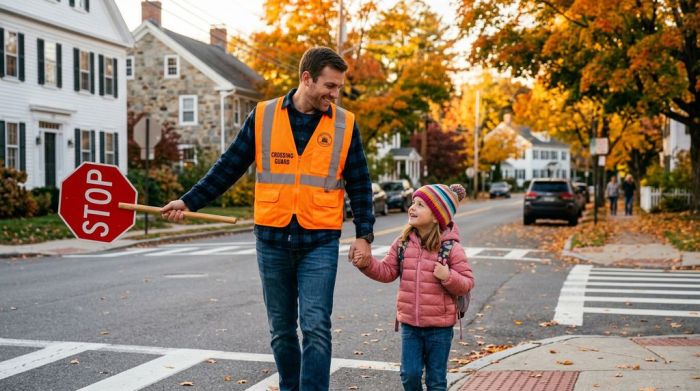
Nobody in the small town of Oakridge, Indiana, knew where the crossing guard came from. He appeared one morning in late August, two weeks before the fall semester started, standing at the corner of Elm and Maple with a faded orange vest and a stop sign he held like a shield. He was young — maybe thirty-two — with tired eyes and the kind of quiet that made people curious but too polite to ask questions.
The children called him Mr. Mike. The parents called him a godsend. But nobody — not the principal, not the PTA president, not the old ladies who walked their dogs past his corner every afternoon — knew the truth about where he had been before he showed up in Oakridge.
His name was Michael Torres. Three years earlier, he had been living under a bridge on the outskirts of Indianapolis, sharing a sleeping bag with a stray cat he had named Gizmo, surviving on whatever change strangers dropped into a cardboard cup. He had served two tours in Afghanistan as a combat medic. He had come home to a girlfriend who had moved on, a mother who had passed away during his deployment, and a country that did not know what to do with a twenty-nine-year-old veteran who could not stop the nightmares.
The VA had given him medication. The medication had given him side effects. The side effects had cost him a job at a warehouse, then an apartment, then the last shred of dignity that kept him from calling his sister, who lived in Oregon and had offered to help a dozen times. He had stopped answering her calls because he could not bear to tell her that her brother, the boy who had fixed her bicycle and walked her down the aisle, was sleeping under a bridge.
The morning that changed everything started like any other morning under the bridge. Cold. Gray. The sound of traffic rumbling overhead like distant thunder. Michael woke up to find Gizmo licking his face, which meant it was probably time for breakfast, which meant it was time to walk to the convenience store two blocks away and hope the clerk was in a generous mood.
But on this particular morning, a Tuesday in July, something was different. A car had pulled over on the shoulder of the road above. A woman was standing at the railing, looking down at him. She was maybe sixty, with silver hair pulled into a neat bun, wearing a floral blouse and carrying a leather handbag. She did not look afraid or pitying. She looked curious.
"Are you a veteran?" she asked. Her voice was steady, kind.
Michael did not answer. He had learned that answering questions led to more questions, and more questions led to complications, and complications were not something he could afford.
"I'll take that as a yes," the woman said. She reached into her bag and pulled out a folded piece of paper. "I have an address for you. It's a room above a garage in a town called Oakridge. It's small, but it's clean. There's a job waiting for you if you want it. It doesn't pay much, but it comes with a place to stay."
She tossed the paper down. It fluttered through the air and landed on the gravel beside his sleeping bag. Michael stared at it. "Why?" he asked. His voice came out rougher than he intended, cracked from disuse.
"Because my son was a veteran too," the woman said. "He didn't make it home. But you did. And I think that means something."
She got back in her car and drove away before he could ask her name.
That paper sat in his pocket for three days. He took it out and read it a dozen times: "Oakridge Elementary School. Ask for Principal Delgado." On the fourth day, he packed his sleeping bag, said goodbye to Gizmo (who had already adopted another homeless man down the road), and started walking. It took him two days to hitchhike the sixty miles to Oakridge. He arrived on a Thursday evening, dirty and exhausted and terrified.
Principal Delgado was a man in his fifties with a kind face and a firm handshake. He did not ask Michael where he had been sleeping. He did not ask about the scars on his arms or the tremor in his hands. He simply said, "The crossing guard position starts in two weeks. The room above the garage is ready whenever you are."
And so Michael Torres became the crossing guard at Elm and Maple.
The first week was terrifying. Children ran toward the street with the reckless abandon of children who had never known real danger. Cars sped through the intersection even when the crossing light was red. Michael stood in the middle of it all, holding his stop sign, feeling the weight of thirty young lives in his hands. He discovered, to his surprise, that he was good at it. The medic training kicked in — the hyper-awareness, the quick reflexes, the ability to stay calm when everything around him was chaos.
The children loved him. He learned their names, their favorite colors, which ones were afraid of dogs and which ones had a loose tooth. He learned that Lily, the first-grader with pigtails, had lost her father to cancer last year. He learned that Marcus, the shy third-grader, was being bullied at school. He learned that the best way to start a child's day was with a high-five and a joke.
The parents started noticing. They left him coffee on cold mornings. They invited him to their block parties. They asked about his life, and he deflected with practiced ease. "I just moved here," he would say. "I like the quiet."
But secrets have a way of surfacing, especially in small towns.
It happened on a rainy October afternoon. Michael was finishing his shift, walking back toward the garage apartment, when a woman stepped out of a car parked across the street. She was younger than the woman under the bridge — maybe thirty-five — with the same kind eyes and the same determined set to her jaw. She was holding a photograph.
"Michael?" she said. Her voice was hesitant, hopeful, afraid.
He stopped. He looked at her face, and something clicked into place. "Lydia?"
His sister burst into tears.
They sat in the garage apartment until midnight, catching up on three years of silence. Lydia told him about her husband, her two kids, the house in Portland she had bought. She told him that she had hired a private investigator after he stopped answering his phone, that the PI had traced him to Indianapolis, that she had spent months searching. She told him that she had found him because of a post on a veteran support forum — a post written by an elderly woman named Margaret, whose son had not made it home, who had seen a man under a bridge and decided he deserved a second chance.
"She never told me her last name," Michael said, his voice thick.
"She didn't need to," Lydia said. "She just needed to help."
Michael told her everything. The bridge, the cat, the long days of nothing, the shame that had kept him silent. He told her about the crossing guard job, about the children, about the way their laughter made him feel like he might, just maybe, be worth something after all.
Lydia listened without interrupting. When he finished, she took his hand across the small table. "You are worth something, Michael. You have always been worth something. I am so sorry that it took a stranger under a bridge for you to hear it."
That was two years ago. Michael still lives in the garage apartment. He still works the corner of Elm and Maple every school day, rain or shine. But now he has a phone in his pocket, and he calls his sister every Sunday. He has dinner at the Delgado house once a month. He has coffee with the parents who once were strangers, and they have become friends.
He still does not talk much about Afghanistan. Some wounds are too deep to share over coffee. But he talks about the children. He talks about Lily, who brought him a drawing last week that said "My hero" in crooked crayon letters. He talks about Marcus, who no longer gets bullied because Michael taught him how to stand up straight and look people in the eye. He talks about the way the morning sun hits the oak trees on Maple Street, turning the leaves to gold, and how he never noticed beauty like that before because he was too busy trying to survive.
The first time Michael Torres stood at the corner of Elm and Maple, he was a man who had given up on himself. He had been broken by war, swallowed by poverty, erased by a system that did not know how to save him. But in a small town in Indiana, a crossing guard with a tired smile and an orange vest found something he had lost years ago: purpose. And in saving children from traffic each morning, he had somehow managed to save himself.