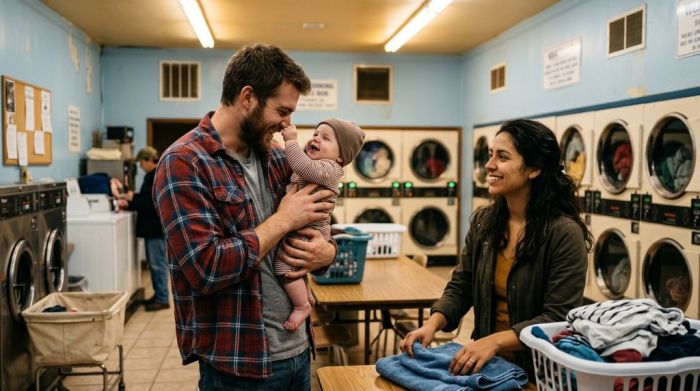
Ethan Porter was twenty-seven years old when he inherited a laundromat he never wanted, in a town he had spent his entire adolescence trying to escape.
The call came on a Tuesday afternoon in February. Ethan was sitting in his cubicle at a graphic design firm in Cleveland, staring at a logo he had redesigned seventeen times, when his phone buzzed with a number he did not recognize. It was Dr. Harris from the county hospital in Millbrook, Ohio, calling to inform him that his father had suffered a massive heart attack while changing a dryer belt at the family laundromat. He was gone before the paramedics arrived.
Ethan did not cry at the news. He sat in his cubicle, the phone pressed to his ear, watching the snow fall outside the window, and felt nothing but a dull, familiar numbness. He had not spoken to his father in three years. Not since the Christmas he had announced he was moving to Cleveland to pursue a career in design, and his father had looked at him with those tired, disappointed eyes and said, "You're running away, son. You've been running since your mother died."
He was right. Ethan had been running. But that did not make the words hurt any less.
The funeral was small. A handful of his father's customers, a few neighbors, the mailman who had worked the route for thirty years. Ethan stood at the back of the church in a suit that did not fit, shaking hands with people whose names he did not remember, accepting condolences he did not deserve. He had not been there for his father’s final years. He had not visited, not called, not written. He had been too busy building a life in a city that did not care about him, pretending that the small town of Millbrook, Ohio, had never existed.
And now his father was gone, and Ethan owned a laundromat he did not know how to run.
The First Week
The laundromat was called Porter's Suds & Dry, a name his father had come up with in 1987, the year Ethan was born. It sat on Main Street, between a diner that had been serving the same meatloaf since 1972 and a hardware store that smelled like sawdust and old paint. The floor was linoleum, yellowed with age and tracked with a thousand muddy footprints. The dryers hummed a constant, off-key melody. The bulletin board by the door was layered with faded flyers for lost cats and guitar lessons and church bake sales.
Ethan’s plan was simple: sell the property, split the proceeds with the bank, and return to Cleveland as if none of this had ever happened. He called a real estate agent, who told him the building was worth less than he hoped. He called the bank, who told him the business was carrying more debt than he expected. He sat in the back office of the laundromat, surrounded by his father's ledgers and receipts and the faint smell of fabric softener, and he felt the walls closing in around him.
He was stuck. A graphic designer from Cleveland, trapped in a small town he hated, running a business he knew nothing about.
The Regulars
The first person to break through his wall of resentment was a woman named Diana Reyes.
She came in on a Thursday evening, carrying a baby on her hip and a laundry basket balanced on her shoulder. She was maybe twenty-five, with dark circles under her eyes and a smile that looked like it had not been used in a while. The baby was maybe six months old, a girl with round cheeks and a tuft of black hair, fussing softly against her mother's shoulder.
Ethan was behind the counter, scrolling through his phone, trying to ignore the growing sense of dread that had settled into his chest like a permanent resident. He looked up when the bell above the door jingled, and he watched Diana struggle to get the laundry basket through the door without dropping the baby.
He did not move to help her. He was not that kind of person. Not yet.
She managed to get the basket onto a table, shifted the baby to her other hip, and started feeding quarters into the machine. The quarters ran out after three. She checked her wallet. She checked the coin return slot. She checked her wallet again, as if the money might have magically reappeared.
Ethan watched her. He watched the way her shoulders sagged when she realized she did not have enough. He watched the way she bit her lip, fighting back tears, trying to figure out how to wash her baby's clothes with three dollars and a broken spirit.
And something in him shifted.
"It's free," he said, the words coming out before he could stop them.
She looked up, startled. "What?"
"The machine. It's free. I have a — there's a special. This week. Customer appreciation." He was making it up as he went along, and he knew it sounded ridiculous. But he could not take it back now. "Go ahead. Put your clothes in. I'll start it for you."
Diana stared at him for a long moment, trying to read his intentions. Then her face crumpled, and she started to cry. Not the dramatic, heaving sobs of someone seeking attention, but the quiet, exhausted tears of a woman who had been holding it together for too long and had finally been given permission to let go.
Ethan did not know what to do. He was not good with crying people. He grabbed a roll of paper towels and handed it to her, which was probably the wrong thing to do, but it was all he had.
"Thank you," she whispered, taking the paper towels. "I'm sorry. I don't usually cry at strangers. It's been a hard week."
"You don't have to apologize." He started the washing machine, and they stood in the quiet hum of the laundromat, two strangers connected by a moment of unexpected kindness.
That was the beginning.
Diana started coming every Thursday. Ethan learned her story in pieces, the way you learn about people when you are not trying to pry. She was a single mother. Her ex-husband was serving a five-year sentence for armed robbery. She worked two jobs — a daytime shift at the diner next door and a nighttime cleaning job at the elementary school. She lived in a small apartment above the hardware store with her daughter, a six-month-old named Sofia. She was exhausted, broke, and running out of hope.
But she kept showing up. Every Thursday, she would walk into Porter's Suds & Dry with Sofia on her hip and a laundry basket on her shoulder, and Ethan would make sure her machines were free. He would hold Sofia while Diana folded clothes. He would make coffee from the old machine in the back that his father had used for twenty years. He would sit with her during her dryer cycles, and they would talk about nothing and everything.
He learned that Sofia had been born with a heart murmur that was slowly healing. He learned that Diana's mother had passed away when she was nineteen, the same year Ethan's mother had died. He learned that she dreamed of going back to school to become a nurse, but she could not afford the tuition and could not afford the time.
And slowly, imperceptibly, Ethan stopped counting the days until he could leave Millbrook.
The Letter
He found it on a rainy Sunday in April, three months after the funeral. He was cleaning out the back office, preparing to list the business for sale, when he discovered a locked drawer in his father's desk. He had to use a screwdriver to pry it open. Inside was a single envelope, yellowed with age, addressed to him in his father's careful handwriting.
Ethan sat down in the old swivel chair, the one that had held his father's weight for thirty years, and opened the letter with trembling hands.
Dear Ethan,
If you are reading this, I am gone. I am sorry I never got to say goodbye properly. I am sorry for a lot of things — for the words I said that Christmas, for the years I let pass without picking up the phone, for the pride that kept me from telling you that I was proud of you every single day.
Your mother used to say that I was stubborn as a mule. She was right. I was too stubborn to tell you that I understood why you had to leave. Millbrook was too small for you. I knew that when you were ten years old, drawing pictures of cities you had never seen. You were always meant for bigger things.
But I want you to know something. This laundromat — it was never about the money. It was about the people. Mrs. Kowalski, who comes in every Tuesday because her arthritis is too bad to use her own washing machine. The Miller family, who lost everything in the fire and used this place as their laundry room for six months. The single mothers, the struggling fathers, the old men who come in just to sit by the dryers because they are lonely and the hum of the machines is the only sound that fills the silence.
I built this place for them, Ethan. And I always hoped that one day, you would understand that the biggest impact you can have on the world is not in a skyscraper in Cleveland. It is in a small laundromat on Main Street, where you help people carry their burdens, one load at a time.
I love you, son. I have always loved you. And I am so sorry I did not say it enough.
Take care of our neighbors.
That is all I ever wanted.
Love, Dad
Ethan read the letter three times, tears streaming down his face, the paper trembling in his hands. He thought about the single mothers, the struggling fathers, the old men who sat by the dryers. He thought about Diana, carrying her laundry basket and her baby and her broken dreams. He thought about his father, who had spent thirty years serving a town that most people had forgotten, not for glory or money, but because he believed that small acts of kindness could change the world.
He did not list the business for sale.
The Transformation
Ethan started making changes. Small ones at first. He painted the walls a warm, inviting blue. He fixed the broken dryer that had been out of service for six months. He installed a changing table in the bathroom, a small gesture that made Diana cry when she saw it. He started a "pay it forward" board, where customers could prepay for someone else's laundry, and within a month, the board was covered with sticky notes and dollar bills.
He started a free laundry night once a month, for families who were struggling. He put out a basket of free socks for anyone who needed them. He learned the names of every regular customer, their stories, their struggles, their small victories.
And somewhere along the way, he fell in love with Diana.
It happened the way most important things happen — quietly, without fanfare, in the ordinary moments between the big events. He was holding Sofia while Diana folded clothes, and the baby reached up and grabbed his nose, and she laughed — a gurgling, toothless laugh that filled the laundromat like sunshine. Diana looked up, saw the expression on Ethan's face, and smiled. It was the same smile she had worn on that first Thursday evening, but different now. Brighter. Hopeful.
That night, after Diana had gone home, Ethan sat in the back office and called the real estate agent. "I'm taking the laundromat off the market," he said.
There was a pause on the other end. "Are you sure, Ethan?"
"I've never been more sure of anything in my life."
Epilogue: One Year Later
Porter's Suds & Dry looks different now. The walls are a warm shade of blue, the same color as the summer sky over Millbrook. The dryers no longer hum their off-key melody — Ethan fixed them himself, learning from the repair manual his father had left behind. The bulletin board by the door is still covered with flyers, but now they are for community events and support groups and the free laundry night that happens every last Thursday of the month.
Diana moved into the apartment above the laundromat. She still works at the diner next door, but she is taking night classes at the community college, studying to become a nurse. Ethan watches Sofia while she studies, and he has become an expert at making her laugh, at reading her bedtime stories, at the particular rhythm of caring for a child who is not his by blood but is his by every measure that matters.
Last week, Diana handed him a piece of paper. It was a printout from the county clerk's office. "I filed the name change papers," she said. "Sofia's last name. I changed it to Porter."
Ethan looked at the paper, then at Diana, then at Sofia, who was sitting on the floor of the laundromat, banging two plastic measuring cups together like cymbals. He felt the tears coming, and he did not try to stop them.
"Are you sure?" he asked.
She took his hand. "You're her father, Ethan. You have been since the day you gave a stranger free laundry and asked for nothing in return."
He pulled her into his arms and held her, standing in the middle of the laundromat on Main Street, surrounded by the hum of dryers and the smell of fabric softener and the quiet, steady rhythm of a life he had never expected to find.
He had come to Millbrook planning to run away. He had stayed because a letter from his father taught him that the biggest things happen in the smallest places. And he had found a family in a laundromat, because sometimes, love shows up in the most unexpected places — not in a grand gesture or a perfect moment, but in a free load of laundry and a baby's laugh and the quiet, stubborn decision to stay.
Ethan Porter is thirty years old now. He still runs the laundromat on Main Street. He still makes coffee from the old machine in the back. He still knows every customer by name.
And every evening, before he locks up for the night, he walks to the back office and touches the framed letter on the wall — the one his father wrote, the one that changed everything. He reads the last line, the one that has become his motto, his mission, his reason for staying:
"Take care of our neighbors. That is all I ever wanted."
He is taking care of them. One load at a time.