Leo Peterson was nine years old, and he had never met anyone as quiet as the woman who delivered his mail.
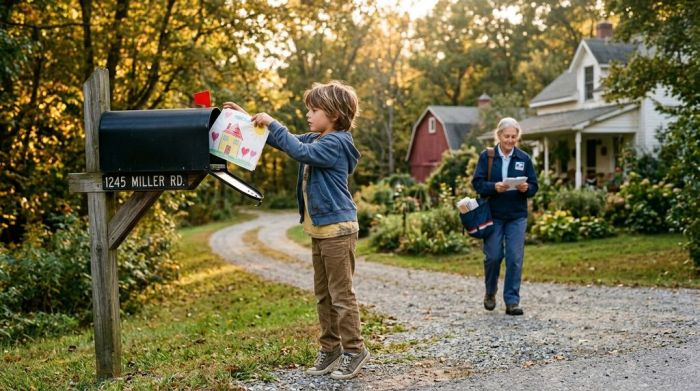
Her name was Mrs. Beatrix Harlow, though Leo did not learn that until much later. To him, she was simply the mail lady — a tall, silver-haired woman in a faded blue USPS uniform who walked the streets of Hickory Ridge, Iowa, with the slow, deliberate steps of someone who had been walking the same route for a very long time. She never smiled. She never waved. She placed the mail in the box with mechanical precision, closed the lid, and moved on to the next house without a single wasted motion.
Leo's mother, a nurse at the county hospital, said Mrs. Harlow had been delivering mail on Maple Street since before Leo was born. "She used to be different," his mother said once, when Leo asked why the mail lady looked so sad. "Before her husband passed, she used to whistle while she walked. She used to bring hard candies for the children at Halloween."
That was all Leo needed to hear.
He was a boy who felt things deeply — the kind of child who noticed when a classmate sat alone at lunch, who brought home stray cats with the hopeless optimism of someone who believed every creature deserved a home. He had a heart that had not yet learned to protect itself, and that heart decided, on a cool September afternoon, that the mail lady needed a friend.
He started small. A drawing of a sunflower, done in crayon on a piece of notebook paper, tucked into the mailbox with a note: "For the mail lady. I hope you like yellow. — Leo"
He did not know if she would find it. He did not know if she would care. But when he checked the mailbox the next morning, the drawing was gone. In its place was a single, perfect sketch — a robin perched on a branch, drawn in pencil with a lightness and precision that made Leo's breath catch. There was no note. Just the bird, looking at him from the paper with eyes that seemed to hold a thousand secrets.
Leo stared at the drawing for a long time. He had never seen anything like it. His own crayon sunflowers looked like the work of a toddler compared to this. He showed it to his mother, who was equally astonished. "This is beautiful," she said, studying the sketch. "She must have been an artist, Leo."
That was the beginning of a secret correspondence that would change both their lives.
Every afternoon, Leo would leave a drawing in the mailbox. A dog. A tree. A picture of his house with the sun shining. And every morning, he would find a new drawing in return. A butterfly with wings that seemed to shimmer. A cat stretching in a patch of sunlight. A pair of hands, folded in prayer, the knuckles lined with age. The drawings were always small, always perfect, always unsigned. But they spoke to Leo in a language he understood instinctively — the language of someone who had a great deal to say and had learned to say it with a pencil.
Leo did not tell anyone at school. The mailbox drawings were his secret, his treasure, the thing he looked forward to every single day. He started walking to the mailbox before breakfast, his bare feet cold on the dewy grass, his heart pounding with anticipation. Some mornings, if he was lucky, he would catch a glimpse of Mrs. Harlow at the end of the street, her gray head bent over her mail cart, and he would wave. She never waved back. But once, he was sure he saw her pause. Once, he was sure she almost smiled.
Winter came, and the drawings continued. Leo drew a snowman. Mrs. Harlow left him a sketch of a cardinal in a bare tree, its red feathers like a flame against the gray sky. Leo drew his cat, Mittens, curled up by the fireplace. She left him a drawing of a farmhouse at sunset, the windows glowing with warm yellow light, a curl of smoke rising from the chimney. He studied that drawing for hours, wondering who lived in that house, wondering if it was the house where she had been happy.
Spring arrived, and Leo's ninth birthday came. He did not expect anything from the mail lady. He did not even know if she knew when his birthday was. But on the morning of March 14, he opened the mailbox and found a small package wrapped in brown paper. Inside was a sketchbook — the kind artists use, with thick, cream-colored paper that felt expensive and important. Tucked inside the first page was a note, written in handwriting that was elegant and slightly unsteady:
Every artist needs a place to put their dreams. Keep drawing, Leo. You have a gift. — B.H.
Leo carried that sketchbook everywhere. He drew in it at the kitchen table, in the car, in his bed at night when he was supposed to be sleeping. He filled it with pictures of his family, his cat, the trees outside his window. And every time he finished a drawing, he thought of the mail lady. He thought of her silent walks, her hidden talent, the way she had given him a piece of herself without ever saying a word.
He wanted to know her story. He wanted to ask her about the farmhouse drawing, about the robin, about the hands folded in prayer. But he did not know how. The silence between them had become a language of its own, and he was afraid that words would break it.
Summer came, and with it, a change that Leo did not expect. A new mail carrier appeared on Maple Street — a young man with a buzz cut and an efficient stride. Leo watched him from the window, waiting for the familiar silver head, the slow, deliberate steps. They did not come.
He asked his mother that evening. "Where is the mail lady?"
His mother's face softened. "I heard she retired, honey. She moved to a small town in Minnesota to be with her sister."
Leo felt something crack in his chest. He had not said goodbye. He had not thanked her. He had been so careful to preserve the silence between them that he had lost the chance to break it.
He walked to the mailbox, his feet heavy, his heart hollow. He opened the lid, expecting nothing. But there, tucked inside, was one last envelope. It was thicker than usual, and heavy. Leo carried it inside and opened it with trembling hands.
Inside was a letter, written on delicate stationery, and a single photograph. The photograph showed a young woman in her twenties, standing in front of an easel in a sunlit studio. She was holding a paintbrush, and her face was lit with a joy that Leo had never seen on the mail lady's face. Behind her, covering the walls of the studio, were paintings — dozens of them, landscapes and portraits and abstracts, each one more beautiful than the last.
Leo turned the photograph over. On the back, in the same elegant handwriting, it said: Beatrix Harlow, 1975. The year I believed I could be an artist.
He unfolded the letter.
Dear Leo,
I am not good at goodbyes. I never have been. When my husband Arthur passed away, I stopped saying goodbye to anyone. I stopped talking altogether. I walked my mail route in silence, and I told myself that I had said everything I needed to say in the sixty-three years I had been alive.
But then a little boy with messy hair left a crayon drawing of a sunflower in his mailbox. And I realized, with a start that I had not felt in years, that I had something left to say.
You should know something about me. Before I became a mail carrier, I was a painter. I studied at the Art Institute of Chicago. I had a gallery show in New York when I was twenty-seven. Critics called me "promising." They said I had a future. But then I met Arthur, and I fell in love, and I chose a different kind of life — a quieter life, in a small town, with a man who made me happier than any gallery opening ever could. I did not regret that choice. Not for a single day.
But when Arthur died, I stopped painting. I could not look at a blank canvas without seeing his face. I could not hold a brush without remembering the way he used to watch me work, sitting in his old armchair, drinking coffee, telling me I was the most talented woman in the world. The paint dried up. The canvases gathered dust. And I convinced myself that the artist in me had died with him.
Then you left me a sunflower.
I do not know if you understand what that drawing did to me. It was not perfect. The proportions were wrong, and the colors ran outside the lines. But it was full of hope. It was the work of a child who believed that the world was worth drawing. And it reminded me, in a way that nothing else had, that I used to believe that too.
I started drawing again because of you, Leo. Small things at first. A bird. A cat. The farmhouse where Arthur and I spent our honeymoon. And with every drawing, I felt a little more of myself coming back. The grief did not disappear. But it became lighter. It became something I could carry instead of something that crushed me.
You saved me, Leo. I need you to know that. A nine-year-old boy with a crayon and a kind heart saved an old woman from disappearing into her own sadness.
I am leaving you something in return. In the box below the mailbox, I have placed a portfolio. It contains every painting I have made since I started drawing again. They are yours now. Do with them what you will. But I hope you keep them. I hope they remind you, when you are older, that the smallest acts of kindness can save a life.
Keep drawing, Leo. You have a gift. But more importantly, you have a heart. And that is rarer than any talent.
With all my gratitude,
Beatrix Harlow
Leo ran to the mailbox. He pulled open the small compartment beneath it, the one he had never thought to check, and found a flat portfolio case, wrapped in plastic. He carried it inside, opened it on the kitchen floor, and gasped.
There were twenty-three paintings. Landscapes, portraits, still lifes — each one more stunning than the last. There was the farmhouse from the drawing, rendered in oils, the sunset casting golden light across the fields. There was a portrait of a man with kind eyes and a gentle smile — Arthur, Leo knew, without being told. There was a painting of a robin, the same robin she had drawn for him on that first day, now alive in color, its feathers catching the morning light.
And at the bottom of the portfolio, there was a painting of a small boy with messy brown hair, standing on tiptoes at a mailbox, placing a crayon drawing inside. The title was written in pencil on the back: "The Boy Who Taught Me to Paint Again."
Leo sat on the kitchen floor, surrounded by the legacy of a woman he had never truly known, and he cried. He cried for the grief she had carried, for the gift she had given him, for the strange and beautiful truth that a sunflower drawn in crayon had saved an artist's soul.
---
Leo Peterson is twenty-six years old now. He lives in Chicago, and he works as a curator at the Art Institute — the same school where Beatrix Harlow once studied. On the wall of his office, hung in a place of honor, is a small crayon drawing of a sunflower, framed and preserved. Next to it is a photograph of a young woman in a sunlit studio, holding a paintbrush, her face lit with joy.
Mrs. Harlow passed away peacefully in her sleep three years after she left Hickory Ridge. Her sister sent Leo a letter, along with a box of her remaining belongings. Inside the box was a stack of letters — every single note Leo had ever left in the mailbox, preserved in plastic sleeves, organized by date. She had kept them all. She had treasured them the way he had treasured her drawings.
Leo organized a retrospective of her work at the Art Institute last spring. It was called "The Mailbox Artist: The Lost Works of Beatrix Harlow." It was the most well-attended exhibition the institute had hosted in a decade. People came from all over the country to see the paintings of a woman who had spent thirty years delivering mail and never told a soul that she had once been a rising star in the art world.
At the entrance of the exhibition, Leo placed a small plaque. It read: "This exhibition is dedicated to everyone who has ever left a drawing in a mailbox. You never know whose life you might save."
Because that is the truth about kindness. It does not have to be grand. It does not have to be expensive. It does not have to be noticed. Sometimes, it is just a sunflower drawn in crayon, left in a mailbox by a nine-year-old boy who noticed that someone was sad and decided to do something about it.
And sometimes, that is enough to change everything.