Maya Okonkwo never expected to find her purpose in a heat wave. But when her grandmother collapsed in their sweltering Detroit kitchen, the seventeen-year-old discovered a truth that would change her life: her neighborhood had no trees.
LaBelle Street was an urban heat island — a place where concrete and asphalt absorbed the sun's heat and released it at night, making the temperature five to ten degrees hotter than the rest of the city. The elm trees that had once lined the street were gone, killed by disease and decades of neglect. And no one had thought to replace them.
This is a story about a girl who refused to accept that her neighborhood was invisible. It is about the elderly botanist next door who had not left his house in years, the photo album that showed what LaBelle Street used to be, and the city council meeting where a high school senior stood up and demanded change.
It is about the courage it takes to plant a tree when you know you won't live to see it grow tall. It is about the quiet power of community action, the healing that comes from working with your hands, and the unexpected friendship between a teenage girl and a grieving old man that saved a block — and both of them.
Maya's journey from a science textbook to a city council podium is a reminder that the people who change the world are not always the ones with power or money. Sometimes they are seventeen-year-old girls with dirty hands, stubborn hearts, and a grandmother who taught them that love means leaving the world better than you found it.
Pour yourself something cold, settle in, and meet Maya Okonkwo — the girl who planted trees in the city.
hr>The summer Maya Okonkwo turned seventeen, the temperature in Detroit hit 102 degrees for eleven straight days, and the city began to bake like a clay pot left too long in the kiln.
She sat on the front steps of her family's duplex on LaBelle Street, fanning herself with a science textbook that was supposed to prepare her for the AP exam in the fall. The air was thick with the smell of hot asphalt and exhaust fumes. The concrete radiated heat like a furnace, and there wasn't a single tree on the entire block to offer shade.
Not one.
Maya had lived on LaBelle Street her whole life. She had walked these sidewalks to school, ridden her bike to the corner store, sat on these steps through a thousand summer evenings. And she had never really noticed the absence of trees until the summer her grandmother almost died.
Nana Okonkwo was seventy-four years old, with a heart that had been beating in the Nigerian village of Enugu before migrating to America and settling in Detroit. She had raised four children, buried a husband, and cooked jollof rice for every family gathering for five decades. She was the anchor of the Okonkwo family, the voice on the phone every Sunday, the woman who pinched Maya's cheeks and told her she was growing too fast.
And on the fourth day of the heat wave, Nana collapsed in the kitchen while making dinner.
Maya heard the crash from her bedroom upstairs — the clatter of a pot hitting the linoleum floor, followed by a silence that was worse than any scream. She ran down the stairs and found her grandmother on the kitchen floor, her face pale, her breathing shallow. The apartment was stifling. The air conditioner had broken the day before, and the landlord had not come to fix it.
The ambulance came in twelve minutes. Maya rode with her grandmother to the hospital, holding her hand, watching the city pass by in a blur of concrete and heat shimmer. The emergency room was crowded — it was always crowded during heat waves. Old people, babies, people with asthma, people whose bodies had simply given up trying to cool themselves.
Nana was diagnosed with heat exhaustion and dehydration. She stayed in the hospital for two days. And every time Maya visited, she saw the same thing in the waiting room — more elderly patients, more children with asthma attacks, more families who lived in neighborhoods without trees, without shade, without relief.
"It's not fair," Maya said to her mother that evening, sitting at the kitchen table while Nana rested in the next room. "Nana almost died because there's no shade on our street. Because the city planted trees everywhere except here."
Her mother, a nurse's aide who worked double shifts at the same hospital, looked at her daughter with tired eyes. "It's been like this a long time, baby. Some neighborhoods get trees. Some don't."
"Why not?"
Her mother did not answer. But the silence itself was an answer.
Maya spent the next week researching. She learned about tree equity — the term for how wealthier neighborhoods had more trees and cooler temperatures, while poorer neighborhoods had less trees and hotter temperatures. She learned that Detroit had lost over a million trees to Dutch elm disease and urban development since the 1950s. She learned that predominantly Black neighborhoods like hers had been systematically neglected in tree-planting initiatives for decades.
She learned that her neighborhood was classified as an "urban heat island" — a place where concrete and asphalt absorbed the sun's heat and released it at night, making the temperature five to ten degrees hotter than the rest of the city.
And she decided to do something about it.
The first person she told was her best friend, Jasmine, who looked at her like she had grown a second head. "Plant trees? On our block? Maya, nobody's gonna pay for that."
"I'll figure it out."
"The city barely picks up our trash on time. You think they're gonna give us trees?"
"Then we'll do it ourselves."
Jasmine shook her head, but she was smiling. "You're crazy. You know that, right?"
"Crazy enough to try."
The second person she told was Mr. Washington.
Mr. Jerome Washington lived three houses down from Maya, in a peeling white bungalow with a sagging porch and curtains that never opened. He was eighty-one years old, a widower of fifteen years, and the only person on LaBelle Street who still had a garden. Not a flower garden — a real garden, with tomato plants and okra and collard greens that he tended every morning before the sun got too high. He had lived on LaBelle Street since 1973, back when the neighborhood still had elm trees that formed a canopy over the street, back when children played under the shade and old men sat on porches and fanned themselves with newspapers.
Maya had known Mr. Washington her whole life, but she had never really talked to him. He was the quiet neighbor, the one who kept to himself, the one who waved from his porch but never came to block parties. Her mother said he had been different before Mrs. Washington died — friendlier, more talkative. Grief had made him small.
She knocked on his door on a Saturday morning. He opened it slowly, suspiciously, as if he expected a salesperson. He was tall and thin, with skin the color of dark honey and eyes that held a lifetime of stories he no longer told.
"Mr. Washington," Maya said, "my name is Maya Okonkwo. I live down the street. I want to plant trees on LaBelle Street, and I heard you used to know everything about the trees in this neighborhood."
He stared at her for a long moment. Then he opened the door wider. "Come in."
His house smelled like old books and dried herbs. The living room was filled with photographs — a younger Mr. Washington in a suit, a beautiful woman with a wide smile, a garden that must have been magnificent. He led her to the kitchen, where he poured her a glass of iced tea from a pitcher that had been sitting on the counter.
"You want to plant trees," he said, sitting down across from her.
"Yes, sir."
"Why?"
Maya told him about her grandmother. About the heat wave, the collapsed air conditioner, the hospital room full of people who could not afford to cool their homes. She told him about tree equity and urban heat islands and the million trees Detroit had lost.
Mr. Washington listened without interrupting. When she finished, he was quiet for a long time. Then he stood up and walked to a bookshelf in the corner of the living room. He pulled out a worn photo album, its cover faded and cracked, and laid it on the table.
"LaBelle Street, 1975," he said, opening to a page.
Maya leaned forward. The photograph showed a street she barely recognized. The houses were the same, but the street was transformed by trees — massive American elms that arched over the road like a green cathedral, their branches interlocking to create a tunnel of shade. Children played on the sidewalk. An old man sat on a porch, exactly where Mr. Washington's porch was now.
"This was our street," Mr. Washington said softly. "Before the disease took the elms. Before the city stopped caring. Before we became invisible."
He turned the page. More photographs — a block party under the trees, a wedding reception in someone's backyard, a group of children holding watermelon slices and grinning at the camera. In every picture, the trees were there, silent witnesses to a community's joy.
"When did they go?" Maya asked.
"Slowly at first. Then all at once. The city planted new trees in the suburbs. They said there wasn't enough money for our neighborhood." He closed the album. "I stopped gardening for a while after Evelyn died. It didn't seem worth it. But then I realized that the garden was the only thing I had left. The only thing that reminded me that things could still grow here."
Maya looked at the photograph of LaBelle Street in 1975, then at the barren street outside the window. She thought about her grandmother, lying in a hospital bed because there was no shade to cool her home. She thought about the children who had never known what it felt like to play under a canopy of green.
"I want to bring them back," she said. "The trees. I want to bring them back."
Mr. Washington looked at her for a long moment. Then he smiled — a small, fragile smile that cracked the mask of grief he had worn for fifteen years.
"Well," he said, "you're going to need a lot of help."
The first obstacle was money. Maya calculated that a single tree cost about fifty dollars — the sapling, the soil, the mulch, the water. She wanted to plant fifty trees on LaBelle Street alone. That was twenty-five hundred dollars. She had four hundred and sixty dollars saved from her summer job at the library.
She started a GoFundMe. She posted it on her social media, her church group, her mother's Facebook page. In the first week, she raised two hundred dollars — mostly from her aunties and church members. It was not enough.
The second obstacle was permission. The city required a permit to plant trees on public property. Maya called the Parks and Recreation department five times. She was transferred four times, put on hold twice, and eventually told that the process could take six to eight months.
"We don't have six months," she told Jasmine. "Nana's okay now, but what about next summer? What about other people's grandmothers?"
"So what are you going to do?"
Maya thought about Mr. Washington's photo album. She thought about the children in the pictures, laughing under the elm trees. She thought about her grandmother, who had crossed an ocean to give her family a better life, and who had almost died because there was no shade on LaBelle Street.
"I'm going to change the rules," she said.
She went to the city council meeting. She stood at the podium in her school uniform — a white blouse and navy skirt, her hair pulled back in a neat ponytail — and she spoke for three minutes. She told them about her grandmother. She told them about the heat wave. She told them about the million trees Detroit had lost and the neighborhoods that had been left behind.
"We are not asking for a handout," she said, her voice steady despite her trembling hands. "We are asking for permission to do the work ourselves. We have the volunteers. We have the plan. We have a man who remembers when LaBelle Street was lined with elm trees, and who wants to see it that way again. All we need is for you to say yes."
The council members looked at each other. The chairwoman, an older Black woman named Patricia Owens, adjusted her glasses and studied Maya with eyes that had seen a lot of young people come and go.
"How many trees?" she asked.
"Fifty to start. More if we can."
"Who's going to maintain them?"
"We are. The neighbors. We'll water them, mulch them, take care of them. We're not going to plant them and walk away."
Councilwoman Owens was quiet for a moment. Then she nodded. "I'll have my office fast-track your permit. But I'm going to hold you to that promise, young lady. Those trees better be alive a year from now."
"Yes, ma'am. They will be."
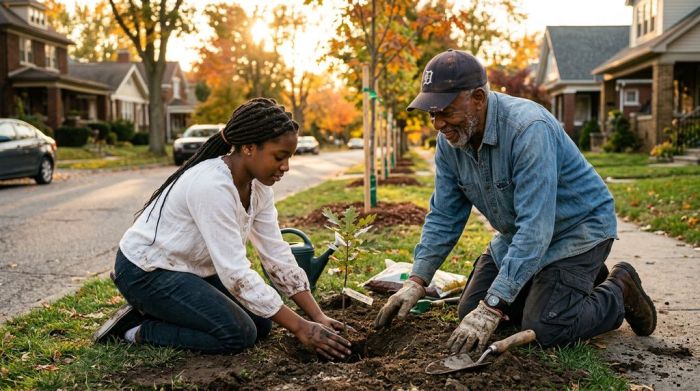
The planting day was a Saturday in early October, when the Michigan air had finally cooled and the sky was a deep, endless blue. Mr. Washington came out of his house at seven in the morning, carrying a gardening shovel that must have been older than Maya's mother. He was wearing a faded denim shirt and a baseball cap that said "Detroit vs. Everybody."
"You ready?" he asked.
Maya looked at the pile of saplings stacked on the curb — fifty young trees in black plastic pots, donated by a nursery that had heard about her project and offered a discount. She looked at the neighbors who had gathered on the sidewalk — Jasmine and her mother, the family from two doors down, the old man from the corner who never talked to anyone. She looked at her grandmother, sitting on the porch in a folding chair, wrapped in a blanket, watching with the same proud smile she had worn at Maya's kindergarten graduation.
"I'm ready," Maya said.
They planted trees all day. Mr. Washington showed them how to dig the holes deep enough, how to loosen the roots, how to stake the saplings so they would grow straight. Maya's hands blistered. Her back ached. Her knees were stained with dirt. But by five o'clock in the evening, fifty saplings stood along LaBelle Street — oak, maple, and serviceberry, spaced every twenty feet, their small leaves rustling in the autumn breeze.
Maya stood at the end of the block, looking at the street she had known her whole life. It looked different now. Smaller, somehow, and more hopeful. She thought about the photograph in Mr. Washington's album — the elm trees arching over the road like a green cathedral. It would take years for these saplings to grow that tall. Decades, maybe. She would be in her thirties by the time they cast real shade.
But that was okay. She had planted them for the children who would play under them. For the grandmothers who would sit on their porches and feel the cool breeze. For the neighborhood that had been invisible for too long.
Mr. Washington walked up beside her, his shovel over his shoulder. He was tired, she could see it in the way he moved, the way he leaned slightly to one side. But his eyes were bright, brighter than she had ever seen them.
"Your grandmother would have loved this," he said.
Maya nodded. She knew he was not just talking about Nana.
"Thank you, Mr. Washington. I couldn't have done it without you."
"You would have figured it out." He paused, looking at the saplings. "I used to think that after Evelyn died, nothing would grow again. Not in my garden, not in this neighborhood, not in my heart. But you showed me I was wrong."
He reached into his pocket and pulled out a small, folded piece of paper. "I found this in Evelyn's old gardening book. It's a quote she kept taped to the cover. I think you should have it."
Maya unfolded the paper. In faded handwriting, it said: "The best time to plant a tree was twenty years ago. The second best time is now."
She read it twice. Then she folded it carefully and put it in her pocket, next to her heart.
That was eighteen months ago.
The saplings on LaBelle Street are taller now. Not much — maybe two feet — but they have survived a winter and a summer, and their leaves are thick and green. Maya waters them every Saturday morning, and she is not alone. The neighbors have formed a tree committee. They take turns watering, weeding, and checking for disease. Mr. Washington is the chairman, a title he carries with a dignity that would make a Supreme Court justice jealous.
Maya Okonkwo is eighteen now. She is a freshman at Michigan State University, majoring in environmental science. She comes home every other weekend, and the first thing she does is walk the length of LaBelle Street, touching the leaves of her trees, greeting each one like an old friend.
Her grandmother is still alive. She sits on the porch on summer evenings, in the shade of a young maple that Maya planted right in front of their house. She tells everyone who visits that her granddaughter is going to change the world. And maybe she is right.
Because Maya learned something that summer in Detroit. She learned that a seventeen-year-old girl with a science textbook and a stubborn heart can change her neighborhood. She learned that the trees that were taken away can be planted again. She learned that grief, like soil, can be tilled and turned and made ready for new growth.
And she learned that the best time to plant a tree is not twenty years ago.
It is now.
It is always now.