Captain James Thompson was forty-two years old, and he had spent the last twenty of them at 35,000 feet. He had flown through monsoons over the Pacific, navigated snowstorms into O'Hare, and landed a 737 with one engine on a runway in Denver when the other one decided to quit. He had seen more sunrises from the cockpit than most people see in a lifetime.
But on Christmas Eve morning, sitting alone in his condo near the Atlanta airport, he felt like he had never been anywhere at all.
The divorce had been finalized in September. Eighteen years of marriage, dissolved into a stack of papers that arrived in the mail with less ceremony than a credit card statement. His daughter, Maya, was sixteen now, living with her mother in Charlotte. He called her every Sunday, and she answered every third call, and the conversations lasted exactly as long as it took to ask about school and weather and whether she needed money.
He had volunteered for the Christmas Eve flight because someone had to, and because the thought of sitting alone in his condo with a frozen dinner and the Hallmark channel was worse than the thought of spending six hours in a metal tube with two hundred strangers.
The first officer that day was a young woman named Denise, twenty-nine years old, sharp and cheerful in a way that JT found both irritating and endearing. "You know most captains try to avoid the Christmas Eve red-eye," she said as they went through the pre-flight checklist.
"Most captains have somewhere to be," JT replied.
Denise looked at him with the kind of pity that young people reserve for the newly divorced. She did not say anything. She did not have to.
They pushed back from the gate at 7:47 PM, right on schedule. The cabin lights dimmed, the safety demonstration played, and JT's voice came over the intercom with the practiced warmth of someone who had said the same words a thousand times.
"Ladies and gentlemen, welcome to Flight 1742 from Atlanta to Seattle. We've got a smooth ride ahead of us tonight, and we expect to be on the ground in Seattle around 10:30 Pacific time. Sit back, relax, and let us take you home."
It was the "home" part that stuck in his throat. He was taking two hundred people home. He did not have a home to go to.
A Mother and Son in the Middle Seat
The seatbelt sign had been off for about twenty minutes when the flight attendant, a veteran named Carol who had been flying since before JT grew his first gray hair, appeared in the cockpit doorway.
"Captain, I've got a situation in 14B."
JT turned. "What kind of situation?"
"Single mother with a little boy. Maybe five years old. He's scared. Crying. She's trying to calm him down, but she's about to lose it herself. I think they need a distraction."
JT unbuckled his harness. He had been a pilot long enough to know that sometimes the most important part of the job happened outside the cockpit. He walked through the first-class cabin, past the business travelers with their laptops open, and stopped at row 14.
The boy was small for his age, with dark hair and eyes that were red from crying. His mother was young — late twenties, maybe — with the kind of exhausted beauty that comes from too many sleepless nights and too few moments of peace. She was holding the boy's hand, whispering something JT could not hear, her own eyes glistening.
JT knelt down in the aisle, bringing himself to eye level with the boy. "Hey there, young man. I'm Captain James. What's your name?"
The boy sniffled. "Caleb."
"Caleb. That's a strong name. You know, I have a secret to tell you."
Caleb looked up, his curiosity battling his fear.
"I have a special place on this airplane. A secret room. And I think you're old enough to see it."
Caleb's mother looked at JT with an expression he could not quite read. Relief, maybe. Or suspicion. Or both.
"Go ahead, baby," she said softly. "It's okay."
The Cockpit That Changed Everything
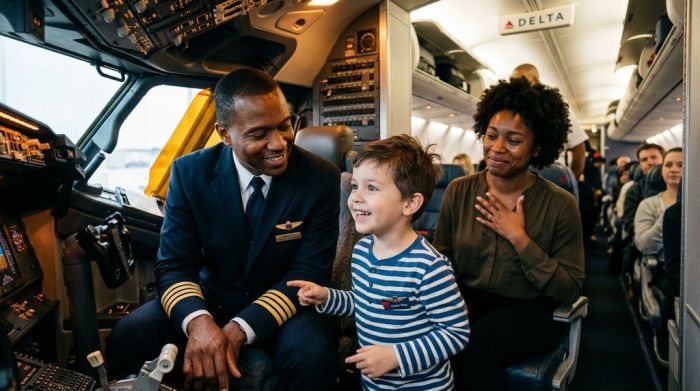
JT extended his hand, and Caleb took it. They walked together through the cabin, past the galley, and into the cockpit. JT lifted Caleb onto the jump seat and pointed at the instrument panel.
"This is where I sit," JT said. "All these buttons and screens? They help me fly this big bird. See that screen right there? That's our map. We're right here, over Kansas. And those lights down there? That's a town called Wichita."
Caleb's eyes widened. "You can see my house from here?"
"Not your house. But I can see the whole world from here. And you know what? One day, you could sit in this seat. You could fly this plane anywhere you want to go."
Caleb looked at the controls, at the stars visible through the windshield, at the vast, dark sky that stretched into infinity. His crying had stopped. In its place was something JT had not seen in a long time: wonder.
"I'm scared of flying," Caleb admitted.
JT nodded. "That's okay. Being scared is normal. Do you know what brave people do?"
Caleb shook his head.
"Brave people feel scared, and they do the thing anyway. You got on this plane even though you were scared. That makes you braver than most adults I know."
Caleb smiled — a small, fragile smile that lit up his entire face. JT felt something crack open in his chest.
The Landing
They landed in Seattle at 10:22 PM, eight minutes ahead of schedule. JT walked through the cabin as the passengers deplaned, saying goodnight and happy holidays. When he reached row 14, Caleb was waiting for him.
"Captain James! I wasn't scared the whole rest of the flight!"
JT knelt down. "I knew you wouldn't be. You're a natural."
Caleb's mother stood behind him, a duffel bag over her shoulder, her eyes red but dry. "Thank you," she said. Her voice was quiet, barely audible over the noise of the cabin. "You have no idea what that meant to him. To us."
JT reached into his jacket and pulled out a small silver pin — a set of pilot wings that the airline gave out to children on their first flight. He pinned it on Caleb's shirt. "These are official pilot wings. Wear them with pride."
Caleb looked down at the wings, his hand covering them protectively. "I'm gonna be a pilot when I grow up."
JT smiled. "I believe you will."
He stood up and faced the mother. "Do you have someone picking you up?"
She hesitated. The pause was brief, but JT caught it.
"My sister's supposed to meet us. She's running late."
JT did not ask the questions that were forming in his mind. He simply said, "The airport has a family waiting area near baggage claim. It's warm, and there's coffee. Go make yourselves comfortable."
She nodded, her eyes filling with tears she was too proud to let fall. "Merry Christmas, Captain."
"Merry Christmas, Rachel."
He did not ask how he knew her name. He had read it on the manifest. But the way she looked at him when he said it — like she had been seen for the first time in a long time — made him wish he had asked more.
Thirteen Years Later
A cold December morning. JT was fifty-five now, his hair more gray than black, his joints stiffer, his heart heavier. He had retired from flying six months ago. The airline had given him a plaque and a party and a gold watch that he kept in a drawer. His daughter Maya was twenty-nine now, a pediatric nurse in Chicago. She called every Sunday, and she always answered when he called back.
The mail had piled up. Bills. Catalogs. A thick envelope with no return address, postmarked from Seattle.
Inside was a photograph. It showed a young man in a crisp white shirt and navy blue tie, standing in front of a small airplane, his arm around a woman with silver-streaked hair. The woman was older now, but JT recognized her immediately.
Rachel.
And the young man? He was tall and confident, with dark eyes and a smile that JT remembered from a little boy in a middle seat.
A letter fell out. The handwriting was neat, careful.
Dear Captain James,
I do not know if you will remember me. My name is Caleb Morrison. Twenty years ago — well, thirteen years ago, on a Christmas Eve, you let a scared five-year-old boy sit in the cockpit of your airplane.
I am writing to tell you that I remembered every single word you said that night.
You told me that brave people feel scared and do the thing anyway. I thought about those words every single day for the next decade. When my mother finally left my father for good, six months after that flight, she told me that a kind pilot in Atlanta had made her believe that the world was full of good people. She said you gave her hope when she had none left.
We built a new life in Seattle. My mother became a nurse. She remarried a good man, a carpenter who taught me how to build things with my hands. And I built something too. I built a dream.
Captain James, I am twenty-three years old now. I just got my commercial pilot's license. I am writing to you from the cockpit of a Cessna 172, sitting in the same seat where I sat thirteen years ago, looking out at the same sky you showed me.
I fly out of Boeing Field in Seattle. Every time I take off, I think of you. I think of the man who knelt in the aisle of a 737 and told a scared little boy that he could fly.
I wanted you to know that you changed my life. You changed our lives. My mother still has the silver wings you gave me. They are framed on her nightstand.
Thank you for stopping. Thank you for kneeling. Thank you for seeing us when we were invisible.
I hope you have a Merry Christmas, Captain.
Your friend, First Officer Caleb Morrison
The Truth About the Middle Seat
JT read the letter three times. Then he walked to the window and looked out at the gray Atlanta sky, at the vapor trails crossing the clouds, at the endless, beautiful sky that had been his home for twenty years.
He thought about the Christmas Eve he had volunteered for because he had nowhere else to go. He thought about the little boy in the middle seat who had been afraid. He thought about the mother who had been running from a life that was killing her.
And he understood, for the first time, that the flight had not been about getting two hundred people from Atlanta to Seattle.
It had been about one boy. One mother. One moment of kindness that had rippled across thirteen years and changed everything.
JT picked up his phone and called his daughter.
"Hey, Dad," Maya said. "Everything okay?"
"Everything is perfect," he said, and for the first time in a long time, he meant it.
Because that is the truth about the middle seat. It is not the most comfortable place on the plane. It is not the seat anyone would choose. But sometimes, the people who end up there are the ones who need to be seen the most.
And sometimes, all it takes is one person kneeling in the aisle to remind them that they are not invisible. That they matter. That they, too, can fly.
**The greatest gift you can give someone is not money or advice or even time. It is the gift of being seen. One moment of genuine kindness can echo across years and change the entire trajectory of a life. Captain James Thompson learned this at 35,000 feet, on a Christmas Eve he thought he would spend alone. Instead, he spent it making a little boy believe he could fly. And that little boy did.