Maya Torres had been teaching fifth grade at Booker T. Washington Elementary in Baltimore for six years, and she had learned that the children who needed love the most always asked for it in the most unlovable ways.
Elijah Walker was living proof of that theory.
He was ten years old, small for his age, with brown eyes that held a wariness no child should carry. He came to school every day in a hoodie that was too big for him, even in September when the Baltimore humidity made the classroom feel like a steam room. He sat in the back row, his chair pushed as far from everyone else as possible, and he spent most of his time either staring out the window or getting into trouble.
Maya had read his file on the first day of school. It was thick, the kind of thick that made a teacher's heart sink before she even opened it. Two suspensions last year. Multiple referrals. Notes from the previous teacher that used words like "disruptive," "defiant," and "unreachable." His mother's name was listed as Sharon Walker, with a note that she worked the night shift at a warehouse and was "difficult to reach." There was no father listed.
By the second week of October, Elijah had already been sent to the principal's office four times. He had thrown a pencil across the room. He had knocked over a bookshelf. He had told a substitute teacher a word that made her turn red and walk out of the classroom. Each time, Maya sat him down after school, looked him in the eye, and asked him the same question: "What's really going on, Elijah?"
Each time, he shrugged and said nothing.
But Maya noticed things. She noticed that Elijah wore the same sneakers every day — the same worn, torn sneakers with a hole in the right toe. She noticed that he never ate lunch, even though he picked up a tray like everyone else. She noticed that he flinched whenever anyone raised their voice, even in excitement. She noticed that he sat alone at the farthest corner of the playground, drawing in a beat-up spiral notebook that he hid whenever anyone got close.
The first crack in his armor came on a Thursday afternoon in late October. Maya had kept him after school for talking during a lesson — a minor infraction, but she needed a reason to keep him. She pretended to grade papers while he sat at his desk, his arms crossed, his face a mask of sullen defiance.
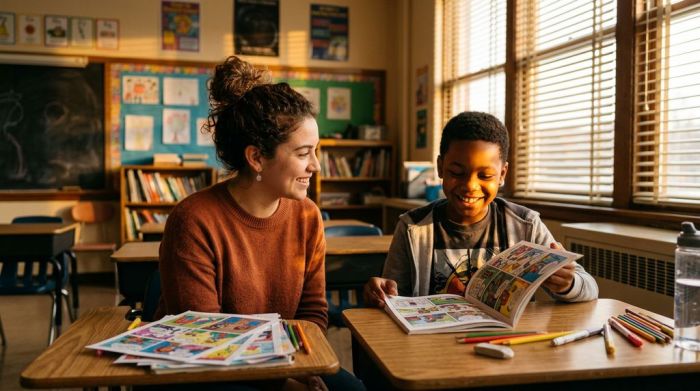
The classroom was quiet except for the hum of the old radiator and the distant sound of traffic on North Avenue. The afternoon sun slanted through the blinds, casting striped shadows across the floor. Maya let the silence stretch, the way she had learned to do with difficult children. She did not lecture. She did not threaten. She just waited.
After twenty minutes, Elijah's stomach growled. Loudly.
Maya looked up. "Did you skip lunch again?"
He did not answer. But the mask slipped, just slightly. She saw a flicker of something in his eyes — shame, maybe, or fear.
She opened her desk drawer and pulled out a granola bar. She walked over to his desk and set it in front of him. "Eat," she said. "Can't have you passing out on me."
He looked at the granola bar like it might be poisoned. Then he picked it up, unwrapped it slowly, and took a bite. He ate the whole thing in about thirty seconds.
Maya did not say anything. She returned to her desk and continued grading papers. When she looked up again, Elijah had opened his spiral notebook and was drawing. She caught a glimpse of it — a superhero, cape flowing, fist raised to the sky. Underneath, in careful letters, he had written: "Protector of the Lost."
Maya felt something click into place.
"Elijah," she said, her voice soft, "I didn't know you could draw like that."
He slammed the notebook shut, his eyes wide. "It's nothing."
"Can I see it?"
"No."
"Please?"
He stared at her, trying to read her intentions. She held his gaze, letting him see that she was not mocking him, not trying to catch him doing something wrong. She was just curious.
Slowly, reluctantly, he opened the notebook and slid it across the desk.
Maya looked at the drawings. Page after page of superheroes — flying, fighting, protecting. But the details told a deeper story. In every drawing, the superhero was protecting someone small. A child. A girl with pigtails. The same girl, over and over. And in every drawing, the superhero had the same face — a young face, a tired face, a face that looked a lot like Elijah's.
"Who's the little girl?" Maya asked.
Elijah looked down at his hands. "My sister. Kendra. She's six."
"Does she like your drawings?"
He nodded, a small, quick nod. "She says I'm her hero."
Maya felt her throat tighten. She turned to a blank page in the notebook, picked up a pencil, and drew a simple star. "Do you know what makes a real hero, Elijah?"
He shook his head.
"A real hero is someone who keeps going even when things are hard. Someone who protects the people they love, even when no one is watching. Someone who draws pictures of superheroes because they are trying to be one themselves." She slid the notebook back to him. "You are a hero, Elijah. You just don't see it yet."
That was the beginning.
The next week, Maya stopped by a bookstore and bought a pack of blank comic books — the kind with empty panels, waiting for stories to be told. She left them on Elijah's desk with a note: "For the next great comic book artist. — Ms. Torres"
He pretended not to care. But the next day, the comic books were gone from his desk, and Maya spotted the corner of one sticking out of his backpack.
Over the next few weeks, something remarkable happened. Elijah started trying. Not dramatically — not with grand gestures or sudden transformations. But in small ways. He raised his hand in class once. He turned in a homework assignment for the first time all year. He did not get sent to the principal's office for an entire month.
And he drew. Every day, he drew. Maya would find pages on her desk — sketches of superheroes, of cityscapes, of a little girl with pigtails being lifted into the sky by a caped figure. The drawings got better. The stories got longer. The characters got names and backstories and motives.
One afternoon in November, Elijah stayed after school without being asked. He walked up to Maya's desk and placed a completed comic book in front of her. It was eight pages long, hand-drawn, with dialogue bubbles and a cover that said: "The Guardian of the Lost: Issue #1."
"It's about a kid who finds out he can fly," Elijah said, his voice barely above a whisper. "He uses it to protect kids who don't have anyone else."
Maya read the comic right there, at her desk. It was not perfect. The drawings were rough, the story simple. But it was real. It was honest. It was a ten-year-old boy telling the world exactly what he wished someone would do for him.
"Elijah," she said, looking up with tears in her eyes, "this is the best thing a student has ever given me."
His face broke into a smile — a real smile, the first one she had seen in four months. "You really think so?"
"I know so. And I think other people should see it too."
That weekend, Maya drove to the local library and asked about writing contests for young artists. The librarian, a kind woman named Mrs. Chen, told her about the annual Maryland Young Authors Contest — a statewide competition that accepted graphic novels and comic books. The deadline was three weeks away.
Maya called Elijah's mother that evening. It was the first time they had spoken directly, and the conversation lasted an hour. Sharon Walker was exhausted — that was the first thing Maya noticed in her voice. She worked the night shift at an Amazon warehouse, from 7 PM to 5 AM, six nights a week. She came home, slept until Kendra left for school, and then tried to nap before picking them up at 3:30. She barely had time to breathe, let alone help with homework or attend parent-teacher conferences.
"I know Elijah's been having trouble," Sharon said, her voice cracking. "I know I'm not there enough. But I'm trying, Ms. Torres. I'm trying so hard."
"I know you are," Maya said. "And I'm not calling to judge you. I'm calling because your son is incredibly talented. He has a gift. And I want to help him share it with the world."
There was a long silence on the other end of the line. When Sharon spoke again, her voice was thick with tears. "No one has ever said that about my son before."
The three weeks that followed were a whirlwind. Maya stayed after school with Elijah every single day, helping him refine his comic book. She taught him about panel layouts and dialogue pacing. She showed him how to use shading to create depth. She helped him edit his story without changing his voice. He worked with a focus she had never seen in him — staying until 5 PM, sometimes 6 PM, drawing until his hand cramped.
Sharon started coming to pick him up. At first, she waited in the car. Then she started coming to the door. Then she started coming inside, sitting in the back of the classroom, watching her son draw with a look of wonder that Maya would never forget.
The comic was twenty-four pages when they finally printed it. Elijah had titled it "The Guardian of the Lost: The Boy Who Learned to Fly." It told the story of a ten-year-old boy named Marcus who discovers he can fly, but only when he is protecting someone he loves. The villain was not a monster or a supervillain — it was loneliness. And Marcus defeated it not with his fists, but by finding other lost children and showing them they were not alone.
Maya mailed the entry on December 1st, the day of the deadline. She did not tell Elijah about the contest. She did not want him to be disappointed if he did not win. She just told him she had sent his comic to "some people who might like it."
Three weeks later, on the last day of school before winter break, Maya's phone rang during her planning period. She almost did not answer.
"Ms. Torres?" The voice on the other end was bright, excited. "This is Diane from the Maryland Young Authors Committee. I'm calling because Elijah Walker's entry — 'The Guardian of the Lost' — has won first place in the elementary division."
Maya's hand flew to her mouth. "Are you serious?"
"Very serious. The judges were blown away. They said it was the most emotionally mature submission they had seen in years. We'd like to invite Elijah and his family to the awards ceremony in January. And we'd like to publish his comic in our annual anthology."
Maya did not tell Elijah right away. She waited until the last bell rang, until the classroom was empty, until he was packing his backpack — slowly, the way he did everything, as if he was in no hurry to go home because there was nothing waiting for him there.
"Elijah," she said, "I have something to tell you."
He looked up, his guard immediately up. "What did I do?"
"Nothing. You didn't do anything wrong." She walked over to his desk and knelt down beside him. "Do you remember the comic you made? The one I told you I would send to some people?"
He nodded, wary.
"Elijah, you won. First place. The whole state."
He stared at her. His mouth opened. Closed. Opened again. "You're lying."
"I'm not lying. I just got the call. They want to publish your comic, Elijah. They want to put it in a book."
His face crumpled. The tough mask, the sullen defiance, the wall he had built around himself — it all came down at once. He buried his face in his hands and sobbed. Maya put her arms around him and held him, the way she wished someone had held her when she was ten years old and struggling, when her own brother was slipping away and she did not know how to save him.
"You did this, Ms. Torres," he said into her shoulder, his voice muffled. "You believed in me."
"No, Elijah. I just saw what was already there."
The awards ceremony was held on a Saturday in January, at the Enoch Pratt Free Library in downtown Baltimore. Elijah wore a suit that Sharon had bought from a thrift store — slightly too big in the shoulders, perfectly pressed. Kendra wore a yellow dress with a bow in her hair. Sharon stood in the back, crying before her son's name was even called.
When Elijah walked up to the stage to accept his award, he looked out at the audience — at Maya in the front row, at his mother in the back, at his sister waving from her seat — and he said three words into the microphone: "This is for Ms. Torres."
The place erupted.
After the ceremony, Maya found Sharon standing alone by the refreshment table. They looked at each other, two women who had been fighting the same fight from opposite sides, finally seeing each other clearly.
"Thank you," Sharon said. "For seeing him. For not giving up."
Maya shook her head. "Your son is extraordinary, Sharon. He always was. He just needed someone to show him that the thing he was already doing — drawing, creating, protecting — that was his superpower all along."
Sharon hugged her, a fierce, grateful embrace. "I don't know how to repay you."
Maya hugged her back. "Take him to the library. Buy him more sketchbooks. Tell him you're proud of him every single day. That's all he needs."
That was two years ago.
Elijah Walker is in seventh grade now. He still gets into trouble sometimes — he is still a kid, still learning, still figuring out who he is. But he also gets A's in art. He is the illustrator for the school newspaper. He runs a comic book club that twelve kids attend every Thursday after school. And he is working on Issue #4 of "The Guardian of the Lost."
Sharon got a day shift. She said it took a winning comic book for her to realize that her son needed her presence more than he needed the extra money. She brings him to the library every Saturday. She has a folder of every drawing he has ever made.
Maya is still teaching at Booker T. Washington Elementary. She still stays after school with the kids who need it most. She has a new student this year — a quiet girl named Destiny who writes poetry in a spiral notebook and hides it when anyone gets close. Maya sits with her after school, reading her poems, telling her they are beautiful.
She learned from Elijah that the most important thing a teacher can do is not teach. It is to stay. To stay after the bell rings, after the other kids have gone home, after the world has given up. To sit beside a child who has been told they are unreachable and say, "I see you. I believe in you. And I am not going anywhere."
Because that is the truth about teaching. It is not about lesson plans or test scores or standards. It is about showing up, day after day, for children who have learned that adults do not stay. It is about being the one person who refuses to leave.
Elijah's comic — the original, hand-drawn, twenty-four-page version — hangs framed on Maya's classroom wall. Beneath it, in his careful handwriting, is a note that she reads every morning before the first bell rings:
"To Ms. Torres. Thank you for teaching me that the real superheroes don't wear capes. They stay after school. — Elijah"
If you ever wonder whether the small things you do matter — whether staying an extra hour, buying a pack of comic books, or saying "I believe in you" makes any difference — let Elijah's story be your answer. It does. It makes all the difference in the world.
Sometimes, the most powerful thing you can give a child is not advice or discipline or instruction. It is your presence. It is your stubborn, unwavering belief that they are worth fighting for. It is a seat beside them after everyone else has gone home, and the simple, sacred act of refusing to give up.
Maya Torres stayed after school. And a ten-year-old boy learned to fly.