Riley Adams was twenty-nine years old when she learned that some voices cannot be heard with ears. They have to be felt — in the vibration of a piano string, in the space between two notes, in the silence that speaks louder than any word.
She was the music teacher at Burlington Elementary, a K-5 school nestled between the shores of Lake Champlain and the Green Mountains of Vermont. The school was small, the kind where everyone knew everyone else's name, and the music room was Riley's sanctuary — a sunlit corner of the building filled with secondhand instruments, colorful posters of musical scales, and the particular kind of chaos that came from teaching a hundred children to find their rhythm.
Riley had long, dark hair she kept tied back in a messy bun, and she wore the same silver locket every day — a gift from her grandmother, who had taught her to play piano when she was six years old. She was young for a teacher, but there was a steadiness to her that made even the most chaotic fifth grader pause. She believed, with a stubbornness that bordered on religious, that every child had a song inside them. The trick was finding the right key.
Leo Fischer was eight years old, and he had not spoken a word in two years.
He had not spoken since the morning his mother died.
It happened on a Tuesday in October. Leo's mother, a nurse at the University of Vermont Medical Center, had been battling breast cancer for three years. She had gone through rounds of chemotherapy, radiation, and surgery, each one taking a piece of her until there was barely anything left. Leo had been at school when she passed — a seizure, the doctors said, sudden and final. His father, a carpenter named Dan Fischer, had picked him up from the office at 2:30 PM and told him in the car, his voice cracking like ice on a frozen lake.
Leo did not cry. He did not scream. He simply stopped speaking.
The first month, the doctors said it was trauma-induced mutism. It would pass. Give it time. The second month, they changed the diagnosis to selective mutism — a condition where the person is physically capable of speech but psychologically unable to produce it in certain situations. The third month, they stopped giving diagnoses and started giving referrals.
Two years passed. Leo saw therapists in Burlington, a specialist in Boston, a renowned child psychiatrist who wrote books and charged five hundred dollars an hour. Nothing worked. Leo communicated through nods, through written notes, through the occasional squeeze of his father's hand. But his voice — the voice that had once filled the Fischer household with questions and laughter and off-key renditions of songs from the radio — had gone silent.
Dan Fischer had stopped hoping.
It was Ms. Helen, the school secretary, who first noticed Leo lingering near the music room.
It happened on a cold Friday in February, three months into the school year. Leo had a habit of walking the hallways during his lunch break, his hands in the pockets of his hoodie, his eyes fixed on the floor. The other children had stopped trying to include him. The teachers had learned to accept his silence as a permanent feature of the classroom. But Ms. Helen, who had been a secretary at Burlington Elementary for thirty-four years, had not stopped watching.
She found him standing outside the music room door, his hand pressed flat against the wood, his eyes closed. He was not moving. He was just standing there, listening, as the muffled sounds of Riley's third-grade class singing drifted through the door.
Ms. Helen did not interrupt. She walked to the teachers' lounge, found Riley grading papers during her planning period, and told her what she had seen.
"The Fischer boy," Ms. Helen said. "He was at your door. Just standing there. I think he wanted to go in."
Riley looked up from the stack of worksheets. She knew the Fischer story. Everyone knew the Fischer story. It was the kind of tragedy that clung to a small school like fog, impossible to shake off.
"Has he ever shown interest in music?" Riley asked.
"Not that I know of. But then again, he hasn't shown interest in anything in two years."
That afternoon, Riley found Leo in the cafeteria, sitting alone at a table in the corner, pushing a tray of uneaten food in circles. She sat down across from him, the way she sat down across from every child she taught — open, patient, unafraid of the silence.
"Hi, Leo," she said. "My name is Miss Riley. I teach music. I heard you were standing outside my door today."
Leo did not look up.
"The door is always open," Riley said. "If you ever want to come in. If you ever want to just sit and listen. You don't have to say anything. You don't have to sing or play. You can just be there."
She slid a small piece of paper across the table toward him. On it, she had drawn a single musical note — a quarter note, simple and black. Beneath it, she had written: "This is the note that starts every song. It doesn't mean anything on its own. But when you add others, it becomes something beautiful."
Leo looked at the paper. He picked it up. He folded it carefully and put it in his pocket.
He did not speak.
But the next day, when Riley walked into the music room after school, she found Leo sitting on the floor beside the old upright piano in the corner. He was not playing. He was just sitting, his back against the piano's wooden frame, his eyes closed, as if he was listening to a song only he could hear.
Riley sat down on the floor beside him. She did not ask questions. She did not fill the silence with chatter. She simply sat, her back against the piano too, and closed her eyes. They stayed that way for ten minutes, two people connected by a broken instrument and the quiet understanding that some things did not need to be said.
The next day, Leo was there again. And the day after that. And the day after that.
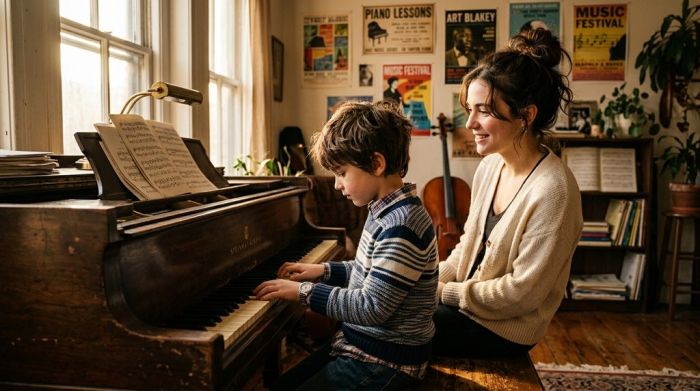
It became a ritual. Every afternoon, after the last bell rang, Leo would walk to the music room and sit beside the piano. And Riley would join him. She started bringing two cups of hot chocolate from the teachers' lounge. She started leaving the sheet music open on the piano, simple melodies — "Twinkle Twinkle Little Star," "Amazing Grace," a children's arrangement of Beethoven's "Ode to Joy." She never asked him to play. She never pushed.
On the ninth day, Leo reached out and touched a key.
It was middle C, the simplest note on the piano. He pressed it once, gently, and the sound rang through the empty music room like a bell. He pulled his hand back quickly, startled by the noise he had made. And then he looked at Riley with an expression she had never seen on his face before.
It was not happiness. It was not sadness. It was curiosity — the pure, unguarded curiosity of a child discovering something new.
Riley did not react. She did not applaud or encourage or make a big deal out of it. She simply lifted her own hand and pressed the same key. Middle C. The note hung in the air between them, a single thread of sound connecting two people across an impossible distance.
Then Leo pressed another key. An E. Then a G. A C major chord, played by accident, by instinct, by a boy who had not spoken a word in two years but who understood, somewhere deep in his bones, the language of harmony.
Riley felt her eyes sting with tears. She blinked them back. She did not want to scare him.
They played together in silence, note by note, for the next thirty minutes. Leo did not speak. But his fingers found the keys, and the keys found the melodies, and the melodies said everything his voice could not.
That was the beginning.
Over the next three months, something miraculous happened in the music room at Burlington Elementary. Leo started coming during lunch too, not just after school. Riley taught him the basics — scales, chords, the difference between major and minor keys. He learned with a speed that astonished her, as if the music had been living inside him all along, waiting for permission to come out.
He still did not speak. But he started nodding. He started making eye contact. He started tapping his foot to the rhythm of the songs Riley played.
And then, one Tuesday afternoon in May, he brought her a piece of paper.
On it was a hand-drawn staff, the lines slightly crooked, the notes placed with careful precision. It was a melody — simple, repetitive, but unmistakably complete. Riley studied it, humming the notes under her breath, and felt her heart stop.
"Leo," she said, "did you write this?"
He nodded.
"It's beautiful," she said. "What's it called?"
Leo looked at her for a long moment. He reached into his pocket and pulled out a small, folded piece of paper. It was the same paper Riley had given him on that first day in the cafeteria — the one with the quarter note and the message about beautiful songs.
He unfolded it. He pointed to the note. And then he pointed to himself.
Riley understood. This song was his first word.
"Can I play it?" she asked.
He nodded again.
Riley sat at the piano and played Leo's melody. It was hauntingly simple, a series of notes that climbed and fell like a question searching for an answer. When she finished, the room was silent except for the resonance of the final chord, fading into the afternoon light.
Leo walked to the piano. He placed his hands on the keys. And he began to play.
But this time, he did not play his own melody. He played the song his mother used to sing to him at bedtime — "You Are My Sunshine." He played it from memory, his small fingers finding the notes with a certainty that came from somewhere deeper than practice or instruction. He played it the way a boy plays when he is saying goodbye.
Riley sat beside him, her hand over her mouth, tears running freely down her face.
When he finished, Leo did not move. His hands stayed on the keys. His head was bowed. And then, in a voice so small and fragile that Riley almost thought she imagined it, he spoke.
"She used to sing that to me."
His voice was scratchy from disuse, barely above a whisper. But it was there. Two years of silence, broken by four words about a song.
Riley did not say anything. She put her arm around his shoulders, and they sat together in the quiet of the music room, the last rays of spring sunlight streaming through the windows, the piano still humming with the memory of the notes.
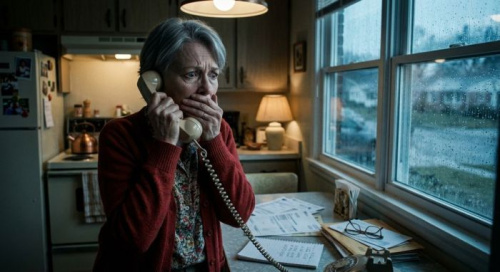
Dan Fischer cried for an hour when Riley called him that evening.
The spring concert was held on the first Thursday of June, in the school gymnasium. The bleachers were filled with parents, grandparents, siblings, and teachers. There were paper flowers taped to the walls and a banner that read "Burlington Elementary Spring Concert" in hand-painted letters.
The third graders performed a recorder medley. The fifth graders sang a pop song from the radio. There were a few off-key notes, a forgotten lyric, a bow that fell off a cello mid-performance. It was exactly what a school concert should be — imperfect, joyful, alive.
And then, at the very end, Riley walked to the microphone.
"Before we close tonight," she said, "there is one more performance. One of our students has been working on something special. He has been working on it for a long time. And I want you to know that what you are about to hear is more than just music. It is a voice that has been waiting a very long time to be heard."
She stepped aside. And Leo Fischer walked onto the stage.
He was wearing a plain white shirt and dark pants. His hair had been combed neatly, and he was holding a single piece of sheet music in his trembling hands. The audience shifted, recognizing him, understanding that something significant was happening.
Leo sat at the piano. He placed his sheet music on the stand. And then, instead of looking at the notes, he closed his eyes.
He began to play.
It was the melody he had written — the one Riley had played in the music room that Tuesday afternoon. But at the end, he added something new. A section he had been working on in secret, note by note, day by day. It started quiet, almost hesitant, and then grew into something full and bright — a crescendo that seemed to lift the entire room off its foundation.
And when the final chord faded, Leo opened his eyes.
He looked at the audience. He looked at Riley, standing in the wings, her hands clasped together, her face wet with tears. He looked at his father, sitting in the third row, his hand over his mouth, his shoulders shaking.
And Leo Fischer, who had not spoken a word in two years, leaned into the microphone and said, "That was for my mom."
The gymnasium erupted. Not in applause — not at first. In something louder. A collective gasp, a sob, a release of breath that the entire room had been holding for two years. And then the applause came, thunderous and sustained, rising to the rafters like a prayer answered.
Dan Fischer made it to the stage in four steps. He lifted his son off the piano bench and held him, the way he had held him on that terrible October afternoon two years ago, but different now. Lighter.
"I love you," Dan whispered into his son's hair. "I love you so much."
"I love you too, Dad," Leo said. His voice was still rough, still fragile. But it was his. It had always been his. It had just been waiting for the right key to unlock it.
Riley Adams still teaches music at Burlington Elementary. She is thirty-two now, and she still wears the silver locket her grandmother gave her. The music room still has the same old upright piano in the corner, slightly out of tune, its ivories yellowed with age.
But on the wall beside the piano, framed and mounted, is a piece of sheet music — hand-drawn on lined paper, the notes slightly crooked, the title written in a child's careful handwriting.
It says: "For Mom. By Leo Fischer."
And every year, on the first day of school, Riley tells the story to her new students. She tells them about the boy who stopped speaking, and the piano that helped him find his voice. She tells them that music is not just notes on a page — it is a language that speaks when words fail.
She tells them that every child has a song inside them.
And that her job, the most important job she will ever have, is to help them find the key.