Tyler Jackson had spent his entire life preparing for a moment that never came. At twenty-one years old, the starting quarterback for the University of Georgia Bulldogs had been named to every preseason All-American list worth mentioning. Scouts had him going in the first three rounds of the NFL draft. His face was on billboards across Athens, Georgia, his name spoken in the same breath as legends who had played in Sanford Stadium before him.
And then, on a humid Saturday afternoon in October, everything changed.
It was the third quarter against Auburn. Third and seven. Tyler dropped back, scanned the field, and saw his receiver break open across the middle. He planted his back foot and threw — a perfect spiral, the kind he had thrown ten thousand times since his father first taught him to grip a football at age six. But as he released the ball, a defensive end broke through the line and drove his shoulder into Tyler's knee from the blind side.
The pop was loud enough for the sideline to hear. Tyler went down, the ball already in the air, incomplete. The stadium went silent. He tried to stand, but his knee buckled sideways in a way that knees were not supposed to move. The pain came a second later, white-hot and nauseating, and Tyler Jackson screamed into the Georgia dirt as the medical staff ran onto the field.
Three torn ligaments. Two surgeries. One shattered dream.
The NFL scouts disappeared. The billboards came down. The scholarship that had paid for everything was honored, but the whispers followed him everywhere — wasted potential, what a shame, he could have been special.
Tyler spent the spring semester in a fog of physical therapy and depression. He lived in a rented house off Milledge Avenue with two teammates who did not know how to talk to him anymore. He stopped going to class. He stopped answering his mother's calls. He sat in the dark, replaying that third-and-seven play in his mind, imagining a thousand different outcomes in which his knee did not explode and his future did not disappear.
His father drove down from Atlanta one weekend in March. They sat on the porch of the rental house, two men who had built their entire relationship around football and now had nothing to say to each other.
"You're still here," his father said finally. "That means there's still a play to be made. You just haven't figured out what it is yet."
Tyler did not believe him. But his father's words lodged somewhere in his chest, a splinter of hope he could not quite dislodge.
The Unexpected Call
The call came on a Tuesday afternoon in April. Tyler was at the physical therapy clinic, working through the same exercises he had done a hundred times, when his phone buzzed. The number was local, unfamiliar. He almost let it go to voicemail, but something made him pick up.
"Tyler Jackson?" The voice on the other end was young, nervous. "My name is Coach Davis. I coach the Special Olympics football team here in Athens. We have a kid — a player — who is a huge fan of yours. His name is Marcus. He has Down syndrome. He watches your old game footage every single night."
Tyler did not know what to say. The mention of his old game footage felt like salt in a wound.
"I know you're not playing anymore," Coach Davis continued, "and I know it's a lot to ask. But Marcus's birthday is next week. He turned nineteen yesterday. He told his mom that the only thing he wanted for his birthday was to meet you. Just meet you. Shake your hand."
Tyler looked at his knee, wrapped in ice, still swollen, still broken. He looked at his reflection in the dark screen of his phone — a man who did not know who he was anymore. And he heard his father's voice: You're still here. That means there's still a play to be made.
"Yeah," Tyler said. "I can do that. Tell me where and when."
The Meeting That Changed Everything
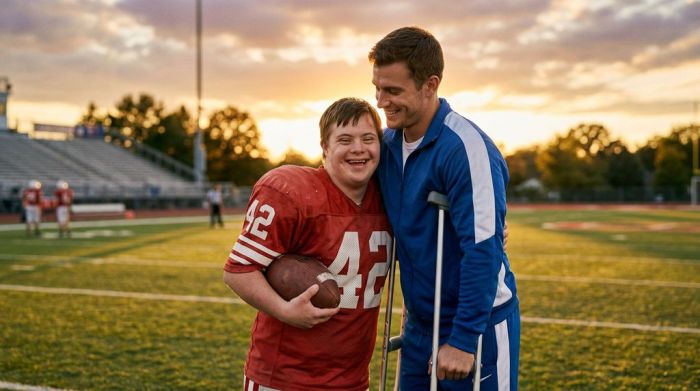
Marcus Williams was nineteen years old, five feet three inches tall, and had more joy in his pinky finger than Tyler had felt in his entire body over the past six months. He met Tyler at the Special Olympics practice field — a small, neglected patch of grass behind the county rec center — wearing a Georgia Bulldogs jersey with Tyler's old number on it. The jersey was faded, the number starting to peel off, but Marcus wore it like it was made of gold.
When Tyler stepped out of his truck, Marcus's face broke into a smile so wide and so bright that Tyler felt something crack open in his chest.
"TYLER JACKSON!" Marcus shouted, running across the field with his arms open. Tyler did not know what to do. He had not been hugged by a stranger since he was a child. But before he could think about it, Marcus had wrapped his arms around him and squeezed with a strength that belied his small frame.
"I watched your game against Auburn," Marcus said, pulling back, his eyes shining. "The one where you threw for four hundred yards. You were amazing. You were the best quarterback I ever saw."
Tyler felt the words hit him like a punch. "That was a long time ago, buddy."
"It doesn't matter," Marcus said, his voice suddenly serious. "You're still Tyler Jackson. You're still a quarterback. Once a quarterback, always a quarterback."
Coach Davis approached, a middle-aged man with a kind face and hands that looked like they had coached a thousand games. "Marcus has been practicing all week," he said. "He wants to show you his spiral."
Tyler looked at Marcus, at the faded jersey, at the earnest hope in his eyes. And for the first time in six months, he felt something other than despair.
"Alright, Marcus," Tyler said. "Show me what you got."
Marcus picked up a football — a worn, deflated thing that had seen better days — and dropped back the way he had seen Tyler do in a hundred game films. His form was terrible. His elbow was too low, his feet were not set, his release was all wrong. But when he threw the ball, it spiraled through the air — wobbly, imperfect, but a spiral nonetheless — and landed in Coach Davis's hands ten yards away.
Marcus turned to Tyler, breathless. "Did you see that? Did you see?"
Tyler looked at Marcus's face, at the pure, unfiltered joy of a young man who had just done something he was proud of. And he felt the tears come before he could stop them. "I saw it, Marcus. That was a beautiful spiral."
"Can you teach me more?" Marcus asked. "Can you teach me to throw like you?"
Tyler looked at his knee. He looked at the crutches leaning against his truck. He looked at the field — the ragged grass, the faded lines, the goalposts that were slightly crooked. And he made a decision that would change his life.
"I can't run with you yet," Tyler said. "But I can teach you everything I know about throwing a football. If you want to learn."
Marcus's answer was another hug, even tighter than the first.
A Season of Discovery
That was the beginning. Tyler started coming to the Special Olympics practices twice a week, then three times, then every single day. He taught Marcus how to grip the ball, how to set his feet, how to follow through. He taught the other athletes too — a dozen young men and women with disabilities who had been told their whole lives that they could not do things, and who showed up every single day to prove everyone wrong.
He learned their names, their stories, their dreams. There was Sarah, who had cerebral palsy and the most accurate short pass on the team. There was David, who was autistic and could recite every Georgia Bulldogs statistic from the past twenty years. There was Jasmine, who was blind in one eye and could read a defense better than most college quarterbacks Tyler had played against.
And there was Marcus, who had Down syndrome and a heart so big that Tyler sometimes felt like he was the one being taught.
One afternoon, after practice, Marcus sat next to Tyler on the bleachers. The sun was setting over the rec center, painting the sky in shades of orange and pink. Marcus was quiet for a long time, which was unusual for him.
"Tyler," he said finally, "are you sad that you can't play anymore?"
Tyler considered the question. Six months ago, it would have broken him. But sitting there, on those old wooden bleachers, watching the sunset with a kid who had never given up on anything, he realized the answer had changed.
"I was sad," Tyler said slowly. "I was really sad for a long time. I thought my life was over when I got hurt. I thought I had lost everything that mattered."
"But you didn't," Marcus said.
"No," Tyler said, putting his arm around Marcus's shoulders. "I didn't. I found something better."
"What? What did you find?"
Tyler smiled, the first real smile he had worn in months. "I found out that being a quarterback is not about throwing touchdowns. It is about showing up for your team. It is about believing in people when they do not believe in themselves. And you, Marcus Williams, have taught me more about being a quarterback than I learned in ten years of playing."
Marcus thought about this for a moment. Then he leaned his head against Tyler's shoulder and said, "You're my hero, Tyler. You always will be."
The Game of His Life
The Special Olympics state championship was held on a Saturday in June, at a high school stadium thirty miles outside of Athens. The stands were not full — a few hundred parents, siblings, and volunteers. There were no scouts, no cameras, no billboards. But to Tyler Jackson, it was the most important game he had ever been part of.
He had been named an assistant coach a month earlier. Coach Davis had insisted. "You have a gift, Tyler," he had said. "These kids trust you. They play harder for you than they play for anyone."
Marcus was the starting quarterback. He had worked harder than anyone Tyler had ever seen, practicing until his arm was sore, studying the plays until he knew them by heart. He was not the most talented player on the field. He was not the fastest or the strongest. But he was the one who never gave up, the one who picked up his teammates when they fell, the one who cheered louder for others than he cheered for himself.
The game was close. With two minutes left, Marcus's team was down by four points. They had the ball on their own thirty-yard line. Coach Davis looked at Tyler. "You call the plays," he said.
Tyler knelt beside Marcus on the sideline. The noise of the crowd faded away. It was just the two of them, a quarterback and his coach, the same way Tyler had stood with his own coaches a thousand times.
"Marcus," Tyler said, "this is your drive. This is the moment you have been preparing for. I need you to trust yourself the way I trust you. Can you do that?"
Marcus looked at him, his eyes bright with tears and determination. "I can do it, Coach Tyler."
"I know you can."
Marcus led his team down the field. He completed three passes in a row, each one better than the last. He scrambled for a first down when the pocket collapsed, his small legs churning, refusing to go down. And with fifteen seconds left on the clock, facing fourth and goal from the eight-yard line, he dropped back and threw the ball toward the end zone.
The spiral was perfect.
The receiver caught it in the back corner, toes dragging against the turf. Touchdown.
The crowd erupted. Marcus's teammates mobbed him, a pile of joy and sweat and tears. And Tyler stood on the sideline, his crutches forgotten, tears streaming down his face, watching a young man who had been told his whole life that he could not do things do the thing he loved most in the world.
Marcus broke free from the pile and ran straight toward Tyler. He jumped into his arms, and Tyler caught him, his knee screaming in protest, not caring at all.
"We did it, Tyler!" Marcus shouted, his voice raw with emotion. "WE DID IT!"
"You did it, Marcus," Tyler said, holding him tight. "You did it."
The Epilogue
Tyler Jackson never played another down of college football. His knee never fully recovered, and the NFL dream died quietly, replaced by something he had never expected to find.
He is twenty-four years old now. He is the head coach of the Athens Special Olympics football team. He works part-time at a sports equipment store and spends the rest of his time on that ragged field behind the county rec center, teaching young athletes with disabilities how to throw spirals and believe in themselves.
Marcus Williams is twenty-two. He works at a grocery store in Athens, bagging groceries with a smile that makes every customer's day better. He still plays football every season. And every season, Tyler is there on the sideline, calling plays, believing in him.
Last fall, Tyler received a letter from an NFL scout — the same scout who had stopped returning his calls three years ago. It said there was an opening for a quarterback coach at a Division III school in Ohio. The pay was modest. The hours were long. But it was a foot in the door.
Tyler read the letter twice. Then he folded it carefully, placed it in a drawer, and drove to practice. Marcus was waiting for him, holding a worn football, his faded Georgia jersey hanging loose on his shoulders.
"What's the play today, Coach?" Marcus asked.
Tyler looked at Marcus, at the field, at the sunset painting the sky in shades of gold. He had spent his whole life preparing for a moment that never came. But he had found something better than the moment he had prepared for. He had found a purpose that did not depend on his knee or his draft stock or the roar of a stadium full of strangers.
He had found his team.
"Same play as always, Marcus," Tyler said, clapping him on the shoulder. "We show up. We work hard. We believe in each other. And we throw the best damn spirals this county has ever seen."
Because that is the truth about dreams. Sometimes they do not come true the way you planned. Sometimes they break apart in front of you, leaving you on the ground with a knee that does not work and a future that looks like a dead end. But if you are willing to look up, if you are willing to show up on a ragged field behind a rec center, if you are willing to let a young man with Down syndrome teach you what it really means to be a quarterback — you will discover that the dream you lost was never the dream you were meant to have.
The real dream was waiting for you all along.
It was just wearing a faded jersey and a smile that could light up the whole world.