David Park never expected to find a daughter through a text message sent to the wrong number. But that is exactly what happened on a cold November evening in San Jose, California, when a teenage girl named Jade accidentally texted him thinking he was the father who had walked out on her ten years ago.
David was forty-nine years old, a senior accountant at a firm in downtown San Jose. He had been divorced for three years, and his own daughter, Emily, was a sophomore at UC Davis who returned his calls about once every two weeks. He lived alone in a two-bedroom condo that felt too big for one person, ate frozen dinners most nights, and had reached the age where he had stopped expecting surprises from life.
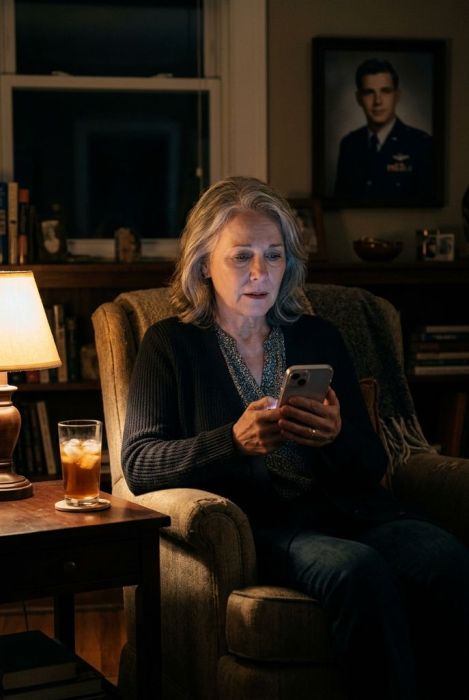
The text came at 8:47 PM on a Tuesday. He was watching a documentary about deep-sea creatures, half-asleep on his couch, when his phone buzzed. The number was unfamiliar, a 408 area code he did not recognize. The message read: "Hey Dad. It's Jade. I know we haven't talked in a long time. But I really need someone to talk to right now. Can you call me?"
David stared at the message for a long time. He was not Jade's father. He had never met Jade. He did not know a Jade. But someone out there — a teenage girl — had just reached out to the man she thought was her father, and she was hurting. He could feel it in the words. That desperate, cautious hope that maybe this time, he would answer.
He could have ignored it. He could have texted back "Wrong number" and gone back to his documentary. But he thought about his own daughter, Emily, and the last time she had called him — three weeks ago, a five-minute conversation about her midterms that had ended with her saying, "I have to go, Dad. Study group." He thought about how much it would mean to him if Emily reached out when she needed someone. And he thought about Jade, alone somewhere, texting a number she had probably been holding onto for years, hoping for a response that never came.
He typed back: "Hi Jade. This isn't your dad. My name is David. I'm sorry you're hurting. But if you need someone to talk to, I'm here to listen."
He almost deleted it three times before hitting send. When the message went through, he set the phone down and stared at the ceiling, wondering if he had just made a terrible mistake. The reply came thirty seconds later: "Oh my god. I'm so sorry. I must have typed the wrong number. I'm so embarrassed."
David smiled. He typed back: "No need to apologize. I've dialed the wrong number plenty of times. Are you okay?"
There was a long pause. Then: "Not really. But it's okay. I didn't mean to bother you."
"You're not bothering me. I was just watching a documentary about fish. You're way more interesting than fish."
That was how it started. A wrong-number text, a lonely man who decided to stay on the line, and a teenage girl who needed someone — anyone — to tell her that she mattered. Over the following weeks, David and Jade developed an unlikely friendship conducted entirely through text messages. He learned that she was sixteen years old, a junior at a high school in South San Jose. She lived with her mother, who worked as a home health aide and was rarely home before eight. Her father had left when she was six, and she had not heard from him since her eighth birthday, when a card arrived with twenty dollars and a return address in Arizona. She had tried calling the number years later. It was disconnected.
David did not tell her what to do. He did not lecture her about grades or boys or the importance of eating vegetables. He listened. He asked questions. He shared stories about his own daughter, about the mistakes he had made as a father, about the things he wished he had done differently. He told her about the divorce, about the loneliness of living alone, about the frozen dinners that were starting to taste like cardboard.
Jade started texting him every day. Good morning texts. Good night texts. Updates about her chemistry test (she got a B-), her fight with her best friend (they made up), the stray cat that had been hanging around her back porch (she named it Mr. Whiskers). David found himself looking forward to her messages the way he used to look forward to coming home to his family. He started making extra food on weekends, packing it in containers, leaving it on his porch for her to pick up after school. She sent him a photograph of herself holding the container, a rare selfie, with a caption that said: "Best lasagna I've ever had. You sure you're not Italian?"
He was Korean-American. He had never made lasagna before in his life. He had looked up a recipe online and spent four hours making it from scratch. But he did not tell her that.
Three months into their friendship, Jade sent a text that made David's heart stop: "I want to meet you. For real. There's a coffee shop on Bascom Avenue called The Grind. Saturday at 2 PM. Please say yes."
David sat on his couch, staring at the message, his hands trembling. He had known this moment would come. He had been dreading it and hoping for it in equal measure. He was not her father. He was a stranger who had accidentally become a confidant. What if she was disappointed? What if the real thing could not live up to the voice in her phone? What if he said the wrong thing, looked the wrong way, and broke the fragile trust they had built over hundreds of text messages?
He typed back: "I'll be there. But Jade — I need you to know something. I'm not your father. I never wanted to pretend to be him. I just wanted to be someone you could count on."
Her reply came quickly: "I know you're not my real dad. But you're the one who showed up. That's what makes a father, isn't it?"
David arrived at The Grind at 1:45 PM on Saturday. He ordered a black coffee he did not drink and sat at a table by the window, watching the door. He was nervous in a way he had not been nervous since his first date with his ex-wife. He checked his phone seventeen times. He rehearsed opening lines in his head and discarded each one.
At 2:03 PM, the door opened, and Jade walked in.
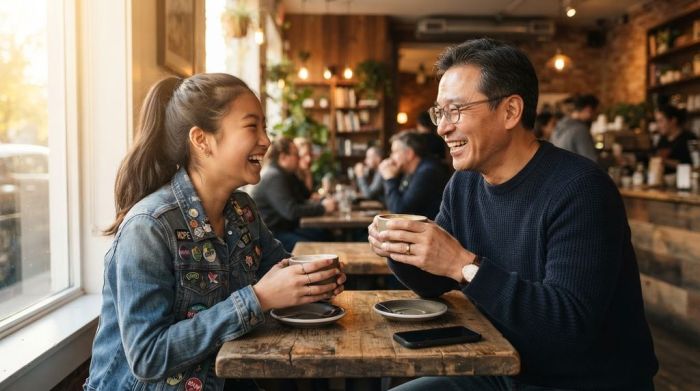
She was shorter than he had imagined, with dark hair pulled into a ponytail and a denim jacket covered in patches. She looked around the coffee shop, her eyes landing on him, and for a moment, neither of them moved. Then she walked over to his table, set down her backpack, and sat across from him.
"You're David," she said. It was not a question.
"I'm David." He smiled, a nervous, uncertain smile. "You're Jade."
"I'm Jade." She was quiet for a moment, studying his face. "You look exactly like I imagined."
"Is that good or bad?"
"Good. You look like someone who makes lasagna for strangers."
He laughed, and she laughed, and the tension that had been building for months dissolved into something warm and ordinary and real. They talked for three hours that day. She told him about her mother's cancer scare last year (she was fine now, but Jade had been terrified). He told her about Emily, about the distance between them, about the guilt he carried for not being a better father. She told him that she had stopped looking for her biological father. She did not need him anymore.
"I found someone better," she said, looking at David across the table. "I found someone who chose me."
David felt his eyes sting. He blinked back the tears. "I didn't choose you because I felt sorry for you, Jade. I chose you because you reminded me that I still had something to give. You gave me a reason to look at my phone in the morning. You gave me a reason to care about someone other than myself."
She reached across the table and took his hand. "Then we chose each other."
That was eight months ago.
David Park is fifty years old now. He still works as an accountant, but he no longer eats frozen dinners. Jade comes over every Sunday for dinner, and he has learned to cook a dozen new dishes — Korean barbecue, enchiladas, a lemon chicken recipe that Jade's mother taught him over the phone. Emily came home for spring break and met Jade. They were awkward at first, two young women who shared a father in different ways. But by the end of the week, they were staying up late watching movies together, and Emily told David, "She's kind of like the sister I never had." He cried that night, alone in his room, the way he had cried when Emily was born.
Jade's mother, a woman named Rosa, invited David to Thanksgiving dinner. He sat at a table filled with people he had never met, and Rosa raised a glass and said, "To David — the man who answered a wrong number and gave my daughter a father." The table cheered. Jade hugged him. And David, who had spent three years believing that his best days were behind him, realized that his best days were just beginning.
Last week, Jade sent him a text that said: "I got accepted to San Jose State. I'm going to college. I'm going to be the first person in my family to graduate."
David called her immediately, something he rarely did because he knew she preferred texting. When she answered, he said, "I am so proud of you, Jade. I have never been more proud of anyone in my life."
There was a long pause on the other end. Then, in a voice thick with tears, Jade said, "Thanks, Dad."
David sat down on his couch, the phone pressed to his ear, tears streaming down his face. It was the first time she had called him that. It was the most beautiful word he had ever heard.
Somewhere in San Jose, a teenage girl is getting ready for college. She has a denim jacket covered in patches, a stray cat named Mr. Whiskers, and a father who found her through a wrong-number text. She has a Korean-American accountant who makes lasagna from scratch and cries at graduation announcements. She has a family that was not born, but chosen — one text message at a time.
Because that is the truth about family. It is not about blood. It is not about biology. It is about who shows up when you need them most. It is about a wrong number that turned out to be exactly right. It is about a man who answered a desperate text from a stranger and discovered that the daughter he had been looking for had been on the other end of the line all along.
Sometimes, the family we choose is the one that saves us. David Park chose to answer. Jade chose to trust. And together, they proved that the most meaningful connections often begin with the smallest gestures — a lasagna made from scratch, a coffee shop meeting, a text message sent to the wrong number that led both of them exactly where they needed to go.