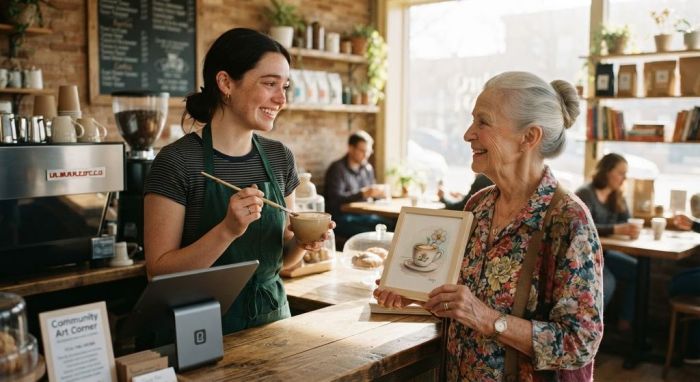
Audrey Morales never expected to find a mentor in a woman who ordered the same black tea every afternoon. But that is exactly what happened on a rainy Tuesday in October, when a silver-haired stranger walked into Brew & Bean on the corner of Elm and Maple in Columbus, Ohio, and changed everything.
Audrey was twenty-two years old, a barista at a small coffee shop that smelled like cinnamon and old books. She had been working there for two years, saving every penny for art school tuition she could barely afford. She lived in a studio apartment above a laundromat, ate a lot of ramen, and had not picked up a paintbrush in six months because she was too exhausted to create anything beautiful.
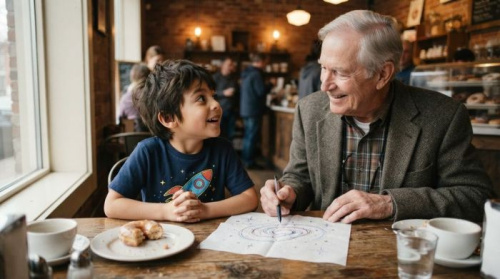
The woman walked in at exactly 2:47 PM, shaking rain from her umbrella, wearing a pale blue cardigan and sensible shoes. She ordered a cup of Earl Grey tea — no sugar, no milk — and found a seat by the window. She did not read a book or scroll through a phone. She simply sat, watching the rain trace patterns on the glass, her hands wrapped around the warm cup as if she were holding something precious.
Her name was Margaret Holloway. She was seventy-two years old, a retired librarian who had been widowed for eight years. She came to Brew & Bean every Tuesday and Thursday at exactly the same time, ordered the same tea, sat in the same chair by the window. And every time, Audrey noticed something about her hands. They were elegant, with long fingers that moved with a grace most people lacked. They were the hands of an artist.
Audrey did not know why she noticed those hands. She just knew that they reminded her of something she had been trying to forget — the feeling of a brush in her own hand, the smell of turpentine and linseed oil, the quiet joy of watching a blank canvas turn into something that had never existed before.
The Question That Started Everything
On the fourth Tuesday, Audrey brought Margaret her tea and did not walk away. She stood at the table, wiping her hands on her apron, and asked a question that surprised even herself.
"Excuse me, ma'am," she said. "This is going to sound strange. But did you used to be an artist?"
Margaret looked up at her with pale blue eyes that held a lifetime of stories. She did not look surprised by the question. She looked like she had been waiting for someone to ask it.
"How did you know?" Margaret asked quietly.
"Your hands," Audrey said. "The way you hold your cup. The way you move your fingers when you're thinking. My grandmother had hands like that. She was a painter too."
Margaret set down her cup. She looked at her own hands, turning them over as if seeing them for the first time. "It has been sixty years since I held a paintbrush properly," she said. "I was twelve years old the last time I painted something that mattered."
"Sixty years?" Audrey sat down across from her, pulled by a force she could not name. "Why did you stop?"
Margaret smiled, a sad, knowing smile. "Life happened. I got married. I had children. I became a librarian. I told myself I would paint again when I had time. But time kept moving, and the paints dried up, and the canvases sat in a closet until I finally gave them away." She paused. "And then my husband passed away, and I realized I had spent fifty years being everything except what I was meant to be."
The Canvas That Had Been Waiting
That evening, Audrey could not stop thinking about Margaret. She lay in her studio apartment, staring at the water stain on the ceiling, thinking about the woman who had put down her paintbrush at twelve years old and never picked it up again. She thought about her own paints, sitting in a box under her bed, untouched for six months. She thought about all the excuses she had made — too tired, too busy, too scared of failing.
The next morning, Audrey brought a small canvas to work. She set it on the counter behind the register, where customers could see it but not touch it. She did not paint on it. She just placed it there, a blank rectangle of possibility, a silent invitation.
Margaret noticed it the moment she walked in. Her eyes went to the canvas before she even reached the counter. "What's that for?" she asked.
"I'm not sure yet," Audrey said. "I thought maybe someone should use it."
Margaret stared at the canvas for a long moment, and Audrey saw something flicker in her eyes — something that looked like hunger. The next Thursday, Margaret brought a small watercolor set in a worn metal case. She did not say anything about it. She simply sat at her table by the window, opened the case, and began to paint.
Audrey watched from behind the counter, her heart pounding. Margaret's hands moved with the confidence of someone who had been born to create. She painted the view from the window — the rain, the street, the bare trees bending in the wind. It was not perfect. The proportions were slightly off, and the colors were a little muddy. But it was alive. It was real. It was a woman rediscovering a part of herself she had buried for sixty years.
The Friendship That Grew
Over the following weeks, Margaret and Audrey developed a ritual. Every Tuesday and Thursday, Margaret arrived with her watercolor set and painted the view from the window. Audrey started bringing her own paints to work, and during her breaks, she would sit across from Margaret and paint too. They did not talk much. They did not need to. The silence between them was filled with the scratch of brushes and the quiet joy of creating.
Customers started noticing. Some of them asked to buy Margaret's paintings. She refused at first, embarrassed by her own work. But Audrey insisted. "Your art deserves to be seen," she said. "You cannot keep hiding it in a coffee shop."
Margaret sold her first painting to a young mother who had been watching her paint for weeks. It was a small watercolor of the coffee shop at sunset, the light falling across the empty tables. The woman paid fifty dollars and hung it in her kitchen. Margaret cried when she handed it over. "I never thought I would sell a painting," she whispered. "I never thought anyone would want something I made."
The Exhibition That Changed Both of Them
Audrey had been saving for art school for two years. She had three thousand dollars in a shoebox under her bed — not enough for tuition, but enough for a down payment on a future she was not sure would ever arrive. But watching Margaret paint, watching the joy return to her eyes, watching a woman who had spent sixty years hiding her gift finally share it with the world — it made Audrey realize that she had been hiding too. She had been waiting for permission to be an artist. And she had been waiting for someone to tell her that her work mattered.
In February, Audrey organized an art show at the coffee shop. She called it "The Second Canvas." She hung Margaret's watercolors on the walls — thirty of them, spanning the months they had spent painting together. And she hung her own work beside them — the paintings she had been too afraid to show anyone, the ones she had kept hidden in the box under her bed.
The coffee shop was packed on the night of the show. Families, neighbors, strangers who had heard about the elderly woman who had started painting again. Margaret wore her best dress — a deep burgundy that brought out the color in her cheeks. She stood in the corner, holding a cup of tea, watching people look at her work with expressions of wonder.
A man approached her — a gallery owner from the Short North Arts District in Columbus. He introduced himself and asked if she would consider a solo exhibition at his gallery. Margaret looked at him, then at Audrey, then at the walls covered in her work. "I am seventy-two years old," she said. "I do not have time to be afraid anymore." She said yes.
At the end of the night, when the last客人 had left and the coffee shop was quiet, Audrey found Margaret sitting at their usual table by the window. The paintings were still on the walls. The street outside was empty. The city was asleep.
"I never told you the whole truth," Margaret said softly. "The reason I stopped painting at twelve years old."
Audrey sat down across from her. "What was it?"
"My mother died that year. She was my biggest supporter. She was the one who bought me my first paint set, who hung my drawings on the refrigerator, who told me I was going to be a famous artist someday. When she passed away, I stopped painting because painting reminded me of her. And I was too young to understand that the pain would eventually become something else." She looked at Audrey, her eyes bright with unshed tears. "I thought I had lost my mother. But I had lost my courage along with her."
Audrey reached across the table and took Margaret's hand. "You found it again," she said. "You found it because you were brave enough to walk into a coffee shop and sit by a window. Brave enough to open a watercolor set. Brave enough to sell your first painting. Brave enough to let a stranger see your work."
"No," Margaret said, squeezing her hand. "I found it because a young barista asked me if I used to be an artist. She saw something in me that I had forgotten was there. She gave me permission to be who I was always meant to be."
Epilogue: What Happened Next
Margaret's solo exhibition opened in April. It was called "Sixty Years Later" — a collection of watercolors that spanned her rediscovered journey. It sold out on the first night. She donated half the proceeds to a scholarship fund for young artists at the Columbus College of Art & Design. The other half she gave to Audrey.
"Use it for tuition," Margaret said, pressing the envelope into Audrey's hands. "You gave me back my life. The least I can do is help you build yours."
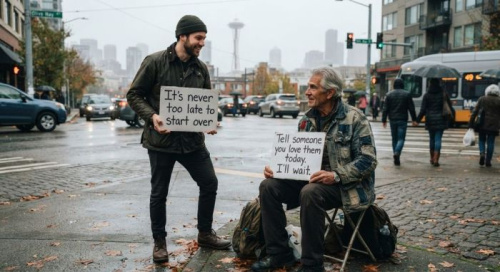
Audrey enrolled at CCAD the following fall. She studied fine arts, and she graduated with honors three years later. Today, she runs a small art studio in the Short North district, two blocks from the gallery that hosted Margaret's first show. She teaches painting classes to children and adults. She tells all her students the same thing: "It is never too late to start. The paint will wait for you. The canvas will be there. All you have to do is show up."
Margaret Holloway is seventy-six now. She has had three solo exhibitions. Her paintings hang in homes across Ohio, in coffee shops and living rooms and the occasional corporate lobby. She still comes to Brew & Bean every Tuesday and Thursday, but now she brings a larger watercolor set and a sketchbook filled with ideas. She sits by the window. She paints the changing seasons, the faces of strangers, the light that falls across the tables at different hours of the day. And she thinks about the young barista who changed her life with a single question.
The Paintbrush That Never Really Left Her Hand
There is a photograph that hangs on the wall of Brew & Bean, framed and preserved like a sacred relic. It shows two women sitting across from each other at a table by the window. One is young, with paint-stained fingers and a smile that suggests she is exactly where she is supposed to be. The other is older, with silver hair and a watercolor set open in front of her, her hands moving with the grace of someone who has finally remembered how to fly.
They are not related by blood. They are not teacher and student, not grandmother and granddaughter. They are something rarer — two people who found each other at exactly the right moment, when one needed to remember her gift and the other needed to believe she had one worth sharing.
The second canvas is always the hardest. The first one is full of hope, untouched, unmarred by expectation. The second one carries the weight of everything that came before — the mistakes, the doubts, the years of silence. But Margaret Holloway learned that the second canvas is also the most important one. It is proof that we can begin again. It is proof that it is never too late to pick up the brush you put down sixty years ago.
And somewhere in Columbus, Ohio, a young woman who once served tea for a living is teaching a classroom full of students that creativity is not a talent — it is a choice you make every single day. She learned that from a seventy-two-year-old widow who walked into a coffee shop on a rainy Tuesday and decided, after sixty years of silence, to paint one more picture.
That is the power of a single question. That is the power of showing up. That is the power of the second canvas.