Cooper Hayes had been walking the same route around Green Lake every morning for thirty-seven days, and he had run out of places to hide.
The lake was a mirror today, flat and gray under the November sky, reflecting the bare branches of the maples and the slow-moving clouds. Cooper walked with his hands shoved deep into the pockets of his wool coat, his shoulders hunched against the cold, his eyes fixed on the path ahead.
He was not resting. He was hiding. He was hiding from the phone calls he had stopped answering, from the LinkedIn messages that piled up like unread confessions, from the reality that he had been laid off seventy-three days ago and had no idea what to do next.
He had been a graphic designer at a startup called Vellum, a company that made productivity apps for remote teams. He had worked there for five years, climbed the ladder from junior designer to lead. And then the funding dried up, and the CEO announced layoffs in a Zoom call that lasted exactly four minutes, and Cooper found himself staring at a severance package that would last six months and a future that looked like a blank page.
The first month, he had been productive. The second month, the rejections started trickling in. The third month, he stopped applying altogether. He woke up later each day, ate cereal for dinner, and watched the daylight hours slip through his fingers like sand.
That was when he saw the sign.
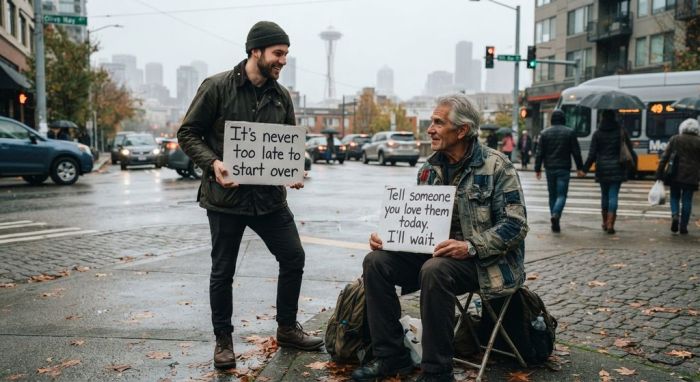
It was propped against a lamppost at the corner of Aurora and 85th, a busy intersection where the traffic never stopped. The sign was made of corrugated plastic, the kind you see at yard sales, but the message was unlike anything Cooper had ever seen. It was written in black marker, in careful, deliberate handwriting:
TELL SOMEONE YOU LOVE THEM TODAY. I'LL WAIT.
And beneath it, an old man sat on a folding stool, his hands resting on his knees, his face turned toward the traffic with the patient stillness of someone who had learned that waiting was its own kind of prayer.
He was maybe seventy-eight years old, with silver hair that the wind had tousled into a mess of white, and a denim jacket that had been patched at the elbows. He was not holding a cup for change. He was not asking for money. He was just sitting there, holding his sign, watching the cars stream past.
Cooper crossed the street and sat down on the curb, a few feet away. He did not introduce himself. He just sat. After a long moment, the old man spoke. "First time?"
"Is it that obvious?"
"You've got the look. The one people get when they're trying to figure out if I'm crazy or just lonely." He smiled, a slow, warm smile that crinkled the corners of his eyes. "The answer is both. My name is Marcus."
"Cooper."
"Nice to meet you, Cooper. You want to hold the sign for a while? My arms get tired."
Cooper took the sign and held it above his head. He stood at that corner for the next hour, watching the cars pass, watching the faces of the drivers who glanced at the sign and then looked away. And when he handed it back, something in his chest felt lighter.
"Same time tomorrow?" Marcus asked.
Cooper nodded. "Same time tomorrow."
That was the beginning of a friendship that neither of them had expected. Marcus had been a high school English teacher for thirty-seven years. He had retired in 2010, the same year his wife Eleanor was diagnosed with Parkinson's disease. He had spent eight years caring for her until she passed away in 2018, holding his hand while the sun set over the Puget Sound.
"She made me promise something," Marcus told Cooper. "She said, 'Marcus, when I'm gone, I don't want you to sit in this house and be sad. I want you to go out into the world and remind people that love is real.'"
"So I made a sign. I've been standing at this corner for five years now. Every day, rain or shine."
Cooper thought about his own life — the phone calls he had stopped returning, the friends he had stopped texting, the mother who had left him voicemails he listened to but never answered.
"Can I borrow your sign?" he asked.
He walked to the payphone and dialed a number he had not called in three months. His mother answered on the second ring. "Mom," he said. "I love you. I just wanted to tell you that I love you."
She cried. He cried. And for the first time in months, Cooper felt like he was not drowning.
That was six months ago. Cooper started a small design studio in Seattle. His specialty is something unexpected — he designs signs. Not digital signs, but the kind of signs people hold at intersections, at weddings, at funerals. He designed a sign for a man who wanted to propose on a busy street corner, for a woman who wanted to thank the nurses who saved her mother's life, for a group of children who wanted to welcome their father home from deployment.
And every Saturday morning, Cooper takes his folding stool and his own sign and sits at the corner of Aurora and 85th, next to Marcus. Marcus's sign still says: "Tell someone you love them today. I'll wait." Cooper's sign says: "It's never too late to start over."
Cooper is thirty-one now. His mother came to visit last month. She stood at the corner, watching her son hold his sign, and she hugged Marcus and thanked him for saving her son's life. Marcus laughed. "I didn't save him. I just gave him a sign to hold. He did the rest."
Cooper Hayes learned that a blank page is not a threat — it is an invitation. And sometimes, the most important thing you can do with your life is to stand on a street corner and remind people that love is real, that it is never too late, and that the only thing you have to fear is the words you never say.
The last time I saw Cooper, he was standing at the corner, holding his sign, the afternoon sun casting long shadows across the pavement. Marcus was beside him, as always, and they were both smiling. A woman in a blue sedan had pulled over and was sitting in her car, crying. Cooper walked over and knelt down beside her window.
I do not know who she called. But I know that somewhere in Seattle, two men stood on a street corner with signs that weighed nothing and meant everything. And I know that the world was a little brighter because of it.