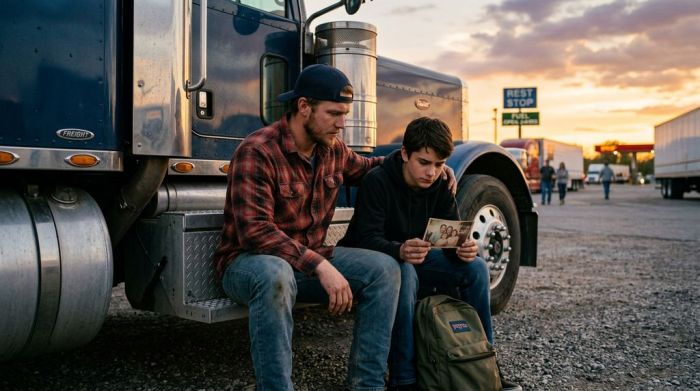
Jake Morrison never expected to find a family at a truck stop in Nebraska. But that is exactly what happened on a cold October night, when a fifteen-year-old boy with a backpack and a bruised face climbed into his eighteen-wheeler and changed everything.
Jake was twenty-eight years old, and he had been driving trucks since he was twenty-two. Six years of cross-country hauls, six years of diner coffee and highway rest stops and the particular loneliness that comes from spending three hundred nights a year in a sleeper cab the size of a closet. He had chosen this life because it was the only one he knew how to live. His own father had walked out when Jake was sixteen, leaving him to raise his younger sister, and he had been running from that emptiness ever since.
The boy was at the Pilot Travel Center off Interstate 80, just outside of North Platte. Jake had pulled in to fuel up and grab a sandwich, and he noticed him immediately — a thin kid in an oversized hoodie, sitting on a curb near the diesel pumps, staring at the ground. He had a backpack clutched to his chest like a life raft, and his face was marked with a fresh bruise spreading across his left cheekbone.
Jake had been that kid once. Sixteen years old, sitting on a curb, wondering where the next meal was coming from. He recognized the look in the boy's eyes — the particular shade of desperate that comes from having no one to call.
He bought two sandwiches instead of one. He walked over to the boy and sat down on the curb beside him, the way someone had once sat beside him in a similar moment.
"Hungry?" Jake asked, holding out the sandwich.
The boy looked at him with the suspicion of someone who had learned that kindness from strangers usually came with strings attached. But hunger won. He took the sandwich and ate it in about thirty seconds flat.
"Where you heading?" Jake asked.
The boy shrugged. "Nowhere. Anywhere."
"Those are two very different directions."
The boy almost smiled. Almost.
His name was Ethan. He was fifteen years old, and he had been on the road for three days, hitching rides from truckers who asked too many questions. He was running from a stepfather who had been hitting him and a mother who looked the other way. He had a grandmother in Oregon who he had not seen since he was seven, and he had a crumpled letter in his pocket that she had sent last Christmas, with a return address that he had memorized.
Jake was heading west. Oregon was west. It felt like the kind of coincidence that was either fate or a really bad decision. He decided to find out which.
"I'm heading to Portland," Jake said. "That's not far from Oregon. If you want, I can get you close."
Ethan studied him for a long moment, trying to read his intentions. Jake held his gaze, letting him see that there was nothing hidden, no angle, no price. He was just a truck driver who had once been a kid on a curb, and he knew that sometimes the only thing that saved you was someone stopping.
"Okay," Ethan said.
They drove through the night, across the flat expanse of Nebraska, the headlights cutting through the darkness like a promise. Jake talked about the road — the places he had seen, the people he had met, the time a buffalo had crossed the highway in front of his rig in Wyoming and he had nearly jumped out of his skin. Ethan listened. He did not talk much, but he listened, and that was enough.
In the morning, they stopped at a diner in Cheyenne, Wyoming. Jake ordered pancakes for both of them, and Ethan ate like he had not seen food in weeks. Between bites, he asked the question that had been building since they left Nebraska.
"Why are you helping me?"
Jake considered the question. He could have given a dozen answers — because it was the right thing to do, because he had been there, because the kid reminded him of himself. But the truest answer was simpler than all of them.
"Because someone helped me once," Jake said. "A truck driver named Frank. I was sixteen, sitting on a curb in Ohio, and he bought me a sandwich and asked where I was heading. I didn't know then, but that sandwich saved my life."
Ethan was quiet for a long moment. Then he said, "I think I know what you mean."
They drove through Wyoming, through the Rocky Mountains of Colorado, through the high desert of Utah. Somewhere past Salt Lake City, as the sun was setting over the Great Salt Lake, Ethan started talking. He talked about his stepfather, about the arguments that turned into shoving that turned into fists. He talked about his mother, who used to be brave but had been worn down by years of fear. He talked about the grandmother he barely remembered, who had sent him a birthday card every year even though he never wrote back.
Jake listened. He did not offer advice or solutions. He just listened, the way Frank had listened to him all those years ago.
When Ethan finished, his voice was raw and his eyes were wet. "Do you think my grandmother will want to see me?"
Jake thought about the letter Ethan carried, the return address in Oregon that had been worn soft from being folded and unfolded a hundred times. "I think she's been waiting for you her whole life."
They reached the Oregon border on the third day. Jake pulled off at a rest stop near the Columbia River Gorge, the last stop before Portland. He called Ethan's grandmother from a payphone — the number from the letter, his heart pounding as the phone rang.
She answered on the second ring. Her name was Margaret, and when Jake told her who he had with him, she began to cry.
"Is he okay?" she asked. "Is my grandson okay?"
"He's a little banged up," Jake said, keeping his voice steady. "But he's alive. And he needs you."
Jake drove Ethan the rest of the way to a small town outside of Eugene, Oregon, where Margaret lived in a white farmhouse with a porch swing and a garden full of roses. She was waiting on the porch when the truck pulled up, a small woman in her seventies with silver hair and the kind of face that had been shaped by a lifetime of both sorrow and joy.
Ethan got out of the truck. He stood in the driveway, his backpack in his hands, looking at the grandmother he had not seen in eight years. And then Margaret opened her arms, and Ethan walked into them, and Jake sat in the cab of his truck and watched a boy come home.
Margaret came to the driver's side window. She reached through and took Jake's hand, her grip surprisingly strong. "Thank you," she said. "Thank you for bringing my boy home."
Jake nodded, not trusting his voice.
"What's your name?" she asked.
"Jake Morrison."
"I'm going to remember that name, Jake Morrison. I'm going to pray for you every night for the rest of my life."
Jake drove away with a weight in his chest that he could not quite name. He had done what Frank had done for him. He had passed it on. And for the first time in years, the emptiness inside him felt a little smaller.
That was seven years ago.
Jake is thirty-five now. He still drives trucks, but he took a regional route so he could stay closer to home. He bought a house in Portland, a small bungalow with a yard and a garage. He married a woman named Sarah, who runs a bookstore and makes him laugh in ways he had forgotten he could laugh. They have a three-year-old daughter named Lily, who has her mother's smile and her father's restless energy.
And every year, without fail, Jake receives a card in the mail. It is always the same — a plain white envelope, postmarked from Eugene, Oregon. Inside is a handwritten note from Margaret, updating him on Ethan's life, and a photograph of a young man who grows taller and happier with each passing year.
Last year's photograph showed Ethan at his high school graduation. He was wearing a cap and gown, grinning at the camera, the same grin he had worn when Jake bought him that first sandwich. The note said he had been accepted to Oregon State University, that he wanted to study engineering. It said he talked about Jake all the time. It said he wanted to be a truck driver when he was a kid, until he realized that what he really wanted was to be the kind of man who stopped for strangers.
Jake keeps the photographs in a shoebox under his bed. On the hard days, when the road feels longer than usual and the loneliness creeps back in, he opens the box and looks at them. He looks at the face of a boy who had been given a second chance, and he remembers that a single act of kindness does not end when the moment passes. It echoes. It grows. It crosses states and years and generations.
The truck stop in North Platte, Nebraska, is still there. Jake stops there sometimes, when his route takes him that way. He buys a sandwich, sits on the curb, and looks at the spot where he met a boy who changed his life.
He wonders, sometimes, if there is another kid out there, sitting on a curb, waiting for someone to stop. And he hopes, with everything he has, that someone will.
Because that is the truth about the road. It is long and lonely and full of people who are running from something. But every now and then, if you are lucky, you meet someone who reminds you why you are still driving.
Jake Morrison found that someone at a truck stop in Nebraska.
And he has been carrying him in his heart ever since.