Jake Morrison never expected to find his way back to joy through a stack of crayon drawings hidden under his daughter's bed. But that is exactly what happened on a cold February night in Columbus, Ohio, when he discovered that his seven-year-old daughter Lily had been running a secret operation for months — and that her small acts of kindness had quietly transformed their entire town.
Jake was thirty-four years old, an electrician who had been working for the same company since he was twenty-two. He was a good father — the kind who made sure Lily had breakfast every morning, who never missed a parent-teacher conference, who read her a story every night before bed even when he was exhausted. But he had been going through the motions for years, operating on autopilot, the way people do when they have learned to function without feeling.
His father, a high school math teacher named Gerald, had passed away five years ago. It was not dramatic or tragic. Gerald was seventy-two, and his heart simply gave out one evening while he was reading the newspaper in his favorite armchair. The doctor said it was peaceful. Jake had not cried at the funeral. He had stood at the graveside in a black suit that felt too tight and listened to people say beautiful things about a man he had loved more than he had ever told him. He had held Lily, who was only two at the time and did not understand why Daddy was sad. And he had gone home that night and cooked dinner and washed the dishes and gone to work the next morning, because that was what you did. You kept going.
But somewhere along the way, Jake had stopped laughing. He had stopped calling his friends. He had stopped noticing the small, beautiful things that had once made life worth living — the way the morning light fell across the kitchen table, the sound of Lily's laugh when she watched cartoons, the smell of fresh coffee on a Saturday morning. He had become a machine that performed the functions of a father without inhabiting the role. And Lily, with the intuitive wisdom of a child who notices everything, had decided to do something about it.
The discovery happened on a Thursday night. Jake had put Lily to bed at eight, read her two chapters of a book about a rabbit who went on adventures, and kissed her forehead. He had gone downstairs to pay bills, a task he had been putting off for three weeks. But when he reached for his wallet on top of the refrigerator, he knocked over a stack of papers that had been hidden behind the cereal boxes. They scattered across the floor — dozens of sheets of colored construction paper, each one covered in Lily's careful, wobbly handwriting and crayon drawings.
Jake knelt down and picked up the first one. It was a drawing of a sun with a smiley face, surrounded by yellow rays, with a note underneath: "Dear Mrs. Patterson, I hope your knee feels better. My dad says when your knee hurts, you should put ice on it. Also, here is a picture of a sun to make your day bright. From Lily."
Mrs. Patterson was their elderly neighbor two doors down, a widow who had been on crutches since she fell on the ice in December.
He picked up another. This one had a drawing of a dog with a curly tail and the words: "Dear Mr. Kowalski, I saw you looking sad at the bus stop. My goldfish died last year and I was sad too. But then I got a new goldfish and named him Sparkles. Maybe you need a new goldfish? From Lily."
Mr. Kowalski was the mailman, a quiet man in his fifties whose wife had left him six months ago.
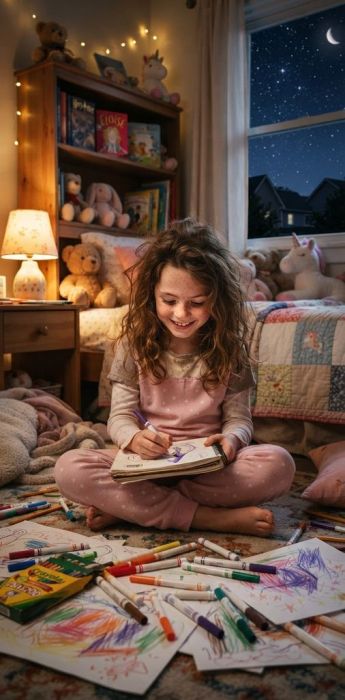
There were more. Dozens of them. Jake sat on the kitchen floor, surrounded by his daughter's secret project, and read each one with a growing sense of wonder. Lily had been drawing pictures and writing notes for people in the neighborhood who seemed sad or lonely. She had been slipping them into mailboxes, under doors, into coat pockets at church. She had been running her own kindness campaign, and she had never told anyone — not her father, not her teacher, not her best friend at school.
Jake did not confront her that night. He put the papers back where he had found them, went to bed, and lay awake for hours, staring at the ceiling. He thought about the way Lily hugged him a little tighter in the mornings. He thought about the drawings she left on his pillow, the ones he had barely glanced at before tossing them into the recycling bin. He thought about the question she had asked him last week, out of nowhere, while they were eating dinner: "Daddy, are you happy?"
He had said yes, because that was what you say. But the look in her eyes told him she had not believed him.
The next morning, Jake followed her.
It was a Saturday, and Lily had finished her breakfast and announced she was going to play in the backyard. Jake watched from the kitchen window as she walked to the far end of the yard, near the fence, and slipped a folded piece of paper through a gap in the boards. The house behind them belonged to an elderly man named Arthur, who had lost his wife two years ago and rarely left his house.
Jake walked outside. "Lily," he called, his voice softer than he intended, "what do you have there?"
Lily spun around, her eyes wide. She was holding a piece of purple construction paper, folded into a square. Her face went red. "Nothing," she said. "Just a drawing."
"Can I see it?"
She hesitated. Then she walked over and handed it to him, her eyes fixed on the ground. It was a drawing of a man and a woman holding hands, standing under a rainbow. The note underneath said: "Dear Mr. Arthur, I know your wife is in heaven. But I think she can still see you. And I think she wants you to be happy. From Lily."
Jake felt the words hit him like a wave. He knelt down and pulled Lily into his arms. "These drawings you've been making," he said, his voice thick. "You've been giving them to people who are sad."
She nodded against his shoulder. "I don't like it when people are sad, Daddy. It makes my tummy feel funny. So I make them pictures to help them remember that there are still nice things in the world."
"Like what?"
"Like sunsets and puppies and ice cream. And dads who read stories."
Jake held her tighter, the tears coming freely now. He had not cried in five years. He had locked that part of himself away, convinced that being strong meant never showing weakness. But his daughter, with her crayon drawings and her seven-year-old wisdom, had just unlocked the door.
"You know what, Lily?" he said, pulling back to look at her face. "I think you're the bravest person I know."
She tilted her head. "Because I draw pictures?"
"No. Because you see people. You notice when they're hurting. And you do something about it. Most adults don't know how to do that. But you do."
Lily thought about this for a moment. Then she said, "Daddy, are you sad?"
Jake considered lying. It would have been easier. But he had spent enough of his life lying to himself. "Yes," he said quietly. "I've been sad for a long time. Since Grandpa died. I thought if I didn't talk about it, it would go away. But it didn't go away. It just got quieter."
"Like a whisper?"
"Yeah. Like a whisper."
Lily took his hand. "Then we need to make it louder. Not the sad part. The other part."
"What other part?"
"The part that remembers Grandpa's laugh. And the way he used to bounce me on his knee. And the time he let me eat ice cream for breakfast when you weren't looking."
Jake laughed — a real laugh, the kind that came from somewhere deep and long-buried. It startled him. He had forgotten what it felt like. "He did that?"
"He said it was our secret. I think I can tell you now, since he's in heaven."
Jake pulled her into another hug. "Thank you, Lily. For telling me."
"You're welcome, Daddy. Also, I think you should help me with my project. You're good at drawing too. You drew that picture of a cat last week that actually looked like a cat."
"It did look like a cat."
"It really did."
And so it began. Jake started helping Lily with her happy mail project on weekends. They would sit at the kitchen table together, surrounded by construction paper and markers, and they would talk about who in the neighborhood might need a little brightness. Mrs. Kowalski, whose arthritis was acting up. The teenage boy across the street, who had been walking home from school alone since his best friend moved away. The librarian at the local branch, who had mentioned she was going through a divorce.
Lily drew pictures. Jake wrote notes. Together, they created a small avalanche of kindness that rippled through the town in ways neither of them could have predicted.
Mrs. Patterson, the neighbor with the bad knee, showed up at their door one Saturday with a plate of cookies. "I got your drawing," she said, her eyes glistening. "It made me cry. But in a good way. The kind of cry you need when you've been holding everything in for too long."
Mr. Kowalski, the mailman, started waving at Jake when he passed. One morning, he stopped and said, "Tell Lily I got her note about the goldfish. I did get a goldfish. Named him Gerald, after my grandfather. He's a good listener."
And Mr. Arthur, the widower two doors down, left a note in Jake's mailbox one evening. It was written in shaky handwriting on a piece of yellow legal paper: "Dear Lily, Your drawing is on my refrigerator. It's the first thing I see every morning. It reminds me that my Eleanor is still with me, even if I can't see her. Thank you for being a light in the darkness. Your friend, Arthur."
Jake read the note at the kitchen table, Lily sitting across from him, eating a bowl of cereal. He read it aloud, and when he finished, Lily smiled the smile of someone who had just discovered her superpower.
"See, Daddy?" she said. "Everyone just needs to know that someone sees them."
"Where did you learn that?" he asked.
"From you. You see me. Every single day."
That was the moment Jake Morrison understood that his daughter had not been the only one healing. The happy mail project had started as Lily's way of helping a town full of strangers. But in the end, it had helped him most of all. She had shown him that the antidote to grief was not to ignore it or outrun it. It was to turn outward — to notice the people around you, to offer kindness without expecting anything in return, to believe that even the smallest gesture could change someone's day, or someone's life.
That was a year ago. Jake still works as an electrician. He still reads Lily a story every night. But he laughs now. He calls his friends. He notices the way the morning light falls across the kitchen table, and he thinks about how beautiful it is. He and Lily still make happy mail together every Saturday morning. They have expanded their operation to include the local nursing home, the children's hospital, and the fire station on Main Street. They have recruited three other families from the neighborhood. Last Christmas, they sent over two hundred cards to people who needed to know they were not forgotten.
And Mr. Arthur, the widower, now comes over for dinner every Sunday. He taught Lily how to plant tomatoes in the backyard. He told Jake that Eleanor used to make the best peach cobbler in Ohio, and last summer, the three of them made it together, standing in Jake's kitchen, flour dusting their clothes, laughter filling the room.
Jake still misses his father. He suspects he always will. But the grief has changed shape. It is no longer a weight that presses down on his chest. It is a quiet presence, like a photograph on a shelf, something he can look at without being crushed by it. And when he closes his eyes, he can hear his father's laugh — the same laugh Lily inherited, the one that fills their house on Saturday mornings when they sit down to make happy mail for a world that needs it more than ever.
If you are carrying grief that you have not allowed yourself to feel, consider this your permission to let it out. Consider this your reminder that healing does not always come in grand gestures or dramatic breakthroughs. Sometimes it comes in crayon drawings, slipped through fences, left in mailboxes, waiting to be found by someone who needs to know they are seen.
Lily Morrison saw people. And in doing so, she taught her father how to see again — not just the world around him, but himself.