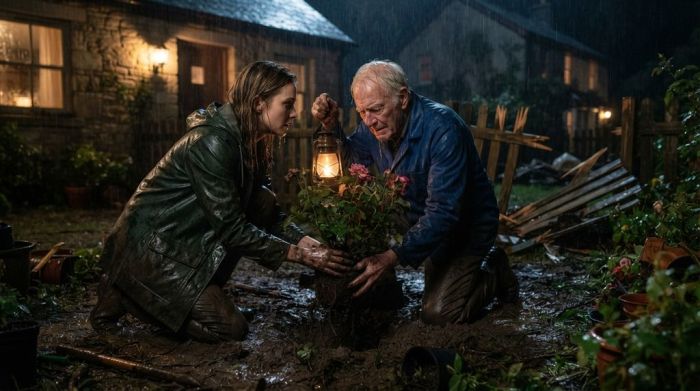
The storm took down the fence between our houses at 2:47 AM on a Tuesday in April. I know the exact time because I was awake, sitting in the dark of my new kitchen, wondering if I had made the biggest mistake of my life by moving to a small town in Pennsylvania where I didn't know a single soul.
My name is Morgan Hayes. I was thirty-four years old, freshly divorced, and the owner of a fixer-upper colonial on Maple Street that I had bought with the last of my savings. My daughter Daisy was seven. She had cried for three hours on moving day, clutching a photograph of our old house in Philadelphia, asking why we couldn't just go back to how things were before. I didn't have an answer for her. I didn't have an answer for anything.
The storm came without warning. One moment the sky was clear, the next the wind was howling through the cracks in the old window frames, rattling the glass like it wanted to break through. I heard the crash from the back of the house — a long, splintering groan followed by the sound of wood hitting earth. I ran to the kitchen window and saw it in a flash of lightning: the fence between my yard and the neighbor's had collapsed into a pile of broken boards. And standing on the other side, silhouetted against the storm, was Arthur Pendleton.
I had met Arthur exactly once, on the day I moved in. He was seventy-eight years old, a retired carpenter who had lived in the white house next door for forty-seven years. He had stood on his porch with his arms crossed, watching the movers haul my furniture up the steps, and when I had walked over to introduce myself, he had said exactly four words: "Keep your dog off my lawn." Then he had turned around and gone back inside. I didn't have a dog.
That was six weeks ago. In all that time, Arthur had not spoken to me again. He didn't wave when I pulled into the driveway. He didn't acknowledge me when I was gardening in the front yard. He was a ghost in the house next door, a presence I felt but never saw. And I had convinced myself that he was just a miserable old man who hated everyone.
But standing in the storm, watching him pick through the wreckage of the fence, I saw something I hadn't expected. He was crying. The rain hid it well, but I saw it in the way his shoulders shook, in the way he pressed his hand against the broken wood as if it were the body of a friend. He stood there for a long moment, the rain soaking through his thin shirt, and then he disappeared into the darkness of his backyard.
I should have gone to bed. I should have let the storm pass and dealt with the fence in the morning. But something about the way he had touched that wood, the tenderness in his old hands, made me grab my raincoat and step out into the night.
The rain was cold and sharp. The grass squelched under my sneakers. The broken fence lay in a tangle between our yards, and beyond it, Arthur's garden — a garden I had never seen from this angle — was a disaster. Trellises had toppled. Flower beds were flooded. A small greenhouse at the back had lost half its glass panels. And in the middle of it all, Arthur was on his knees, trying to save a rose bush that had been torn from the ground.
I didn't ask permission. I knelt beside him in the mud, the rain streaming down my face, and I grabbed the other side of the rose bush. We lifted it together, settled it back into the broken soil, and began to pack mud around its roots. We worked in silence for what felt like an hour, rescuing what we could, letting the storm take what it insisted on taking.
When the worst of the rain had passed, Arthur sat back on his heels and looked at me for the first time with something other than hostility. "Eleanor planted that rose bush," he said. His voice was rough, barely above a whisper. "The day we moved in. 1977. She said every home needed something that would outlast the people who lived in it."
I didn't know what to say. I sat there in the mud, the rain dripping off my chin, and I let him talk. "Forty-seven years," he said. "She was in this garden every single day. Even when the cancer made it hard to walk. She would crawl on her hands and knees if she had to, just to check on her flowers. She told me the garden was her prayer. That every seed she planted was a hope she was sending into the world."
He paused, and when he spoke again, his voice cracked. "She passed away in February. I haven't been able to look at this garden since. I told myself I was taking care of it. But I was just letting it die. Because I didn't know how to take care of something that reminded me of her."
I looked at the garden — the overgrown beds, the wilted flowers, the greenhouse that had clearly been neglected for months. I looked at the broken fence, the physical barrier I had assumed was about privacy. And I understood, with a clarity that hit me like the storm itself, that Arthur had not been trying to keep me out. He had been trying to keep himself in. In his grief. In his memory. In the house where Eleanor's presence still lingered, growing fainter every day.
"My husband left me six months ago," I said. The words came out before I could stop them. "He said he didn't love me anymore. He said he had found someone else. I moved here because I couldn't afford to stay in Philadelphia, and because I didn't know where else to go." Arthur looked at me. The rain had stopped, and the first hint of gray light was touching the sky. "I'm sorry," he said. And I could tell he meant it.
Over the next three weeks, Arthur and I rebuilt the fence together. But we didn't rebuild it as a barrier. We built it with a gate.
The project started slowly. Arthur would come out in the mornings, his tool belt slung low on his hips, and I would join him after I dropped Daisy at school. He taught me how to set fence posts, how to level the rails, how to drive nails without splitting the wood. I learned that he had built half the houses on Maple Street. I learned that he and Eleanor had met at a church picnic in 1962. I learned that he had been a quiet man even before she died — that she had been the one who drew him out of his shell, who made him laugh, who showed him that the world was full of beauty even when he couldn't see it.
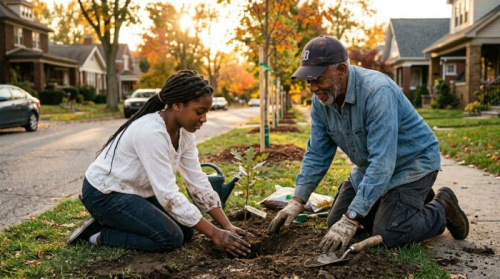
Daisy started coming out to watch us work. At first, she stayed on the porch, too shy to approach the old man who had seemed so scary. But Arthur, I discovered, had a way with children. He started leaving small things on the fence for her — a carved wooden bird, a tiny flower pot, a whistle that made a sound like a robin. She began to venture closer. Then she began to help, handing him nails, holding the level, asking questions that made him smile in a way I had never seen him smile before.
The day we finished the fence, Arthur presented Daisy with a gift. It was a birdhouse, hand-carved from cedar, with a small brass plaque on the front that read: "Daisy's House. Built with love, 2025." Daisy hugged him. She wrapped her small arms around his waist and squeezed, and Arthur — the man who had once told me to keep my dog off his lawn — stood frozen for a moment, his hands hovering in the air. And then he hugged her back. I stood on my porch, watching them, and for the first time in months, I felt something I had forgotten existed. Hope.
That was six months ago. The fence still stands, strong and true, with a gate that we leave unlocked. Daisy runs through it every afternoon, heading straight for Arthur's garden, where she helps him water the roses that Eleanor planted forty-seven years ago. They have become an inseparable team — my daughter and the old man next door. He teaches her about woodworking and growing things. She teaches him about video games and the names of all her favorite characters. On warm evenings, I hear them laughing together, and the sound fills the yard like music.
And me? I have found something I didn't know I was looking for. A neighbor. A friend. A father figure for my daughter. A man who showed me that the walls we build are not always meant to keep people out. Sometimes they are the only things holding us up, and when they fall, what grows in their place can be more beautiful than we ever imagined.
Arthur still misses Eleanor. He always will. But he no longer tends her garden with grief. He tends it with love, the way she taught him. The rose bush that we saved that night is thriving now, covered in deep crimson blooms that catch the morning light. And every morning, when I look out my kitchen window and see him in his backyard, surrounded by the flowers she planted, surrounded by my daughter's laughter, I am reminded that the bravest thing a person can do is not to avoid pain. It is to keep growing things in the same soil where loss has dug its deepest trenches.
The storm took down the fence between our houses. But what grew in its place is something no storm will ever destroy. It is a family, forged not by blood, but by a shared night in the rain, a broken rose bush saved from the mud, and a simple gate that we leave unlocked every single day. Because some doors are not meant to stay closed. And some fences, it turns out, are not meant to keep us apart.