Maddie Torres was twenty-six years old when she learned that the students who need love the most often ask for it in the most complicated ways.
She was in her second year of teaching ninth-grade English at Westbrook High in Springfield, Missouri, a school that sat at the intersection of three different zip codes and served students from every kind of background imaginable. She had grown up in a small town in Kansas, the daughter of a farmer and a school librarian, and she had moved to Springfield because it was big enough to feel like a city and small enough to feel like home.
On the first day of school, a girl named Aaliyah James walked into her classroom fifteen minutes late, wearing a hoodie two sizes too big, and sat in the back row without making eye contact with anyone. She did not introduce herself during the icebreaker. She did not laugh when the boy next to her made a joke. She simply pulled out a notebook, opened it to a blank page, and stared at it for the entire fifty-minute period without writing a single word.
Maddie noticed her immediately. It was a skill teachers develop—the ability to spot the student who is hiding in plain sight, the one who has learned to be invisible because being seen is too dangerous. Aaliyah had mastered that invisibility. But Maddie had been a student like Aaliyah once. She knew the signs.
The First Poem
Three weeks into the semester, Maddie assigned a poetry unit. It was her favorite unit—the one where she got to show students that words could be weapons and shields and windows into souls. She had them read Langston Hughes, Emily Dickinson, Maya Angelou. She had them analyze structure and metaphor and rhythm. And then she asked them to write a poem of their own. Any topic. Any form. No grades. Just words.
The poems came in the following Monday. Most were about love and friendship and the existential dread of being fifteen. A few were surprisingly good. One was about pizza, which Maddie appreciated for its honesty.
And then she opened Aaliyah's notebook.
The poem had no title. It was written in tight, careful handwriting, as if the author had been afraid the words might escape if she wrote them too loosely. It was short—only twelve lines—but Maddie read it three times before she could breathe properly.
I am the silence between two words
The space where things unsaid are stored
I wear my voice like borrowed clothes
Too loose to keep, too tight to fold
At night I practice conversations
With people I will never face
I write the lines I cannot speak
And keep them in a hidden place
Maddie sat at her desk for a long time after the final bell rang, holding the notebook in her hands. She had been teaching for only a year, but she knew—with a certainty that came from somewhere deeper than experience—that this poem was not just an assignment. It was a door. And Aaliyah had left it open, just a crack, to see if anyone would walk through.
The Question
Maddie waited until the end of the week to approach Aaliyah after class. She had learned not to rush these moments. Students like Aaliyah needed time to trust, and trust could not be demanded—it had to be earned in small, consistent doses.
\"Aaliyah,\" Maddie said, as the other students filed out of the classroom, \"can I talk to you for a minute?\"
Aaliyah stopped. She did not turn around immediately. Her shoulders tensed, the way someone's shoulders tense when they expect a blow. Then she turned slowly, her face carefully blank. \"Am I in trouble?\"
\"No. Not at all.\" Maddie held up the notebook. \"I wanted to talk to you about your poem.\"
Aaliyah's face flickered—surprise, fear, something that looked almost like hope before she buried it. \"It's not good. I shouldn't have turned it in. I can write another one.\"
\"Aaliyah.\" Maddie's voice was soft but firm. \"It was beautiful. I have been teaching for only a year, but I have read a lot of poems from a lot of students. And yours is the best I have ever seen.\"
Aaliyah stared at her. She did not know how to respond, because no one had ever said that to her before. She opened her mouth, closed it, and then did something unexpected. She sat down in the front row desk, the one closest to Maddie's chair, and she began to talk.
She told Maddie about her mother, who worked double shifts at a warehouse and came home too tired to talk. She told her about her father, who had left when she was six and sent birthday cards with return addresses that changed every year. She told her about the loneliness of being the quiet girl, the one who listened more than she spoke, the one who filled notebooks with poems she never showed anyone because showing them would mean letting people see who she really was.
\"I don't know how to say things out loud,\" Aaliyah said, her voice barely above a whisper. \"But when I write, it's like the words know where they're supposed to go. Like they've been waiting for me to let them out.\"
Maddie nodded. She understood. She had been that girl once—a teenager in a small Kansas town, filling spiral notebooks with poems she was too afraid to share, until a teacher named Mrs. Patterson had read one and said the words that changed everything: \"You have a gift. And gifts are meant to be shared.\"
\"I want to show you something,\" Maddie said. She opened her desk drawer, the bottom one where she kept her personal things, and pulled out a worn notebook. It was the same one she had used in high school, filled with poems she had written between classes and late at night when she could not sleep. She opened it to a page and handed it to Aaliyah.
It was a poem about her grandmother, who had passed away when Maddie was sixteen. It was not perfect. The rhymes were forced in places, the imagery a little clumsy. But it was real.
\"You wrote this?\" Aaliyah asked, looking up with wide eyes.
\"I was your age. And I was terrified of showing it to anyone. But my English teacher, Mrs. Patterson, read it and told me I should keep writing. She is the reason I am standing here today. She is the reason I became a teacher.\"
Aaliyah looked at the poem in her hands, then back at Maddie. And for the first time since the school year started, she smiled. A small, fragile smile, barely there. But it was real.
The After-School Sessions
What started as a single conversation became a weekly ritual. Every Tuesday and Thursday, Aaliyah stayed after school, and she and Maddie would sit in the empty classroom and write. They did not always talk. Sometimes they just sat in comfortable silence, the scratch of pens on paper the only sound, while the afternoon sun slanted through the windows and the janitor's vacuum hummed in the distance.
Aaliyah's poems grew bolder. She started writing about her mother, about the love she saw in the small things—the way her mother left a plate of food in the microwave for her every night, even when she worked a double shift. She wrote about the father she barely remembered, not with anger, but with a quiet, wondering sadness. She wrote about the sky, about the way the Missouri sunsets turned the clouds pink and gold, about the feeling of being small in a world that was vast and terrifying and beautiful.
And Maddie watched her grow. It was like watching a flower open in slow motion—petal by petal, day by day, until one afternoon in November, Aaliyah walked into the classroom and said, \"I want to enter the poetry contest.\"
The statewide poetry contest for high school students was sponsored by the Missouri Arts Council. The winner would receive a five-hundred-dollar scholarship and publication in the council's annual anthology. Maddie had mentioned it in passing weeks ago, never thinking Aaliyah would consider it.
\"Are you sure?\" Maddie asked.
Aaliyah nodded, her jaw set with a determination Maddie had not seen before. \"I have been hiding my words for too long. Mrs. Patterson told you to share your gift, right? This is my gift. And I am ready to share it.\"
They worked on the poem together for three weeks. Aaliyah wrote draft after draft, and Maddie offered gentle suggestions—a stronger verb here, a more precise image there. But she was careful never to change Aaliyah's voice. The poem had to be hers, entirely hers, or it would not be real.
The final poem was called \"The Words I Never Said.\" It was about growing up in the shadow of someone else's silence, about learning to speak when no one taught you how, about the moment you finally find your voice and realize it was there all along, waiting.
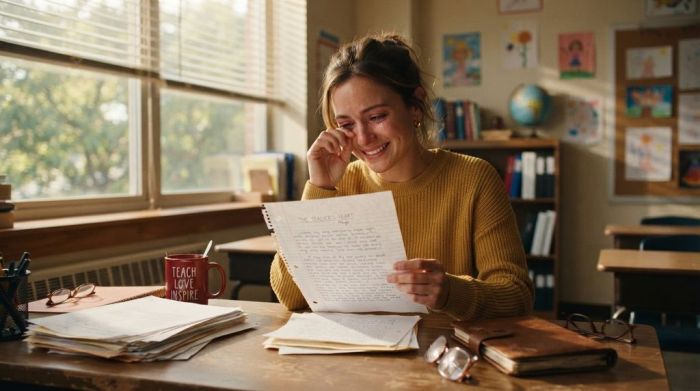
Maddie read the final draft at her desk, the classroom empty, the sun setting outside the window. And she cried. Not because the poem was perfect—it was not, and Aaliyah would keep growing as a writer for years to come. She cried because she remembered what it felt like to be a teenager who did not know if her voice mattered. And she knew that Aaliyah had just taken the first step toward believing that it did.
Epilogue: The Words That Traveled
Aaliyah did not win the contest. She placed third. But when the results were announced, she did not cry. She smiled. She smiled because her poem was going to be published in the anthology, because five hundred other students across the state would read it, because she had done something she had never done before—she had let the world see her.
The following spring, the school held an open mic night in the auditorium. Parents came. Teachers came. Students who had never spoken in public came to support their friends. The auditorium filled slowly, the buzz of conversation rising like a tide, and Maddie stood at the back of the room, watching her students take the stage one by one.
And then Aaliyah walked to the microphone.
She stood there for a long moment, looking at the faces in the crowd. Her mother was in the third row, still in her work uniform, her hands folded in her lap, her eyes full of a pride that could not be contained. Aaliyah looked at her, took a breath, and began to read.
She read the poem she had written for the contest. Her voice was steady. She did not rush. She let the words land the way they were meant to land, one by one, like notes in a song that had been waiting its whole life to be performed. When she finished, the audience was silent for a beat. Then they rose to their feet.
Maddie stood in the back, clapping until her hands hurt, tears streaming down her face. She looked at Aaliyah, standing in the spotlight, holding her paper with trembling hands, and she thought about Mrs. Patterson, her own teacher, who had read a clumsy poem about a grandmother and said, \"You have a gift.\"
She thought about the chain of kindness that connected them—teacher to student, generation to generation, one poem at a time. And she understood, with a clarity that felt like grace, that this was why she taught. Not for the lesson plans or the grades or the standardized tests. For this. For the moment when a girl who had been silent her whole life finally found her voice.
Aaliyah is a senior now. She is the editor of the school literary magazine. She has a scholarship to Missouri State University, where she plans to study creative writing. She still comes to Maddie's classroom sometimes, on Tuesday and Thursday afternoons, just to sit and write. Old habits are hard to break.
And Maddie? She still teaches. She still pulls out her old notebook when she needs to remember why she started. She still watches for the students who are hiding in plain sight, the ones who carry their voices like borrowed clothes. And every time she finds one, she hands them a pen and a blank page and says the words that were once said to her.
\"You have a gift. And gifts are meant to be shared.\"
Because that is the truth about teaching. It is not about filling minds with facts. It is about showing people that the words they carry inside them are worth saying out loud. It is about creating a space where silence can finally learn to speak.
All it takes is one teacher who stays after the bell rings, one poem written in a notebook, one girl who was brave enough to show the world her words.