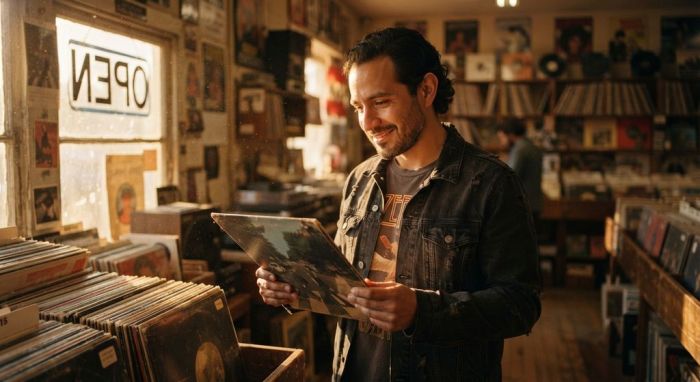
By the time Danny Espinoza unlocked the door to his record store on what he knew would be one of his last mornings, the sun was already baking the asphalt on Main Street, and an old man was sitting on the bench outside, waiting.
The old man's name was Clemente Vega. He was eighty-two years old, a retired mechanic who had fixed every car in town at least once, and he had been coming to Desert Songs Records every Tuesday and Thursday for nine years. He never bought anything. He just sat in the worn armchair by the window, put on his reading glasses, and listened. Glenn Gould's Goldberg Variations. Billie Holiday. Sometimes, if Danny was in the right mood, he would put on something from the Latin jazz collection — Tito Puente, Pérez Prado — and Clemente would close his eyes and tap his fingers on his knee, his lips moving silently to rhythms he had learned in another life, in another country, before he came to America and became someone else.
"You're late," Clemente said, not opening his eyes.
"I know," Danny said, fitting the key into the lock. The lock was old and temperamental, the same lock that had been there when the store first opened in 1977. "The landlord changed the alarm code. I had to call him at six in the morning."
"You should have called me. I would have broken in for you."
"I know you would have."
Danny pushed open the door. The bell above it chimed — a small brass bell that had been there since before he was born, since before his father had bought the store in 1989, when vinyl was supposed to be dead the first time. The store smelled the same as it had smelled his entire life: old paper, dust, the faint chemical scent of vinyl, and something else, something indefinable that Danny had never been able to name. His mother said it smelled like hope. His father said it smelled like broke. Danny thought it smelled like home.
He had been running Desert Songs Records for thirteen years, ever since his father passed away in 2013. He was thirty-nine years old now, and he had spent more than half his life surrounded by albums nobody bought, by music that the world had decided was obsolete. The store had been dying for a long time. Streaming killed it. The pandemic finished it off. The landlord, who had been patient for years, finally ran out of patience last month. Danny had thirty days to vacate.
He had twenty-seven left now. And he had no idea what he was going to do with the rest of his life.
The morning passed the way all mornings passed in Desert Songs Records. A few regulars drifted in. Mrs. Kowalski came for her weekly classical fix — she was working her way through all ninety-nine of Beethoven's works and had recently discovered the string quartets. Mr. Patterson, the retired history teacher, came looking for old jazz albums and ended up talking for an hour about the time he saw Dizzy Gillespie play in Chicago in 1964. A young mother came in with her toddler, looking for children's music on vinyl because she had read that it sounded better than digital. Danny sold her a copy of "Free to Be You and Me" and threw in a Sesame Street album for free.
At noon, the door chimed, and a teenage girl walked in. She was maybe sixteen, with purple streaks in her hair and a denim jacket covered in patches. She looked around the store with the wonder of someone who had discovered something sacred. She walked to the jazz section, pulled out a Miles Davis album, and held it the way you hold something precious.
"My grandmother used to play this," she said, not to Danny in particular, but to the room. "She died last year. I've been looking for this album everywhere."
Danny walked over. "Kind of Blue. That's a good place to start."
"I don't have a record player," the girl admitted. "But I bought one last week at a thrift store. I'm building a collection. For when I have kids someday. I want them to grow up with real music."
Danny felt something catch in his throat. He remembered saying something similar to his father, when he was sixteen, standing in this very spot. He had asked for a turntable for his birthday, and his father had looked at him with an expression he hadn't understood at the time — a mixture of pride and sorrow, the look of a man who knew that the thing he loved was dying, and that his son had chosen to love it anyway.
"You know," Danny said, "we're closing. At the end of the month. Everything is thirty percent off."
The girl looked at him, her face falling. "Closing? But this is the only record store in town."
"I know."
She looked at the Miles Davis album in her hands, then at the shelves stretching behind her, then back at Danny. "That's really sad," she said quietly. "I wish I had known about this place sooner."
She bought the album. She left with it tucked under her arm, and the bell chimed behind her, and Danny stood in the middle of the empty store and felt the weight of all the people who had said the same thing over the past few weeks. I wish I had known. I wish I had come more often. I wish I had done something.
Wishes. That was all anyone had anymore. Wishes and regrets and the lingering guilt that came from watching something die and realizing you could have saved it but didn't.
Clemente was still in the armchair by the window. He had not moved. He had not said a word during the girl's visit. But now he spoke.
"You remember the first time I came in here, Danny?"
Danny thought about it. "Nine years ago. You walked in and asked if I had anything by Pérez Prado. I had just gotten a box of Latin jazz from an estate sale. I put on 'Mambo No. 5' and you stood in the middle of the store and cried."
"I didn't cry."
"You cried, Clemente. It's okay. I won't tell anyone."
The old man was quiet for a moment. Then he said, "My wife loved that song. We danced to it at our wedding in 1965. She passed away in 2014. The year before I walked into this store. I had not listened to music in eleven months. I had forgotten that music could make you feel something other than sad." He paused. "You reminded me."
Danny did not know what to say. He had heard variations of this story a hundred times over the years. Customers who came in looking for a memory, a feeling, a piece of a life they had lost. They found it in the grooves of a record, in the crackle of a needle dropping onto vinyl, in the strange, warm alchemy of analog sound. And Danny had always been there, behind the counter, recommending albums, sharing stories, playing the right song at the right moment.
He had never thought of it as important. He had thought of it as a job. A failing job, in a dying industry, in a town that had been slowly emptying out for twenty years. He had spent his thirties watching his life's work fade away, and he had convinced himself that it didn't matter, that the world had moved on, that he was just a relic like the records he sold.
But sitting there, in the quiet of the store, with the afternoon light slanting through the window and the smell of old paper and dust surrounding him, Danny realized that he had been wrong. The store was not just a store. It was a sanctuary. It was a place where people came to remember who they were before the world told them to forget. It was a place where a sixteen-year-old girl could discover Miles Davis, where an eighty-two-year-old man could dance with the ghost of his wife, where a retired history teacher could travel back in time without leaving his chair.
Danny locked up at six o'clock, the way he always did. Clemente walked him to his truck, the way he always did. And as Danny was about to drive away, Clemente reached into his jacket and pulled out an envelope.
"Open it when you get home," he said. "Not before."
Danny took the envelope. It was thick, heavier than it looked. He wanted to argue, but the look on Clemente's face stopped him. It was the same look his father had worn when Danny had asked for that turntable thirty years ago. Pride and sorrow. The look of a man who knew that the thing he loved was worth saving, even if he couldn't save it himself.
Danny opened the envelope that night, sitting at his kitchen table, a glass of whiskey untouched beside him. Inside was a letter, handwritten in careful, unsteady script, and a check.
The check was for twelve thousand dollars.
The letter said: "Danny — I have been saving for a new roof for nine years. The roof can wait. This store cannot. I do not want to sit on a bench on Main Street and watch another empty building die. I am too old to watch anything else die. Use this however you need. Stay open another month. Another year. Another day. Just stay open. The world needs places where music still matters. — Clemente"
Danny sat at his kitchen table for a long time. He read the letter five times. He looked at the check. And then he did something he had not done in years. He called his landlord, who answered on the third ring, and he made a counter-offer that would use the twelve thousand as a down payment on a new lease.
The landlord said yes.
That was three months ago. Desert Songs Records is still open. It is not making money — not really — but it is surviving. Danny started a GoFundMe that raised another fifteen thousand dollars from former customers who had moved away but still remembered the store. He started a monthly vinyl subscription service that has forty-seven subscribers. He hosts open mic nights on Fridays, and they are always full.
The sixteen-year-old girl with the purple hair comes in every Saturday now. She brings her friends. She has started a vinyl club at her high school, and twenty-three kids have signed up. She told Danny last week that she wants to work at the store when she turns sixteen. He told her he would hire her.
Clemente comes in on Tuesdays and Thursdays, the way he always has. He still does not buy anything. But last week, Danny pulled out an old copy of Pérez Prado's greatest hits, dusted it off, and handed it to him. "This one's on the house," Danny said. Clemente took it with trembling hands, and he did not pretend he was not crying.
Danny Espinoza is forty years old now. He still does not know what he is going to do with the rest of his life. But he knows what he is going to do tomorrow. He is going to unlock the door of Desert Songs Records at ten o'clock, the same as always. He is going to put on a record — something warm, something that sounds like hope. He is going to watch the sun creep across the worn wooden floor. And he is going to wait for whoever walks through the door, carrying their memories and their regrets and their desperate, beautiful need for music that feels real.
The store on Main Street is still open. The records are still spinning. And an old man in a worn armchair is still tapping his fingers on his knee, keeping time to a song that will never stop playing.