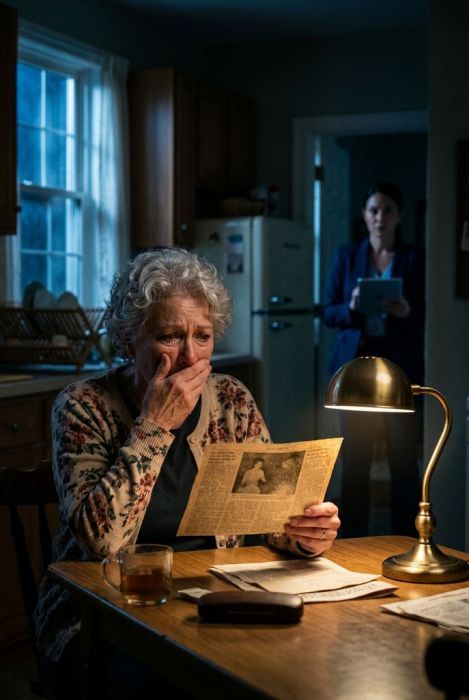
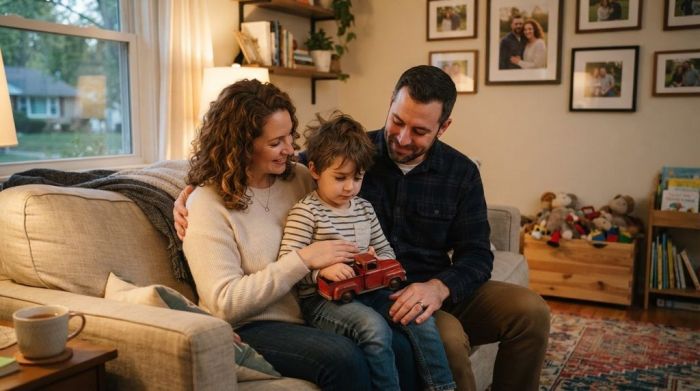
Emma and Jake Patterson had been preparing a room for a child for four years, and in all that time, it had never held a single toy.
\nThe room was at the end of the hallway, a small bedroom with a window that faced the backyard. Emma had painted it a soft, neutral yellow the month they got married, back when they thought children would come easily. She had imagined a crib against the far wall, a rocking chair by the window, a mobile of paper cranes hanging from the ceiling. But the crib never came. The rocking chair stayed in the catalog. The mobile existed only in her mind, like so many other things she had planned for a life that had not materialized.
\nJake was a welder at a fabrication shop on the outskirts of Dayton, Ohio. He was thirty-four years old, with steady hands and a quiet heart. He had been the one to suggest adoption, three years into their marriage, when the fertility treatments had failed and the doctor had used words like "unexplained infertility" and "low probability" and "I'm sorry." Emma had cried for three days. And then she had agreed, because she wanted to be a mother more than she wanted to be pregnant, and because Jake had held her hand and said, "There are so many children who need a home. Our home. Let's give them one."
\nThe foster care certification process took eleven months. There were classes, home inspections, background checks, and a mountain of paperwork that seemed designed to test their resolve. They passed everything. They were approved as foster parents in March of 2022. And then they waited.
\nThe first placement came in June. A baby girl, three months old, with a tuft of black hair and eyes that seemed to look right through you. Her name was Diana. She stayed with them for six weeks. And then the court reunified her with her mother, who had completed her drug treatment program. Emma cried when the social worker came to pick Diana up. Jake held her and said, "We knew this might happen. We knew she might not stay."
"I know," Emma said. "But knowing doesn't make it easier."
\nThe second placement was a boy named Marcus, eighteen months old, with a smile that could light up a room. He stayed for four months. Then his grandmother, who had been fighting for custody, won her case. Marcus went to live with her in Cincinnati. Emma cried again. Jake held her again.
\nThe third placement was a sibling group — two girls, ages four and seven. They stayed for three weeks. Then their aunt, who had been living in Florida, moved back to Ohio and took them in. The fourth placement was a newborn who stayed for exactly two days before the state found a relative placement.
\nSeven children in three years. Seven beds that were slept in for a few nights or a few months. Seven toothbrushes that sat in the bathroom cup holder. Seven favorite meals that Emma learned to cook. Seven goodbyes that broke her heart a little more each time.
\nAnd through it all, the yellow room at the end of the hallway remained empty except for the furniture that waited, patient and silent, for a child who would stay.
\nJake tried to be strong. He was good at being strong. He went to work every day, welded steel beams, came home, and held his wife while she cried. But there were nights when he lay awake, staring at the ceiling, wondering if he was doing the right thing. Wondering if the pain was worth it. Wondering if he could keep opening his heart to children who would leave.
He never told Emma about those nights. He thought she carried enough without adding his doubts to the weight. But she knew. Wives always know. And she loved him more for his silence, even as it broke her heart.
\nThe call came on a Tuesday afternoon in October. Emma was at the grocery store, picking up ingredients for a lasagna she had planned to make for dinner. Her phone buzzed with a number she recognized — the foster care agency. She answered it in the middle of the produce aisle, holding a bunch of bananas in one hand and her future in the other.
\n"Emma," said the social worker, a woman named Karen who had been with them through every placement, "I have a situation I need to talk to you about."
\nEmma's heart dropped. She set down the bananas. "What kind of situation?"
\n"A little boy. Five years old. His name is Marcus — not the same Marcus from before. He's been in emergency foster care for the past week. His mother was arrested for drug possession. His father is not in the picture. The previous foster home had to step back because of a family emergency. He needs a placement tonight."
Emma felt the familiar mix of hope and fear rise in her chest. "How long? Do we know anything about his needs?"
\n"He's experienced trauma. He's been acting out — hitting, biting, screaming. The previous home said he's been through a lot. He needs patience, Emma. A lot of it."
\nEmma looked at the bananas in her hand. She thought about the yellow room. She thought about the seven children who had come and gone. She thought about Jake, who would come home from work tired and hopeful and afraid, all at the same time.
\n"We'll take him," she said.
\nMarcus arrived at seven o'clock that evening, carried by a social worker who looked exhausted. He was small for his age, with dark circles under his eyes and a Batman backpack that was held together with duct tape. He did not look at Emma when she knelt down to greet him. He did not look at Jake when he offered him a handshake. He walked into the house with his head down, clutching the backpack like it was the only thing in the world that belonged to him.
\n"I'm hungry," he said. It was the first thing he said. Not hello. Not who are you. Just "I'm hungry," as if he had learned that food was not something you could take for granted.
Emma made him a grilled cheese sandwich. He ate it in three bites. She made him another one. He ate that too. Then he asked if he could see his room.
\nEmma led him to the yellow room at the end of the hallway. She had spent the afternoon preparing it — a new bedspread with dinosaurs on it, a small basket of toys she had bought on the way home, a nightlight shaped like a rocket ship. Marcus stood in the doorway and looked at the room. He did not smile. He did not say thank you. He walked to the bed, climbed onto it, and curled into a ball with his back to the door.
\nThat was how the first week went. Marcus did not speak unless he was asked a direct question. He did not make eye contact. He flinched when Jake reached for the salt shaker at dinner. He had nightmares every night, screaming himself awake in the dark, and Emma would sit beside his bed for hours, whispering that he was safe, that he was loved, that no one was going to hurt him.
\nHe did not believe her. He had no reason to.
\nThe second week was worse. Marcus started acting out at school — hitting a classmate who had bumped into him, throwing a chair when a teacher tried to calm him down. The school called Emma. Emma picked him up early. In the car, Marcus sat in the back seat with his arms crossed, staring out the window, refusing to speak.
"Marcus," Emma said gently, "I'm not angry. I just want to understand what happened."
\nSilence.
\n"Did something happen at school? Did someone hurt you?"
\nSilence.
\nEmma pulled the car over and turned around to face him. "Marcus, I need you to know something. I'm not going to send you away. No matter what you do, no matter how hard it gets, I'm not going to send you away. You are safe here. You are wanted here. And I will say it a thousand times if that's what it takes for you to believe it."
\nMarcus looked at her. His eyes were hard, the eyes of a child who had learned that adults broke promises. But something flickered behind them — something that looked like hope, buried so deep that he had probably forgotten it was there.
\n"My mom said that too," he said quietly. "Before she left."
\nEmma felt her heart crack. "I know, baby. I know. And I'm so sorry that happened to you. But I'm not your mom. I'm someone else. And I'm going to prove it to you. One day at a time."
\nThe breakthrough came on a Thursday night, three weeks after Marcus arrived. Jake had come home from work late, his hands still dirty from the shop, and found Marcus sitting alone in the living room, holding a small toy truck Emma had bought him. He was not playing with it. He was just holding it, running his thumb over the wheels, staring at nothing.
Jake sat down on the floor beside him. He did not say anything. He just sat there, the way he had learned to sit with his wife when she was sad, the way he had learned to sit with the silence that filled the yellow room.
\nAfter a long time, Marcus spoke. "My dad used to have a truck like this."
\nJake did not react. He did not lean in or ask questions. He just stayed present, the way he had learned to stay present when something fragile was finally emerging.
\n"He left," Marcus said. "A long time ago. I don't remember his face."
\nJake nodded slowly. "That must be really hard."
\nMarcus looked at him. His eyes were wet, but he was not crying. Not yet. "Why do people leave?"
\nJake considered the question carefully. He thought about his own father, who had worked two jobs and was never home. He thought about the seven children who had come and gone. He thought about the yellow room, and the hope that had never quite died, no matter how many times it had been tested.
\n"I don't know why people leave," Jake said. "But I know why people stay. Because they love someone. And love is stronger than the things that make people leave."
Marcus looked at the toy truck in his hands. "Are you going to stay?"
\nJake did not hesitate. "Yes. I'm going to stay."
\nAnd then, for the first time in three weeks, Marcus leaned over and rested his head against Jake's arm. He did not hug him. He did not say anything. He just leaned, the way a child leans when they are tired of carrying the weight alone.
\nJake sat very still, afraid that any movement might break the spell. He felt the warm weight of the boy against his arm, and he thought about all the nights he had lain awake, wondering if he was strong enough to keep doing this. He was not strong enough. But he was here. And that was enough for now.
\nThe call came six months later, on a bright April morning. Karen, the social worker, had news. Marcus's mother had completed her rehabilitation program. She had a job, an apartment, and a lawyer. She was petitioning the court for reunification.
\nEmma listened to Karen's words, and she felt the familiar weight settle onto her chest. The weight of loving a child who might leave. The weight of preparing a room that might become empty again. She set down the phone and walked to the yellow room, where Marcus was sitting on the floor, building a tower out of blocks.
He was different now. He laughed. He told jokes. He called Emma "Mom" without thinking about it, and then corrected himself, and then called her "Mom" again the next day. He had made friends at school. He had stopped having nightmares. He was a boy who had learned to trust, and the thought of sending him back to a mother who had abandoned him was a pain that Emma could not put into words.
\nBut she knew the system. She knew that reunification was the goal. She knew that Marcus's mother deserved a second chance. And she knew, with a certainty that came from somewhere deeper than logic, that she had to let him go if that was what the court decided.
\nThe hearing was scheduled for May. Emma and Jake attended, sitting in the back of the courtroom, holding hands. Marcus's mother was there — a woman in her early thirties, clean and sober, with tears in her eyes and a folder of certificates from her program. She looked at Marcus the way Emma looked at him. With love. With fear. With hope.
\nThe judge listened to the evidence. The social worker recommended reunification with ongoing support. Marcus's lawyer, a young woman who had spent time with him, agreed. And then the judge asked Marcus if he wanted to say anything.
\nMarcus walked to the front of the courtroom. He was small, and the room was big, and every eye was on him. He looked at his mother, who was crying. He looked at Emma and Jake, who were holding their breath. And then he said something that no one expected.
\n"I want to stay with Emma and Jake," he said. "But I want to see my mom too. I want both."
\nThe courtroom was silent. The judge looked at Marcus's mother, who nodded through her tears. She had known, in her heart, that she could not undo the years of absence overnight. She had known that her son had found a home, and that love was not a finite resource. It could be shared.
\nThe judge made a decision that day. Marcus would remain with Emma and Jake as a foster placement, with a plan for open adoption. His mother would have visitation rights, and if she continued to show progress, she would remain a part of his life. It was not the traditional outcome. But it was the right one.
\nThat was a year ago.
\nThe adoption was finalized on a Saturday in June, in the same courthouse where the hearing had been held. Marcus wore a little suit that Emma had bought him, and he carried the toy truck that Jake had given him on the night they first met. His mother was there, sitting in the front row, holding a bouquet of sunflowers. She was sober. She was employed. She was a part of Marcus's life, and she came over for dinner every other Sunday.
\nAfter the ceremony, they went home to the house on Maple Street. Marcus ran to the yellow room — his room — and jumped onto the bed. The walls were covered with his drawings now. The toy box was overflowing. The rocket ship nightlight glowed in the corner.
\nEmma stood in the doorway, watching him. Jake stood behind her, his hand on her shoulder.
\n"We did it," Emma whispered.
\n"No," Jake said, pulling her close. "He did it. He trusted us. And we proved him right."
\nMarcus looked up from his bed. "Mom? Dad? Can we get pizza tonight?"
\nEmma laughed, the kind of laugh that came from somewhere deep and real. "Anything you want, baby. Anything you want."
\nThe room at the end of the hallway is not yellow anymore. Marcus wanted it blue, so Emma painted it blue. The walls are covered with drawings of dinosaurs and spaceships and a family of three — a mom, a dad, and a boy with a gap-toothed smile. The toy truck sits on the nightstand, next to a framed photograph of a woman who visits every other Sunday.
\nEmma and Jake Patterson spent four years preparing a room for a child who would stay. They learned that staying is not about never leaving. It is about coming back. It is about choosing, every single day, to be present for someone who is learning to trust. It is about understanding that love is not a finite resource — it is something that grows the more you give it away.
\nAnd in the end, it is not the room that matters. It is the people who fill it.