Thomas Rivera never expected to find a reason to hope again in the greenhouse behind West Mesa High School. But that is exactly what happened on a hot September afternoon, when a sixteen-year-old girl with a broken spirit and a secret climbed through the window of the greenhouse and changed everything.
Tommy was thirty-two years old, and he had been the groundskeeper at West Mesa High in Las Cruces, New Mexico, for ten years. He was a quiet man, the kind who nodded instead of spoke, who kept his eyes on the ground and his hands busy with the work that needed to be done. The students passed him in the hallways without seeing him. The teachers knew him as the man who kept the campus beautiful, but none of them knew his story.
He had not always been a groundskeeper. Ten years ago, he had been a promising architect in Albuquerque, designing buildings that would never be built because the recession hit and the projects dried up and his marriage collapsed under the weight of unpaid bills and unfulfilled dreams. He had lost everything in the space of eighteen months — his career, his wife, his apartment, his sense of who he was. He had moved to Las Cruces because it was cheap and quiet and no one knew him. He had taken the groundskeeper job because it required no explanations, no resumes, no conversations about what he used to be.
He built a small greenhouse behind the school's agricultural wing, using salvaged materials and his own hands. It was his sanctuary, the place where he could forget about the life he had lost and focus on the small, quiet miracles of seeds sprouting and flowers blooming. He grew tomatoes, peppers, marigolds, and roses. He grew them because they asked nothing of him except water and sunlight, and they gave back beauty without demanding anything in return.
The girl appeared on a Thursday afternoon in late September, just as the monsoon season was ending and the New Mexico sun was beginning to soften into autumn. Tommy was in the greenhouse, repotting a batch of basil seedlings, when he heard the door creak open. He looked up to find a teenage girl standing in the doorway, her arms wrapped around herself, her eyes red from crying.
She was sixteen, maybe seventeen. She had dark hair pulled into a messy ponytail and wore a hoodie that was too big for her thin frame. She looked at him with the wary, defensive gaze of someone who had learned that adults were not to be trusted.
"I'm not supposed to be here," she said. "I know. I'm skipping class. Call the office if you want."
Tommy looked at her for a long moment. He saw the way her hands trembled, the way her jaw was clenched, the way she held herself like she was bracing for a blow. He had seen that posture before. He had worn it himself, in the years after everything fell apart.
"I'm not going to call the office," he said. "I'm just planting basil. You can stay if you want. Or you can go. It's up to you."
She stared at him, trying to read his intentions. Then she walked to the corner of the greenhouse, slid down the wall, and sat on the concrete floor with her knees pulled up to her chest. She did not speak. She just sat there, watching him work, the silence stretching between them like a bridge that neither of them knew how to cross.
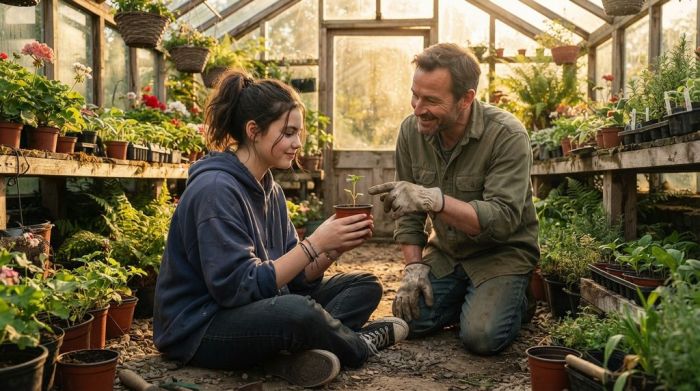
Her name was Elena. Tommy learned this over the following weeks, as she continued to appear in the greenhouse during her skipped classes. She did not talk much, but she watched. She watched him mix soil, sow seeds, transplant seedlings. She watched him prune the rose bushes and stake the tomato plants. And one day, without being asked, she picked up a trowel and started helping.
Tommy did not comment on it. He simply handed her a tray of marigold seedlings and showed her how to loosen the roots before planting them in the ground. She followed his instructions with a concentration that suggested she was used to following instructions from people who did not have her best interests at heart, and she was trying to decide if Tommy was different.
He was different. He did not ask about her grades, her parents, or why she was skipping class. He did not lecture her about the importance of education or the dangers of making bad choices. He simply talked about the plants — about the way marigolds deterred pests, about the patience required to grow tomatoes from seed, about the particular satisfaction of watching something you planted with your own hands grow into something beautiful.
Elena started coming every day. She would appear in the greenhouse during third period, when she was supposed to be in English class, and she would stay until the lunch bell rang. She helped Tommy water the plants, weed the beds, and prepare the soil for the winter crops. She was not very good at it at first, but she learned quickly. She had the kind of hands that were patient and careful, the kind of attention to detail that Tommy recognized from his own days as an architect.
One afternoon in October, as they were planting a row of winter lettuce, Elena spoke without looking up. "My mom doesn't know I'm here. She thinks I'm in class. She works two jobs and she's too tired to check."
Tommy nodded, keeping his hands in the soil. "You don't have to tell me anything you don't want to tell me."
"I know." She was quiet for a long moment. Then, in a voice so soft he almost missed it, she said, "I'm pregnant."
Tommy's hands paused. He looked at her — at her young face, at the fear she was trying so hard to hide, at the way she was bracing herself for his judgment. He set down his trowel and sat back on his heels.
"How far along are you?"
"Four months. I haven't told anyone. Not my mom. Not the father. He's a senior. He's going to college next year. He doesn't want to know."
"How do you feel about that?"
Elena looked up at him, and her mask cracked. Her eyes filled with tears, and she bit her lip to keep from sobbing. "I feel like I'm disappearing. Like I'm becoming invisible. Like I'm carrying this huge secret inside me and it's going to swallow me whole."
Tommy sat beside her on the ground, the lettuce seedlings forgotten, the afternoon sun streaming through the greenhouse glass. "I know what that feels like," he said. "To carry something so heavy that you think it's going to crush you."
"You don't know. You're a grown-up. You have your life together."
Tommy almost laughed. "I have a greenhouse and a toolshed. I live in a one-bedroom apartment with furniture from a thrift store. Ten years ago, I was a licensed architect with a wife and a house and a future I believed in. I lost all of it. And I spent years feeling like I was disappearing too."
Elena stared at him. She had never heard him speak more than a few words at a time, and now he was telling her something that felt like a confession. "What did you do? How did you survive?"
Tommy looked at the rows of seedlings, the delicate green shoots reaching toward the light. "I learned to plant things," he said. "I learned that when everything else falls apart, you can still put a seed in the ground and watch it grow. It's not a solution to your problems. But it's a reminder that life keeps going. That you can start over, even when you don't think you can."
Elena was quiet for a long time. Then she said, "I don't know if I can do this."
"You don't have to know. You just have to take the next step. And then the next one."
That was the beginning of something neither of them could have predicted. Elena started coming to the greenhouse every day, and Tommy started teaching her everything he knew. Not just about plants, but about patience, about resilience, about the slow, steady work of building a life from the ground up.
She told him the full story over the months that followed. The father of her baby was a boy named Jason, a star athlete who had promised to stand by her and then disappeared when she told him the news. Her mother worked sixty hours a week as a home health aide and would be devastated by the news. Elena had been carrying the secret alone for four months, and it had been slowly destroying her.
Tommy listened. He did not judge. He told her about his own failures — the marriage he had let wither, the career he had abandoned, the years he had spent hiding from a world that had hurt him. He told her that the bravest thing a person could do was not to avoid mistakes, but to keep going after making them.
As winter approached, Tommy helped Elena prepare the greenhouse for the cold months. They built a small heater from a clay pot and a candle. They mulched the beds. They planted a crop of winter vegetables that would survive the frost. And Elena started to change. The fear in her eyes began to soften into something that looked like determination. She started talking about the baby as a real person, not a secret she was carrying. She started making plans.
In December, she told her mother. Tommy was there — at her request, sitting beside her in the small living room of their apartment while her mother processed the news. There were tears and anger and fear, but there was also love. Her mother, a woman named Rosa who had been working herself to exhaustion to keep them afloat, held her daughter and said the words that Elena had been desperate to hear: "We will figure this out. Together."
In January, Elena returned to school. She was showing now, her belly round and visible under her oversized hoodies. The whispers started immediately. The stares. The judgment. But Elena had changed. She walked through the hallways with her head held high, not because she was not afraid, but because she had learned that courage was not the absence of fear. It was the decision to keep going despite it.
She still came to the greenhouse every day. She helped Tommy start the spring seedlings — tomatoes, peppers, basil, marigolds. She talked to the plants the way Tommy talked to them, with a gentle voice and patient hands. And she talked to Tommy about her plans — to finish high school, to take parenting classes at the community center, to build a life for herself and her baby.
"You know," she said one afternoon, as they were transplanting pepper seedlings into larger pots, "you're the only adult who didn't tell me what to do. You just... let me figure it out."
Tommy smiled. "That's what plants need too. You can't force them to grow. You just give them the right conditions and trust them to do the rest."
Elena's baby was born on a warm April evening, just as the greenhouse was bursting into its spring bloom. A girl. Seven pounds, three ounces. Elena named her Sofia, after her grandmother, who had passed away when Elena was twelve. Tommy was the first person Elena called after her mother. He drove to the hospital, holding a bouquet of roses he had grown in the greenhouse, and he met Sofia when she was four hours old.
He held her in his arms, this tiny, perfect creature, and he felt something shift inside him. He had spent ten years hiding from the world, convinced that he had nothing left to offer. But here, in a hospital room in Las Cruces, holding the daughter of a teenage girl who had stumbled into his greenhouse six months ago, he realized that he had been wrong. He had been planting seeds all along. He just had not known what they would grow into.
That was four years ago.
Tommy Rivera is thirty-six now. He is still the groundskeeper at West Mesa High, but he is also something else. He is the founder of the West Mesa Community Garden, a project he started with Elena's help, using the greenhouse as a base. The garden provides fresh vegetables to families in need, hosts after-school programs for at-risk students, and has become a gathering place for a community that had forgotten how to gather.
Elena is twenty years old. She graduated from high school with honors, and she is studying nursing at the community college. Sofia is four, a bright, curious girl with her mother's eyes and her mother's stubbornness. She calls Tommy "Tío" — uncle — and she spends every Saturday morning in the greenhouse, helping him water the plants and wearing a tiny pair of gardening gloves that he bought for her second birthday.
Last spring, Elena organized a community fundraiser to expand the greenhouse. She stood in front of the town council, holding Sofia's hand, and told the story of how she had walked into a greenhouse five years ago, lost and afraid, and found a man who taught her that she could grow something beautiful out of the rubble of her life. The council approved the funding unanimously. The expansion broke ground in June.
Tommy still lives in his one-bedroom apartment with the thrift store furniture. He still drives the same beat-up truck. He still wears the same worn work boots. But he no longer feels like he is hiding. He walks through the hallways of West Mesa High, and the students wave at him. The teachers invite him to their staff parties. The principal calls him "the heart of this campus."
And every evening, before he locks the greenhouse for the night, Tommy walks through the rows of plants, checking the soil, touching the leaves, whispering the same words he whispered to Elena on that first day: "You don't have to know everything. You just have to take the next step."
Because that is the truth about seeds. You plant them in the dark, in the uncertainty, in the faith that something will grow. You water them. You wait. And you trust that the same force that pushes a seedling through the soil is the same force that pushes a broken person toward healing.
Tommy Rivera lost everything when he was thirty-two years old. He spent ten years building a life out of soil and seeds and silence. And then a sixteen-year-old girl climbed through the window of his greenhouse, and he realized that he had been planting more than tomatoes all along. He had been planting hope. And hope, unlike any crop he had ever grown, had a way of spreading far beyond the garden where it was planted.