Mari Torres never expected to find a rocket scientist at her donut shop. But on a sleepy Saturday morning in January, an elderly man walked through the door of the Donut Nook on Main Street in Spring Green, Wisconsin, ordered a plain glazed donut and black coffee, and changed everything.
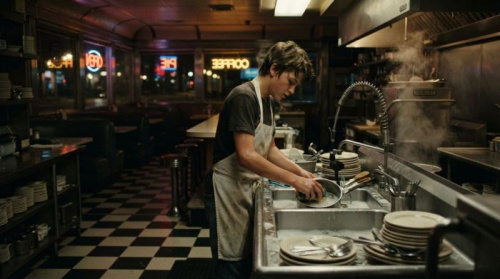
Mari was twenty-nine years old, and she had been waking up at 3:30 AM every morning for the past four years. She was the owner, head baker, and only full-time employee of the Donut Nook, a small shop she had inherited from her grandmother two years ago. Her grandmother had opened it in 1987, and the place still smelled like the same mix of yeast, sugar, and old coffee that Mari remembered from her childhood Saturdays.
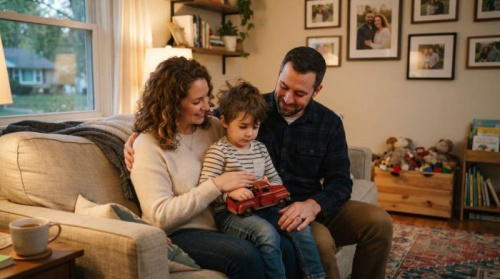
Her son Mateo was seven years old, with a mess of dark hair that refused to stay combed and a gap between his front teeth that appeared every time he smiled. He wanted to be an astronaut. He had wanted to be an astronaut since he was four years old, when his grandmother had taken him to the Adler Planetarium in Chicago and he had stood in front of the scale model of the solar system with his mouth hanging open. His bedroom walls were covered with posters of the Milky Way, the Andromeda Galaxy, the surface of Mars. He had a telescope that was older than Mari, a hand-me-down from a neighbor, and he spent every clear night on the back porch naming the constellations out loud.
Mari's ex-husband, a man named Derek who had decided that fatherhood was not for him, had left when Mateo was two. She did not talk about him anymore. There was nothing to say. She worked, she parented, she slept, and she woke up at 3:30 AM to do it all over again. It was not the life she had imagined for herself. But it was the life she had, and she was grateful for it.
The elderly man appeared on a Saturday in late January, when the Wisconsin winter had settled into the bones of the town and the snow was piled so high against the windows that the Donut Nook felt like a ship floating in a white sea. He was small and silver-haired, with the kind of face that had been creased by a lifetime of either smiling or squinting — Mari could not tell which. He wore a thick wool coat and a cap with ear flaps, and he carried a leather satchel that looked like it had been with him for decades.
He ordered a plain glazed donut and a black coffee. He paid with exact change. And then he walked to the corner booth, the one by the window, and sat down.
Mari did not think much of it. The Donut Nook had its regulars, and new faces appeared now and then. But the man returned the next Saturday. And the Saturday after that. And the Saturday after that. He always ordered the same thing. He always sat in the same booth. And he always pulled out a small sketchbook from his satchel and drew while he drank his coffee.
Mateo noticed him before Mari did. That was how it worked with kids — they saw the things adults had trained themselves to overlook.
On a Saturday in March, when the snow was finally beginning to melt and the first hints of spring were visible in the bare branches of the maples on Main Street, Mateo was sitting at the counter doing his homework. He was supposed to be working on a math worksheet, but his attention had drifted to the old man in the corner booth. Specifically, he was watching the man's hands move across the sketchbook.
Mari caught him staring. "Mateo, finish your homework."
"Mom, what is he drawing?"
"I don't know, baby. Don't stare. It's rude."
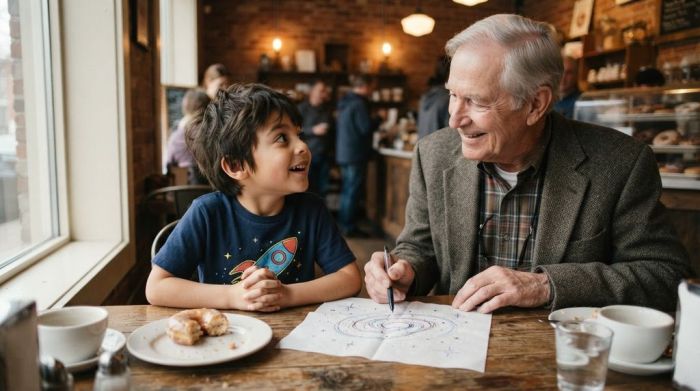
But Mateo could not stop staring. Because the old man was not drawing a landscape or a portrait or a bowl of fruit. He was drawing something that looked like a galaxy — spirals of ink, clusters of dots, lines that curved and twisted like the arms of the Milky Way.
Mateo slid off his stool. Before Mari could stop him, he walked to the old man's booth and stood there, his hands clasped behind his back, his eyes wide.
"Excuse me, sir," he said. "Are you drawing a galaxy?"
The old man looked up. His eyes were a pale blue, the color of winter sky, and they softened when he saw the boy standing in front of him. "It's a spiral galaxy," he said. "NGC 4414, to be exact. About sixty-two million light-years from Earth."
Mateo's jaw dropped. "Sixty-two million? That's really far."
"It is. But light travels fast. The light we see from that galaxy left it sixty-two million years ago, when dinosaurs were still walking the Earth."
"You know a lot about space."
"I used to. I worked on a project that studied galaxies like this one."
Mateo climbed into the booth across from the old man without being invited. "What project?"
The old man smiled. It was a slow smile, the kind that took a moment to arrive but stayed a long time after it got there. "It was called the Hubble Space Telescope. Have you heard of it?"
Mateo's eyes went so wide that Mari thought they might fall out of his head. "You worked on HUBBLE? The Hubble Space Telescope? The one that took the picture of the Pillars of Creation?"
"I was a lead engineer on the optics team. I helped design the mirrors that took those pictures."
Mari set down the coffee pot she was holding. She walked over to the booth, wiping her hands on her apron. "I'm sorry, sir. I didn't catch your name."
"Kowalski," the old man said. "Arthur Kowalski. Retired. And your son is very polite."
"I'm Mari. This is Mateo. And I think you just made his entire year."
Arthur Kowalski had moved to Spring Green after his wife passed away three years ago. He had chosen the town because it was quiet and cheap and because his daughter lived in Madison, only an hour away. He had been coming to the Donut Nook on Saturday mornings because it was the only place in town where the coffee was strong enough to remind him of the pots he used to drink at the Goddard Space Flight Center in Maryland.
He had not expected to meet a seven-year-old boy who could name every planet in order and knew what a light-year was.
Mateo, for his part, had not expected to meet someone who had actually touched the Hubble Space Telescope.
That was the beginning of something neither of them could have predicted.
Every Saturday, Arthur arrived at the Donut Nook at 8 AM, ordered his plain glazed donut and black coffee, and sat in the corner booth. And every Saturday, as soon as the door opened, Mateo was there. He would slide into the booth across from Arthur, and they would talk about space for the next hour.
Arthur taught Mateo about the electromagnetic spectrum. He showed him how to calculate the distance to a star using parallax. He drew diagrams of black holes and explained event horizons. He brought photographs from his old days at NASA — actual photographs, yellowed with age, showing him standing next to giant mirrors and complex machinery. Mateo treated these photographs like religious relics.
One Saturday in May, Arthur arrived with a gift. It was a small box, wrapped in brown paper. He set it on the table in front of Mateo and said, "Open it."
Inside was a model of the solar system — hand-carved from wood, with each planet painted in its approximate color. The Sun was at the center, a sphere of painted gold. The planets were arranged on thin brass rods, their orbits traced in delicate lines. It was the most beautiful thing Mateo had ever seen.
"I made it," Arthur said. "I had a lot of time on my hands this winter. I thought you might like it."
Mateo threw his arms around Arthur's neck. The old man stiffened for a moment, surprised, and then his arms came up and he hugged the boy back. Mari watched from behind the counter, her hand over her mouth, tears streaming down her face.
Arthur started coming to the Donut Nook on other days too. He would show up on Tuesday afternoons and help Mateo with his science homework. He would stay for dinner on Friday nights, eating Mari's homemade lasagna at the small table in the back room. He told them stories about his thirty-seven years at NASA — about the launches he had witnessed, the problems he had solved, the colleagues who had become family. He told them about his wife, Elena, who had been a high school science teacher and had believed that every child deserved to know how the universe worked.
In June, Mari received a letter from the school district. Mateo had been selected to attend a summer space camp at the University of Wisconsin-Madison — a week-long program for gifted students interested in astronomy. The program was free, but it required transportation. Madison was an hour away. Mari closed the Donut Nook early on Fridays. She could not afford to close it more often than that.
Arthur solved the problem. He showed up at the Donut Nook on Saturday morning and announced, "I'll drive him. I'm retired. I have nothing but time. And I know the campus — I gave a lecture there in 1998."
Mari started to protest, but Arthur held up his hand. "Let me do this," he said. "Please. It's been a long time since I had a reason to get out of bed in the morning. Your son gave me that reason back. Let me give him something in return."
She nodded, unable to speak.
So Arthur drove Mateo to Madison every day that week. They left at 7 AM and returned at 6 PM. On the drive, they listened to podcasts about space exploration. They played games identifying constellations. Arthur told Mateo about the time he had met Buzz Aldrin at a conference, and Mateo asked so many questions that his voice went hoarse.
On the last day of camp, the parents were invited to a presentation. Mari closed the Donut Nook for the afternoon — the first time she had closed it for a non-emergency in four years. She sat in the back of the lecture hall, next to Arthur, and watched her son stand at the front of the room and give a five-minute presentation on the potential for human colonization of Mars.
He was nervous. His voice cracked. He forgot his place twice. But he kept going. And when he finished, the room erupted in applause. Mari turned to Arthur, and she saw that he was crying. He was sitting in the chair, his hands folded in his lap, tears running down his face, a smile that seemed to contain every star in the universe.
"He's going to do it," Arthur whispered. "He's going to go to space. I won't be here to see it. But he's going to go."
"You will be here," Mari said firmly. "You're going to live to be a hundred, and you're going to watch him on television, and you're going to tell everyone that you knew him when he was a seven-year-old boy with a telescope and a dream."
Arthur laughed through his tears. "I'll hold you to that."
That was two years ago.
Mateo is nine now. He was accepted into a magnet program for gifted science students at the middle school. He still wants to be an astronaut. He still spends his Saturday mornings at the Donut Nook, sitting in the corner booth across from an old man with a sketchbook full of galaxies.
Arthur Kowalski is eighty-four now. His hands are slower, and his eyes are not what they used to be. But he still draws. He still teaches. He still shows up every Saturday at 8 AM, orders a plain glazed donut and a black coffee, and waits for the boy who changed his life.
Mari Torres is thirty-one. The Donut Nook is still open. She still wakes up at 3:30 AM, but she no longer feels like she is just surviving. She has a son who is going to be an astronaut. She has a friend who helped him believe it was possible. And she has a counter where, every Saturday morning, a nine-year-old boy and an eighty-four-year-old engineer sit across from each other and talk about the stars.
Last week, Arthur pulled Mari aside after his Saturday coffee. He reached into his satchel and pulled out a small envelope. Inside was a check for five thousand dollars, made out to the Donut Nook.
"What is this?" Mari asked, her hands trembling.
"It's for Mateo's college fund," Arthur said. "Start one. Put this in it. And every year, on his birthday, I will add more."
"Arthur, I can't —"
"You can. You will. I have more money than I know what to do with. My wife and I never had children. Mateo is the closest thing I will ever have to a grandson. Let me do this."
Mari hugged him. She hugged him the way she had wanted to hug him on that first Saturday, when she was still too afraid to hope. "Thank you," she whispered. "For everything."
Arthur patted her arm with his papery hand. "Thank you for the donuts. And for the boy. You gave me a reason to keep drawing galaxies."
Somewhere in Spring Green, Wisconsin, there is a small donut shop on Main Street. The coffee is strong, the donuts are fresh, and the corner booth by the window is always reserved. If you come on a Saturday morning, you will see an old man and a young boy sitting across from each other, a sketchbook open between them, talking about the stars.
And if you listen closely, you will hear the quiet, steady sound of a dream being passed from one generation to the next — not through blood, but through the simple, sacred act of showing up.