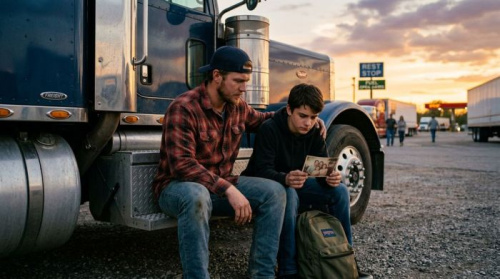
Danny McAllister was sixteen years old when he became the man of the house, not because his father had died, but because his father had simply disappeared. The last time Danny saw his father was a Tuesday morning in March. The man had walked out the door with a duffel bag and a mumbled promise to "find work out West." He never came back. He never called. He never sent a dime.
That was eighteen months ago.
His mother, a waitress at the Blue Moon Diner on Main Street in Harlan, Kentucky, held on for a year after that. She worked double shifts, came home with swollen feet and hollow eyes, and tried her best to keep the small rental house on Chestnut Street from falling apart. But the grief of being abandoned, the exhaustion of carrying everything alone, and the slow erosion of hope that had once kept her going — it all caught up with her one rainy night in September.
She left while Danny was at school. She left a note on the kitchen table, held down by a salt shaker shaped like a rooster. The note said she was sorry. It said she loved him and his little brother, Toby, more than anything. It said she needed to "find herself" and that she would come back when she was better. Danny read the note seventeen times, each time hoping the words would rearrange themselves into something less devastating. They never did.
He was fifteen years old. Toby was seven. And they were alone.
Danny made a decision that afternoon that would define the rest of his life. He folded the note, put it in his pocket, and walked to the Blue Moon Diner. He found Mabel Patterson, the owner, a woman in her sixties with steel-gray hair and a heart as big as the Kentucky sky. He told her what had happened. He asked for a job.
Mabel looked at him for a long moment, the way she looked at everyone who walked through her door — with the patient, knowing eyes of someone who had seen too much to be surprised by anything. She reached across the counter and took his hand. "You start tonight," she said. "Dishwashing and busing tables. Minimum wage. And you eat dinner here every night, on the house. I don't want to hear any arguments about it."
Danny nodded, unable to speak.
"And Danny," Mabel added, her voice softening, "if you ever need anything — anything at all — you come to me. You hear?"
He heard. He would remember those words on the nights when the weight of being both brother and father felt too heavy to carry.
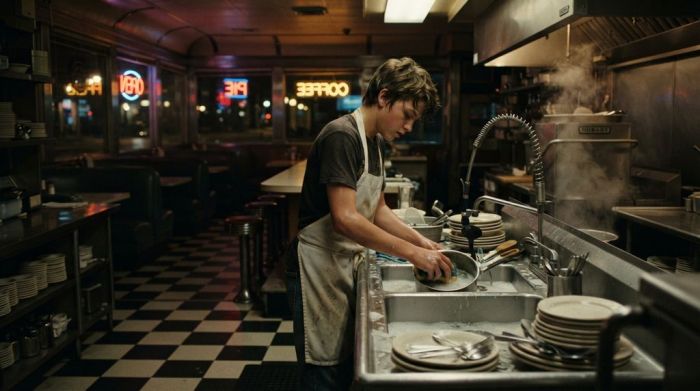
For the next ten months, Danny lived a double life. He woke at six every morning, made Toby's breakfast — usually oatmeal or cold cereal — walked him to the bus stop, and went to school himself. He sat in the back of his classes, took notes mechanically, and kept his head down. He never raised his hand. He never stayed after school. He never told anyone about his mother's note. After school, he picked up Toby from the neighbor's house — an elderly widow named Mrs. Kowalski who watched Toby for free — and walked him home. He helped Toby with his homework, made dinner from whatever was in the cupboards, read him a story, and tucked him into bed by eight o'clock. And then, at nine, he walked the ten blocks to the Blue Moon Diner, where he washed dishes, bused tables, and mopped floors until two in the morning.
After his shift, he walked home through the empty streets of Harlan, the autumn air turning cold against his face. He would fall into bed, sleep for four hours, and wake up to do it all over again. He was surviving on coffee, Mabel's free dinners, and the stubborn refusal to let his brother end up in the foster system.
The money was never enough. Minimum wage in Kentucky was seven dollars and twenty-five cents an hour. After taxes, Danny brought home about two hundred dollars a week. The rent on the Chestnut Street house was four hundred and fifty dollars a month. He paid it in cash on the first of every month, sliding the money under the door of the landlord's office before sunrise, hoping he would not ask questions. The utilities — electricity, water, a bare-bones internet plan for Toby's schoolwork — took another hundred and fifty. That left about two hundred dollars a month for food, gas for the ancient pickup truck his father had left behind, and anything else that came up.
He learned to stretch every dollar until it screamed. He learned that canned beans and rice could be made into a dozen different meals. He learned that the church on Elm Street gave out free breakfast on Saturday mornings. He learned that Mrs. Kowalski would never accept money for watching Toby, so he showed up at her door every Saturday with a plate of Mabel's leftover biscuits and a jar of honey.
Toby never knew how bad things were. Danny made sure of it. Toby still got birthday presents — a new baseball glove from the thrift store, a box of crayons, a bag of his favorite candy. Toby still had clean clothes, thanks to Mrs. Kowalski's washing machine. Toby still believed that their mother was "visiting a relative" and would come home soon. Danny did not have the heart to tell him the truth.
But the truth had a way of surfacing, no matter how carefully you buried it.
It came on a cold Tuesday in January, in the form of a truant officer who had noticed that Danny's attendance had slipped. He had missed seventeen days of school — not because he was lazy, but because he had to take Toby to the doctor when the boy's asthma flared up, because he had to stay home when the pipes froze and the landlord took three days to fix them, because sometimes he was simply too exhausted to drag himself out of bed after four hours of sleep.
The truant officer, a young woman named Ms. Rivera, sat across from Danny in the principal's office and asked him questions he could not answer without revealing the truth. Where were his parents? Why was he responsible for his brother's medical appointments? Why did he work until two in the morning on school nights?
Danny sat in the hard plastic chair and felt the walls closing in. He had been so careful. He had been so careful for ten months, and now it was all falling apart because of seventeen missed days.
He did not tell Ms. Rivera the truth. He sat in silence, staring at his hands, waiting for the inevitable. Social services. Foster care. The separation he had been fighting to prevent. He could feel it coming, the way you can feel a storm before it breaks.
But Ms. Rivera did not make a phone call that day. She closed her notebook and looked at Danny with eyes that held something he did not expect: understanding. "I'm going to give you one week," she said. "One week to get your attendance in order. And if you need help — real help — there are people in this town who want to give it to you. You just have to let them."
Danny nodded, not trusting his voice. He walked out of the principal's office and back to his regular classes, but his mind was racing. Ms. Rivera knew. Or at least, she suspected. And if she suspected, it was only a matter of time before someone with a badge and a clipboard showed up at his door.
That evening, Danny did something he had never done before. He told Mabel the full truth. He stood in the kitchen of the Blue Moon Diner, surrounded by the steam of the dishwasher and the smell of grease and coffee, and he told her about the note, about the ten months, about the truant officer, about the fear that had been living in his chest like a permanent resident. When he finished, Mabel set down the plate she was holding, walked over to him, and pulled him into a hug so fierce that it stole his breath.
"You foolish, brave, stubborn boy," she whispered into his hair. "You should have told me months ago."
"I didn't want to be a burden."
"You're not a burden, Danny. You're family."
The next morning, Mabel made a phone call. And by the end of the week, something remarkable happened — something that Danny, in his sixteen years of life, had never experienced before. The town of Harlan, Kentucky, showed up.
Mabel had called Sheriff Collier, a burly man in his early fifties who had lived in Harlan his entire life and knew every back road, every family secret, and every child who was struggling. Sheriff Collier listened to Mabel's story without interrupting. When she finished, he said, "I'll handle the truant officer. You handle the rest."
He did handle it. He called Ms. Rivera and had a conversation that Danny never learned the details of. The truancy case was quietly closed. Ms. Rivera made a note in Danny's file that he was under "exceptional circumstances" and required flexible attendance.
Then Sheriff Collier showed up at Danny's door on a Saturday morning. He was not in uniform. He was wearing a flannel shirt and holding a toolbox.
"I heard you have a leaky pipe in the bathroom," he said. "I'm here to fix it."
Danny stared at him. "I didn't call anyone about a leaky pipe."
"I know. I heard about it anyway. Small towns work that way."
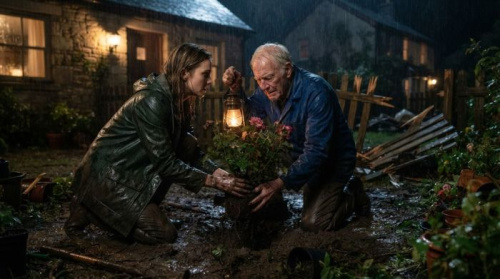
The sheriff fixed the pipe. Then he fixed the broken step on the front porch. Then he came back the next weekend with a load of firewood for the old wood stove that was the house's only source of heat. He never asked for payment. He never made Danny feel like a charity case. He simply showed up, the way people in small towns show up, because that was what you did when a neighbor was in need.
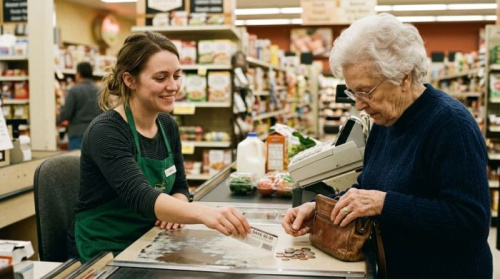
Mrs. Kowalski, who had been watching Toby for free all these months, refused to let Danny pay her. Instead, she started sending him home with Tupperware containers of soup and stew, insisting that he was "skinny as a rail" and needed to eat more. The church on Elm Street, where Danny had been quietly attending Saturday breakfasts, suddenly started leaving a box of groceries on his porch every Thursday night, with no note attached.
And Mabel gave him a raise. She did not tell him she was doing it. He just looked at his paycheck one week and noticed that it was significantly larger than before. When he tried to protest, she pointed a spatula at him and said, "You're worth every penny, and you know it. Now get back to work."
Danny graduated high school in June, a year late, but he graduated. He was nineteen years old, and he had spent three years working the night shift at the Blue Moon Diner, raising his little brother, and learning that the world was full of people who would help you if you let them. He stood on the football field in his cap and gown, the Kentucky sun warming his face, and he looked at the small crowd in the bleachers. Mabel was there, in her Sunday best, crying before his name was even called. Mrs. Kowalski was there, holding a bouquet of flowers she had grown in her garden. Sheriff Collier was there, in his uniform this time, standing at the back with his arms crossed and a smile that cracked his weathered face.
And Toby was there, twelve years old now, holding a sign he had made himself. It said: "My brother is my hero."
Danny walked across the stage, accepted his diploma, and looked at the faces of the people who had carried him through the hardest years of his life. He thought about the note his mother had left on the kitchen table, the one he still carried in his wallet, worn soft from being folded and unfolded a thousand times. He did not hate her anymore. He had forgiven her a long time ago. But he had stopped waiting for her to come back. He had stopped needing her to come back. Because he had found something he never expected to find — a family that was not bound by blood, but by the quiet, stubborn love of a town that refused to let two boys disappear.
Toby ran onto the field and threw his arms around Danny. "You did it!" he shouted. "You did it, Danny!"
Danny hugged him back, lifting him off the ground, the tears coming freely now. "We did it, Toby. We did it together."
Mabel reached them first. She pulled them both into a hug. "I am so proud of you," she said, her voice thick with emotion. "Your mother... she missed out on the best thing that ever happened to her. But we didn't. We got to see you grow up. And that is a privilege I will never take for granted."
Danny looked past Mabel, at the faces of the people who had become his family. Mrs. Kowalski, dabbing at her eyes with a handkerchief. Sheriff Collier, nodding at him with a look that said, "I always knew you would make it." And the quiet presence of the entire town, the people who had left groceries on his porch and paid for his brother's school supplies and never once asked for anything in return.
He thought about the long walk home from the diner at two in the morning. The cold Kentucky nights. The fear that had driven him for three years. The moment he had stood in Mabel's kitchen, terrified and alone, and told her the truth. He thought about the phone calls that had been made, the quiet network of kindness that had wrapped around him like a blanket, the simple miracle of a town that refused to let him fall.
Danny McAllister is twenty-three years old now. He works at a community center in Harlan, running an after-school program for kids who remind him of himself — kids who are carrying too much, too young, without anyone to help them carry it. Toby is sixteen, a sophomore in high school, on the baseball team, making honor roll. They still live in the house on Chestnut Street. Danny bought it last year, with a small loan from the local credit union and a co-sign from Sheriff Collier.
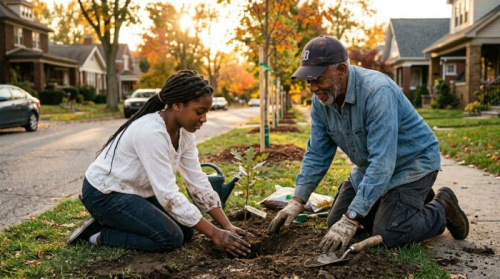
Mabel retired from the diner last spring. She comes over for dinner every Sunday. Mrs. Kowalski passed away two years ago, but Danny still visits her grave every month, leaving a jar of honey and a handful of wildflowers. Sheriff Collier got promoted, but he still stops by the house on Chestnut Street every now and then, just to check in, just to make sure the pipes are not leaking and the porch step is still solid.
And Danny still has the note. It is in a frame now, hanging on the wall above the kitchen table, next to Toby's high school honor roll certificate and a photograph of the Blue Moon Diner's regulars. He does not look at it with anger anymore. He looks at it with gratitude — for the pain that taught him strength, for the loneliness that taught him the value of community, and for the quiet, relentless kindness of a small town in Kentucky that saw two boys alone in the world and decided that they would not stay alone for long.
The boy who worked the night shift at the Blue Moon Diner learned something that most people never learn in a lifetime. He learned that family is not about blood. Family is about who shows up. And the people of Harlan, Kentucky — they showed up.
Every single time.