Nora Chen never expected to become a stepmother at thirty-four. She had been a graphic designer for a decade, living alone in a studio apartment in Chicago's Wicker Park neighborhood, perfectly content with a life that required no one's input but her own. She had a cat named Mochi, a collection of vinyl records, and a standing Friday night dinner date with herself at a ramen shop around the corner. She was happy. Or at least, she had convinced herself she was happy.
Then she met Tom Mercer at a friend's wedding in the summer of 2023. He was forty-two, a structural engineer with kind eyes and a quiet laugh, and he had been a widower for three years. His wife, a high school art teacher named Angela, had died of an aneurysm — sudden, devastating, the kind of loss that left a man walking through the world like a ghost who had forgotten how to haunt properly. He had a daughter named Maya, who was eleven at the time.
Nora did not plan to fall in love with him. It happened slowly, the way ivy grows up a wall — unnoticed at first, then impossible to ignore. They dated for a year. Tom introduced her to Maya cautiously, in small doses — a coffee date, a trip to the farmers market, a Saturday afternoon at the Museum of Science and Industry. Maya was polite, distant, and watchful. She had her mother's dark hair and her mother's habit of biting her lower lip when she was thinking. She also had her mother's absence, a wound that had not healed and that Nora was not sure she was qualified to treat.
They were married in a small ceremony at the Cook County courthouse in October of 2024. Maya stood beside her father, holding a bouquet of white roses, and she did not cry. She did not smile either. She stood with the careful composure of a girl who had learned to control her emotions because showing them had not brought her mother back.
Nora moved into the house in Naperville, a colonial with a backyard that Tom had let go wild since Angela passed. She unpacked her boxes in the bedroom that had once been Angela's study, and she tried not to think about the ghost she was displacing. She redecorated. She painted the walls a soft sage green. She put her own books on the shelves. She tried to make the space hers, but she could feel the weight of the woman who had lived there before, the woman whose photographs were still on the living room mantle, whose handwriting was still on the labels in the pantry.
The first six months were hard. Not catastrophic, but hard in the way that walking through mud is hard — every step required effort, and progress was barely visible. Maya spoke to Nora in monosyllables. She ate dinner with them because her father asked her to, but she kept her eyes on her plate. She called Nora by her first name, not "Mom," and Nora did not push. She knew she had not earned that title.
Tom tried to bridge the gap between them. He suggested they bake cookies together. He suggested they watch movies. He suggested a dozen activities that might create a spark, and each one fizzled before it could catch. Maya was not hostile. She was not cruel. She was simply absent, a girl who had retreated into a fortress of grief and was not ready to let anyone new inside.
Nora did not know what to do. She had read books about blended families. She had talked to therapists. She had prepared herself for resistance, for anger, for the possibility that Maya would never accept her. But she had not prepared herself for the silence. The silence was worse than any outburst, because silence gave her nothing to work with. Silence gave her no clues about what Maya needed, what she feared, what she might be willing to share.
And then, on a rainy Saturday in March, Maya left a cookbook on the kitchen counter.
It was old and worn, the cover held together with masking tape, the pages yellowed and stained. Nora noticed it when she came down to make coffee. She picked it up carefully, the way you pick up something fragile, and opened it. The first page was inscribed in elegant cursive: "To Angela, who cooks with love. Love always, Mom. Christmas 1998."
Nora closed the book. Her hands were trembling. She looked at the staircase, empty and silent, and she understood that Maya had left it there on purpose. It was a test. A door. A question.
She opened the book again and began to read.
The recipes were handwritten — Angela's mother's handwriting, then Angela's own, added over the years. There were notes in the margins: "Add a little more cinnamon next time." "Tom said this was too salty — reduce the soy sauce." "Maya's favorite — make this on bad days." Page after page of a life lived in the kitchen, a life that had been cut short, a life that Nora was now responsible for honoring.
She did not mention the cookbook to Maya that day. She did not mention it the next day either. But on Monday, after Maya left for school, Nora drove to the grocery store and bought every ingredient for the first recipe in the book: Angela's mother's chicken and dumplings.
She cooked it that evening, following the instructions with the precision of someone who knew she was being tested. She chopped the vegetables, seasoned the broth, dropped the dumplings into the simmering pot one by one. The kitchen filled with the smell of rosemary and thyme and something else — something that felt like hope.
When Maya came downstairs for dinner, she stopped at the kitchen doorway. She stood there, frozen, her eyes on the pot on the stove. Her face was unreadable. She walked to the table, sat down, and waited. Nora ladled the stew into bowls and set them on the table. Tom took a bite and closed his eyes, a look of recognition crossing his face. Maya picked up her spoon. She took a bite. She chewed slowly, deliberately. And then she set down her spoon and looked at Nora with an expression that was equal parts anger and gratitude.
"This was my mother's recipe," she said.
"I know," Nora said.
"How did you get it?"
"You left the cookbook on the counter."
Maya stared at her. "That was supposed to be a test."
"I know. I hope I passed."
Maya did not answer. But she picked up her spoon and finished her stew. And when she was done, she said, "The dumplings are good. But my mom used to add a little more black pepper."
Nora smiled. "I'll remember that for next time."
That was the beginning. Slowly, painstakingly, week by week, Nora worked her way through Angela's recipe book. She made the chicken and dumplings again, this time with extra black pepper. She made the lasagna that Angela used to make for Christmas Eve. She made the chocolate chip cookies that were "Maya's favorite on bad days." And every time she cooked, Maya hovered in the kitchen, watching, offering suggestions, correcting her technique. It was not warm. It was not affectionate. But it was something. It was a connection.
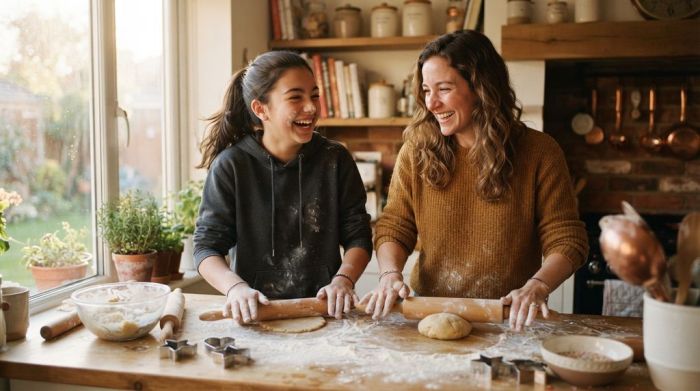
In June, Maya asked if she could help. Nora handed her an apron, and they made Angela's apple pie together. They worked in silence at first, the way they had worked in silence for months. But somewhere between the rolling of the dough and the arranging of the apple slices, Maya started to talk. She talked about her mother. She talked about the morning she had died, how Maya had been at school, how a teacher had pulled her out of math class and driven her home. She talked about the months that followed, the fog of grief, the way her father had tried so hard to hold things together that he had forgotten to hold her.
Nora listened. She did not offer advice. She did not try to fix anything. She just listened, the way she had learned to listen to grieving friends, the way she wished someone had listened to her when her own mother had passed away from cancer when Nora was twenty-two.
When Maya finished, the pie was in the oven, and the kitchen smelled like cinnamon and sugar and the particular sweetness of a confession shared. Maya looked at Nora, her eyes red but dry, and said something that Nora would carry in her heart for the rest of her life.
"I don't need you to be my mom," Maya said. "I already had a mom. But I think... I think I need you to be here. To make her recipes. To remember her with me. To not try to replace her."
Nora pulled Maya into a hug — the first hug they had shared in eight months. Maya did not pull away. She leaned into it, the way a child leans when they are tired of holding themselves up.
"I'm not trying to replace her," Nora whispered. "I'm trying to love you. And I'm trying to learn how. Will you teach me?"
Maya nodded against her shoulder. And that was enough.
That was two years ago.
Nora and Maya have a ritual now. Every Saturday morning, they cook together. They have worked through every recipe in Angela's book, and they have started a new one — a blank notebook where they write their own recipes, their own creations, their own history. Maya is sixteen now. She is taller than Nora, and she has started wearing her mother's old jewelry — a silver necklace, a pair of hoop earrings. She calls Nora by her first name still, but she says it with warmth now, with the ease of someone who has stopped guarding herself.
Last week, Maya asked Nora to teach her how to make the chicken and dumplings from scratch. "I want to know how to make it myself," she said. "So when I have kids someday, I can make it for them. And I can tell them that my stepmom taught me."
Nora did not cry. Not in front of Maya. She saved the tears for later, when she was alone in the kitchen, washing the dishes, the remnants of their cooking session still scattered across the counter. She dried her hands, picked up Angela's old cookbook, and opened it to the first page. She looked at the inscription — "To Angela, who cooks with love." — and she thought about the woman she had never met, the woman whose shoes she had been so afraid to fill.
She was not filling Angela's shoes. She was walking beside them. And somewhere, she hoped, Angela was smiling.
Nora Chen is thirty-seven now. She is a stepmother, a title she wears with the same pride and uncertainty that she wore on her wedding day. She still lives in the colonial in Naperville, but the backyard is no longer wild — Maya planted a garden there, with tomatoes and basil and the peonies that Angela used to love. The photographs on the mantle are still there, but they have been joined by new ones — Maya's first driving lesson, Nora's gallery opening at a local coffee shop, a family portrait taken at the arboretum last fall.
And on the kitchen counter, propped against the wall, is a framed piece of paper. It is a recipe card, written in Maya's careful handwriting. It is for chicken and dumplings, with a note at the bottom: "Add extra black pepper. This is how my mom made it. This is how my stepmom makes it. This is how I will make it for my kids someday."
Some love stories begin with a grand gesture or a perfect moment. Nora Chen's love story as a stepmother began with a worn cookbook left on a kitchen counter, a test she did not know she was taking, and a chicken and dumplings recipe that taught her that the only way to earn a place in a grieving child's heart is to be patient, to be present, and to never, ever try to replace the person who was there before you.
She learned to cook with love. And in doing so, she learned to love.