
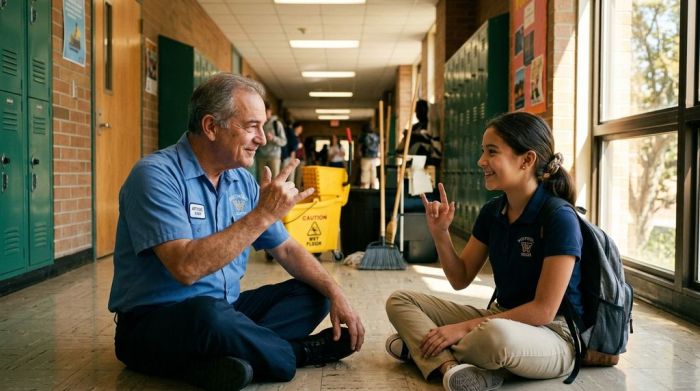
Raymond "Ray" Hawkins had been mopping the hallways of Westbrook High School for thirty-one years, and in all that time, no student had ever asked him how his day was going.\n\nThat was not something he dwelled on. He was a janitor, not a teacher. His job was to keep the floors clean, the trash cans empty, and the bathrooms stocked. He did not need students to notice him. He did not need them to know his name. He had long since accepted that he was part of the background, someone they passed without seeing, the way people pass a tree they have walked by a thousand times.\n\nBut Ray noticed them.\n\nHe noticed the boy who ate lunch alone in the stairwell every day, the one who flinched when teachers raised their voices. He noticed the girl who cried in the bathroom between third and fourth period, the one who always emerged with her eyes dry and her smile perfectly in place. He noticed the quiet ones, the forgotten ones, the ones who moved through the crowded hallways like ghosts, invisible to everyone except the man with the mop.\n\nAnd then, in the fall of 2022, he noticed a girl named Maya Chen.\n\nShe was a freshman, fourteen years old, small for her age, with dark hair she kept tied back in a neat ponytail. Ray first saw her on the second day of school, sitting alone at a table in the far corner of the cafeteria. She was not reading. She was not on her phone. She was simply sitting, watching the other students the way a biologist might watch a unfamiliar species — curious, detached, separate.\n\nHe did not think much of it at first. Freshmen often ate alone in the first week. They were still finding their footing, still learning the social geography of high school. But the weeks passed, and Maya Chen continued to sit alone. Every single day. Same table. Same corner. Same quiet, patient stillness.\n\nIt was a teacher, Mrs. Kowalski, who told Ray the truth about Maya. He was cleaning her classroom after school one day, and she was grading papers at her desk. They had the kind of easy, wordless companionship that develops between people who share a space regularly. After a while, Mrs. Kowalski sighed and set down her red pen.\n\n"Have you noticed the Chen girl?" she asked. "The one who sits alone every day?"\n\nRay paused, his mop resting in the bucket. "I've noticed."\n\n"She's deaf," Mrs. Kowalski said. "Profoundly since birth. Her parents moved here from California over the summer. They wanted her to attend a mainstream school instead of a specialized one. They thought it would help her integrate better." She shook her head, sadness creeping into her voice. "The other kids don't know how to talk to her. They tried at first, but they got frustrated. She reads lips, but it's exhausting for her. And nobody knows sign language. Not a single student. Not a single teacher."\n\nMrs. Kowalski looked at Ray with tired eyes. "She eats alone every day because she has no other choice."\n\nRay did not say anything. He dipped his mop back into the bucket and continued cleaning. But something had taken root in his chest — a small, persistent ache that did not go away when he finished his shift and drove home to his empty apartment.\n\nTHAT NIGHT, Ray did something he had not done in forty-two years. He sat down at his kitchen table, opened his laptop, and typed into the search bar: "American Sign Language classes online."\n\nHe was fifty-seven years old. His fingers were thick and calloused from decades of physical labor. His eyes were not as sharp as they used to be. He had never learned a second language in his life. But he clicked on the first link and started watching a video of a young woman demonstrating the alphabet.\n\nHe practiced until two in the morning, his arthritic fingers forming clumsy approximations of the signs. A, B, C — he traced the letters in the air, over and over, until his hand cramped and he could barely move his fingers. He went to bed with the alphabet imprinted on his brain, and he woke up the next morning and practiced again while he made his coffee.\n\nIt took him three weeks to learn the alphabet.\n\nIt took him two months to learn basic phrases: "Hello," "How are you?," "My name is Ray." He practiced in the mirror while he brushed his teeth. He practiced during his lunch breaks, sitting in the janitor's closet with his laptop propped on a stack of paper towels. He practiced while he mopped, his hands moving through the signs as his feet moved through the familiar rhythm of the task.\n\nHis hands ached constantly. His wrists throbbed at night. He was a fifty-seven-year-old janitor with arthritis in his knuckles, trying to learn a language that required more dexterity than he had used in decades. But he did not stop. He could not stop. Because every time he thought about giving up, he saw Maya Chen sitting alone at that table, her dark eyes fixed on the middle distance, waiting for someone — anyone — to speak to her in a language she could understand.\n\nIt took six months before Ray felt ready.\n\nSix months of nightly practice. Six months of watching videos, practicing signs, making mistakes, starting over. Six months of his fingers learning to move in ways they had never moved before. Six months of an old man teaching himself a new language for a girl he had never spoken to.\n\nHe chose a Thursday in March. It was raining outside, a cold, steady downpour that drummed against the cafeteria windows. The lunch bell had rung ten minutes ago, and the cafeteria was filling with the usual noise — trays clattering, chairs scraping, voices rising in the chaotic symphony of teenage social life.\n\nMaya was at her usual table, in her usual corner, eating a sandwich she had brought from home. She was reading a book propped against her backpack, her eyes moving steadily across the pages. She did not look up when Ray approached. Why would she? He was the janitor. He was part of the background.\n\nRay stopped at her table. He set down his mop bucket. And then, with hands that were trembling despite all his practice, he signed: "Hello. My name is Ray. May I sit with you?"\n\nMaya's eyes flew up from her book. She stared at him. For a long, terrible moment, Ray thought he had done something wrong. His signs were probably clumsy. He had probably mixed up the grammar. He was about to apologize, to retreat to his mop bucket and never try again, when Maya's face broke into a smile so wide and so bright that it seemed to light up the entire cafeteria.\n\nShe set down her book. She signed back, slowly and clearly, the way a teacher might sign to a student: "You know sign language?"\n\nRay felt his heart swell to twice its normal size. He signed: "I learned. For you."\n\nMaya's eyes filled with tears. She blinked them back quickly, but not before Ray saw them. She signed: "Why?"\n\nRay thought about the question. He thought about all the reasons — the loneliness he had seen in her eyes, the way she sat so still and separate, the ache in his chest that had not gone away since Mrs. Kowalski told him her story. But he could not say all of that in the simple sign language he had learned. So he signed the simplest truth he knew: "No one should eat alone."\n\nMaya stared at him for a long moment. Then she moved her backpack off the chair beside her and gestured for him to sit.\n\nRay sat down. He did not know what to say next. He had practiced greetings and introductions, but he had not practiced conversation. He sat there, an old man in a janitor's uniform, sitting across from a fourteen-year-old girl at a cafeteria table, and for a long moment, neither of them knew what to do.\n\nThen Maya picked up her sandwich and offered him half of it. He took it. They ate together in silence, and somehow, that silence was the most beautiful thing Ray had experienced in years.\n\nWORD SPREAD quickly through Westbrook High. The janitor knew sign language. The janitor was having lunch with the deaf girl. The janitor had learned sign language just for her.\n\nThe students did not know what to make of it at first. Some thought it was strange. Some thought it was sweet. But they started watching, started noticing, started paying attention to the man with the mop who had done something none of them had thought to do.\n\nA girl named Sarah, who was in Maya's English class, approached Ray in the hallway one afternoon. "Mr. Hawkins? Can you teach me? A few signs? So I can say hi to Maya?"\n\nRay taught her three signs: "Hello," "How are you?," and "Friend."\n\nThe next day, Sarah approached Maya's table and signed, "Hello. How are you?" Maya's face lit up the way it had lit up when Ray first signed to her. She signed back, "I am good. You?"\n\nSarah fumbled through the signs, laughing at her own mistakes, but Maya did not laugh at her. She helped her. She corrected her gently. And by the end of lunch, they were both laughing, two girls sharing a language that was not easy but was worth the effort.\n\nThat was the beginning.\n\nMore students started learning. A few teachers signed up for an after-school ASL class at the community college. The principal, Mr. Donovan, announced that the school would offer ASL as an elective starting the following year. And at the center of it all, like a stone dropped into a still pond, was Ray Hawkins — the janitor who had decided that a fourteen-year-old girl should not have to eat alone.\n\nBy the end of the school year, Maya Chen was no longer eating alone. She had friends. She had a community. She had a language that more and more people were learning, not because they had to, but because they wanted to. And she had a janitor who had spent six months of his life learning to speak to her with his hands.\n\nOn the last day of school, Maya found Ray in the hallway, cleaning a spill near the water fountain. She tapped him on the shoulder. When he turned, she signed: "Thank you. For everything."\n\nRay signed back: "You are welcome. You are special."\n\nMaya shook her head, her eyes bright with unshed tears. She signed carefully: "No. YOU are special. You saw me when no one else did. You learned my language. You sat with me. You made me feel like I belonged."\n\nShe reached into her backpack and pulled out a small gift, wrapped in brown paper. Ray opened it. Inside was a framed photograph — a candid shot from the cafeteria, taken by one of the teachers. It showed Ray and Maya sitting across from each other at the corner table. He was signing something, his hands in the middle of a sentence. She was watching him, her face lit with the pure, unguarded joy of being understood.\n\nOn the bottom of the frame, a small brass plaque read: "The day I was no longer invisible."\n\nRay Hawkins hung that photograph on the wall of his janitor's closet. It is still there today, surrounded by brooms and mops and bottles of cleaning solution. He looks at it every morning before he starts his shift, and he reminds himself that no act of kindness is too small, no effort is wasted, and no person is beyond the reach of someone willing to learn their language.\n\nIt has been three years since that Thursday in March. Maya Chen is a junior now. She is on the honor roll. She has a group of friends who sign to her in the hallways. The ASL elective at Westbrook High has sixty students enrolled this year. And the janitor who started it all? He is still there, still mopping floors, still emptying trash cans, still learning new signs every week.\n\nHe is teaching a beginner ASL class at the community center on Tuesday nights. Ten students showed up last semester. This semester, there are thirty. Most of them are adults who work in service jobs — cashiers, waitresses, receptionists — people who want to be able to say "hello" and "how can I help you" to the customers they might otherwise miss.\n\nRay Hawkins is sixty years old now. His hands hurt more than they used to. His fingers are not as fast as he would like them to be. But he keeps learning, keeps practicing, keeps showing up. Because he learned something important from a fourteen-year-old girl who ate alone in the corner of a cafeteria.\n\nHe learned that everyone is invisible to someone. And that the greatest gift you can give another person is to make them feel seen.\n\nIf you ever find yourself at Westbrook High, stop by the janitor's closet at the end of the hallway. The door is usually open. You will see a framed photograph on the wall — an old man and a young girl, signing to each other, their faces bright with the joy of connection. And you will understand that the people we pass without seeing are often the ones who see us most clearly of all.\n\nThey are the ones mopping the floors, emptying the trash cans, cleaning up our messes. And sometimes, if we are lucky, they are the ones who teach us that it is never too late to learn a new language — even when your hands ache, even when the signs feel clumsy, even when you are fifty-seven years old and the world has decided that you are past your prime.\n\nRay Hawkins learned to listen with his hands. And in doing so, he taught an entire school how to see.
The Janitor Who Learned to Listen






Loading more...