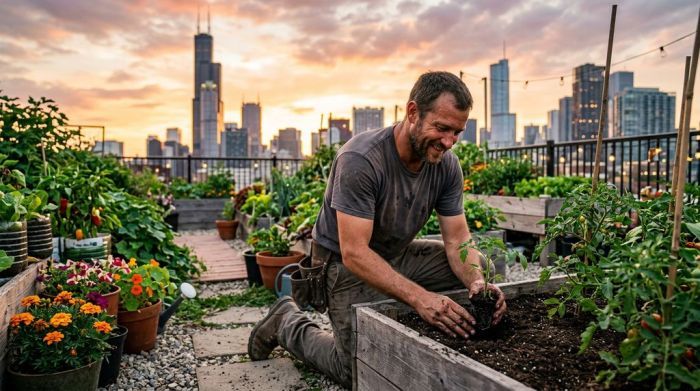
The last time Marcus Webb believed in anything, he was twenty-nine years old, standing at the altar of St. Mary's Church on the South Side of Chicago, watching a woman named Keisha walk toward him in a white dress that cost more than his first car. He was a construction worker then, strong and sure, with hands that could lift steel beams and a heart that believed love was the only force strong enough to hold a broken world together.
Nine years later, he sat alone in a studio apartment on the fifth floor of a building that had seen better decades, staring at a stack of divorce papers that had arrived in the mail that morning. Keisha had signed them three weeks ago. He had been avoiding opening the envelope ever since.
His name was Marcus Webb. He was thirty-eight years old. And he had stopped believing in anything at all.
The apartment was on the corner of Fulton and Central, in the Austin neighborhood of Chicago's West Side. It was a fourth-floor walk-up with a leaking radiator, a kitchen sink that only ran cold water, and a view of a rooftop that looked like a war zone — cracked tar paper, discarded beer bottles, a rusted air conditioning unit that had not worked since the Clinton administration. The landlord, an old Polish man named Mr. Kowalczyk, offered Marcus a fifty-dollar discount on the rent if he would "do something about that eyesore" on the roof.
"Clean it up," Mr. Kowalczyk said, shrugging. "Throw away the trash. Maybe plant some flowers. My wife, God rest her soul, she always said a garden makes a house a home."
Marcus took the fifty dollars. He did not plan to plant anything. He planned to sweep the broken glass into a pile and forget about it.
But something happened on the first Saturday morning he climbed through the fire escape door and stepped onto that rooftop. The sun was rising over the city, painting the sky in shades of pink and gold that seemed almost too beautiful for a neighborhood that had been forgotten by everyone except the people who lived there. The cold March wind cut through his jacket, but he did not go back inside. He stood at the edge of the roof, looking out at the Chicago skyline, and he felt something he had not felt in months. Nothing profound. Just a small, quiet stirring — the kind of feeling that might become something if you gave it enough time.
He started with the trash. He filled seven garbage bags with beer bottles, fast-food wrappers, and the kind of debris that accumulates when people treat a rooftop like a dumping ground. He swept the tar paper until it was clean. He found a discarded wooden pallet behind the building, carried it up four flights of stairs, and broke it apart for lumber. He built his first planter box that afternoon — crooked, splintered, held together with nails he had straightened with a hammer. It was the ugliest planter box in the history of container gardening. But it was his.
The next weekend, he bought soil. Thirty-pound bags, carried up four flights of stairs, one at a time, until his back screamed and his arms felt like they were going to fall off. He filled the crooked planter box. He planted seeds — tomatoes, basil, marigolds — because the woman at the garden center said marigolds kept the pests away and he needed something that would not die on him.
The first time he saw a green shoot push through the soil, he cried.
He did not mean to. He was standing there with a watering can, checking on the plants the way he checked on them every morning before work, and there it was — a tiny, fragile stem, no thicker than a thread, pushing its way toward the light. He knelt down and touched it with the tip of his finger, and the tears came without warning, hot and silent, running down his face and dripping onto the soil.
He had not cried since Keisha left. He had not cried since the day she told him she did not love him anymore. He had not realized how much he needed to.
The garden grew. And as it grew, something shifted in Marcus that he could not quite name. He started talking to the plants. Not in a crazy way — just small things, good morning and looking good and you are doing great, kid. He found himself looking forward to the mornings, to the ritual of checking the soil and trimming the leaves and watching the tiny ecosystem he had created thrive under his care.
He built more planter boxes. He found discarded tires in the alley, painted them bright colors, and filled them with peppers and cucumbers. He found an old wooden ladder, hung it horizontally on cinder blocks, and turned it into a vertical garden for strawberries. He rigged a rain barrel system from a discarded garbage can and a piece of gutter he found at a construction site.
The rooftop was changing. And so was Marcus.
The first visitor came on a Tuesday afternoon in June. Marcus was on the roof, watering his tomato plants, when a small voice behind him said, "Mister, what are you doing?"
He turned. A girl stood in the fire escape doorway, maybe nine years old, with braids tied with yellow ribbons and a gap between her front teeth. She was wearing a pink dress that was too thin for the weather and carrying a worn teddy bear by one ear.
"I'm watering my garden," Marcus said.
"You can't grow nothing up here," the girl said, her eyes wide with skepticism. "There's no real dirt."
"Watch me."
Her name was Nalah. She lived on the third floor with her grandmother, a woman named Miss Geneva who worked the night shift at a nursing home. Nalah's mother was in prison, serving a sentence Marcus did not ask about. Her father was a name on a birth certificate and nothing more. She was nine years old, and she had already learned that the world did not give you things — you had to take them, or do without.
Nalah started coming to the roof every day after school. Marcus gave her a small pot and some seeds and told her she was in charge of the marigolds. She took the job with a seriousness that surprised him. She talked to her marigolds the way he talked to his tomatoes, and she named each one after a character from a cartoon she watched. Marcus found himself laughing for the first time in months.
Then came the others.
Elias was twelve, tall for his age, with a shy smile and a talent for fixing things. His mother worked two jobs and rarely got home before nine. He started coming to the roof to help Marcus build more planter boxes. Tyrell was fifteen, gangly and angry, with a chip on his shoulder the size of Lake Michigan. He came to the roof because he had heard there was a man growing food up there, and he was hungry. Marcus did not ask questions. He handed Tyrell a ripe tomato and told him to sit down and eat.
Tyrell came back the next day. And the day after that. And the day after that.
By July, the rooftop garden had become something Marcus had never expected. It was a gathering place. Nalah brought her homework and did it on a blanket spread across the tar paper. Elias built a bench from scrap wood and old pallets. Tyrell started bringing other kids from the neighborhood, kids who had nowhere to go and nothing to do and a desperate need for someone to believe in them.
Marcus found himself teaching. Not in a formal way — he was not a teacher, had never been a teacher. He showed them how to plant seeds, how to water without drowning the roots, how to tell when a tomato was ripe. But more than that, he showed them how to be patient. How to wait for something to grow. How to believe that the small, daily acts of care would eventually add up to something beautiful.
He did not realize that he was learning the same lesson himself.
One evening in late August, Marcus was on the roof alone, watching the sunset paint the city in shades of orange and purple. The garden was in full bloom — tomatoes hanging heavy on the vines, peppers turning red, basil filling the air with its sharp, sweet scent. He had not felt this peaceful in years. He had not felt this alive.
The fire escape door creaked open. Marcus turned, expecting Nalah or Elias or one of the other kids. But it was Miss Geneva, Nalah's grandmother, still in her nursing home uniform, looking tired and uncertain.
"I hope you don't mind me coming up here," she said, her voice soft. "Nalah talks about this garden all the time. She talks about you."
"She talks about you too," Marcus said. "She says you make the best mac and cheese in Chicago."
Miss Geneva smiled, a tired smile that did not quite reach her eyes. "That's because I use three kinds of cheese. It's the only way."
They stood in silence for a moment, looking at the garden. Then Miss Geneva spoke again.
"I want to thank you, Mr. Webb. Nalah has not smiled like this in two years. Not since her mama went away. She comes home from school and the first thing she asks is whether she can go to the roof. She has not asked to watch television in a month." She paused, her voice catching. "You have given her something to believe in."
Marcus looked at his hands — the same hands that had signed divorce papers, the same hands that had built crooked planter boxes, the same hands that had gently pressed seeds into soil. "She gave me something too," he said. "She reminded me that I still had something to give."
September came, and with it a letter from the city. Marcus read it three times, each time hoping the words would change. They did not. The letter informed him that the rooftop garden was in violation of city zoning codes. It was an "unauthorized structural modification" to a residential building. He had thirty days to remove all planters, soil, and structures, or face fines of up to five hundred dollars a day.
Marcus sat on the bench Elias had built, staring at the letter, feeling the familiar weight of defeat settling onto his shoulders. This was how the world worked. Every time you built something, something came along to tear it down. Every time you started to believe, something reminded you why you had stopped.
He did not tell the kids. Not right away. He spent a week going through the motions, watering the plants, harvesting the vegetables, but the light had gone out of his eyes. Nalah noticed. Kids always notice.
"Mr. Marcus," she said one afternoon, "what's wrong?"
Marcus looked at her — at her earnest face, her braids with the yellow ribbons, her dirty knees from kneeling in the soil. He did not want to lie to her. "The city wants us to take down the garden," he said. "They say it's not allowed."
Nalah's face crumpled. "But why? It's beautiful. It's the most beautiful thing on this whole block."
"I know, baby. But sometimes the rules don't make sense."
Nalah was quiet for a long moment. Then she set her jaw in a way that reminded Marcus of her grandmother. "Then we change the rules."
What happened next was something Marcus could never have orchestrated if he had tried. Nalah told Elias. Elias told Tyrell. Tyrell told his mother, who told the other mothers. And within a week, the rooftop garden had become the most talked-about issue in the neighborhood.
Miss Geneva organized a petition. She went door to door, collecting signatures from every resident in the building, then every resident on the block. Elias's mother, who worked as a secretary at a law firm, typed up a formal appeal to the zoning board. Tyrell, who had not spoken a full sentence to an adult in months, stood up at a community meeting and told the alderman that the garden was the only reason he had not been shot or jailed or lost to the streets like so many of his friends.
The hearing was on a Thursday afternoon in October. Marcus wore his only suit, the same one he had worn to his wedding nine years ago. It was tight in the shoulders now, but he did not care. He stood in front of a panel of city officials, surrounded by the people of his neighborhood — Nalah in her best dress, Miss Geneva in her church hat, Tyrell standing tall and nervous in a borrowed tie.
Marcus did not have a prepared speech. He did not have talking points or legal arguments. He spoke from the heart, the way he had learned to speak to the plants, the way he had learned to speak to the kids.
"I came to this neighborhood six months ago with nothing," he said. "I was broken. I was empty. I did not believe in anything anymore. And then I built a garden on a rooftop that nobody wanted. I did not build it for the city. I did not build it to break any rules. I built it because I needed something to believe in."
He paused, looking at the faces of the people who had come to support him. Nalah was holding her grandmother's hand. Tyrell was standing straight, his head held high. "That garden has taught children how to grow things. It has given them a reason to come home after school. It has fed families who could not afford fresh vegetables. It has turned a rooftop that was full of trash into a place of beauty and hope."
His voice cracked, but he kept going. "I know the rules. I understand that I built something I was not supposed to build. But I am asking you — please, do not make us tear it down. Do not take away the one thing that has brought this community together."
The room was silent. The zoning board members looked at each other. And then the chairwoman, a woman named Alderman Patricia Owens who had represented the neighborhood for twenty years, took off her glasses and looked at Marcus with eyes that held a lifetime of stories.
"Mr. Webb," she said slowly, "I have been sitting on this board for eighteen years. In all that time, I have never seen a whole neighborhood show up for a rooftop garden." She looked at the crowd — at Nalah, at Miss Geneva, at Tyrell, at the dozens of others who had come to stand with Marcus. "I think we can make an exception."
The crowd erupted. Nalah ran to Marcus and threw her arms around his waist. Tyrell shook his hand so hard that Marcus thought his fingers might fall off. Miss Geneva hugged him and whispered, "I told you, Mr. Webb. You gave them something to believe in."
The garden is still there. It is three years old now, and it has grown far beyond what Marcus could have imagined. There are raised beds made of reclaimed lumber, a greenhouse built from salvaged windows, a compost bin that Elias designed and built himself. There are strawberries in spring, tomatoes in summer, kale and collards in fall. There is a picnic table where the kids do their homework on warm afternoons, and a chalkboard where they write the names of the vegetables they have harvested.
Nalah is twelve now. She is the official president of the rooftop garden club, a title she awarded herself. She has taught three other kids how to start seeds. She can identify fifteen different varieties of tomato by sight. She wants to be a botanist when she grows up.
Tyrell is eighteen. He graduated high school last spring. He is studying urban agriculture at a community college, with a scholarship he earned through his work in the garden. He comes back to the roof every weekend to help Marcus with the heavy lifting.
And Marcus? Marcus Webb is forty-one years old. He still works construction during the day. But every morning, before the sun is fully up, he climbs the four flights of stairs to the rooftop. He checks the soil. He waters the plants. He talks to the tomatoes. And he thinks about the strange, beautiful journey that brought him here — from a broken man in a cheap apartment to the keeper of a garden that changed a neighborhood.
Last week, Nalah came up to the roof with a letter. It was from her mother, who had been released from prison and was living in a halfway house on the other side of the city. The letter said she was doing well. She was going to counseling. She asked about Nalah. She asked if she could visit.
"What should I tell her?" Nalah asked, her voice small.
Marcus knelt down so he could look her in the eye. "You tell her the truth," he said. "You tell her about the garden. You tell her about the tomatoes and the marigolds and the friends you have made. You tell her that you have been growing things — and that you are ready to grow something new."
Nalah thought about this. Then she nodded, a serious, determined nod. She took her letter and went back downstairs to write a reply.
Marcus stood on the rooftop, looking at the garden he had built, at the city stretching out around him, at the sky that seemed to go on forever. He thought about the divorce papers, still sitting in a drawer in his apartment. He thought about the man he had been a year ago — the man who did not believe in anything. And he smiled. Because he finally understood something that the garden had been trying to teach him all along.
You do not have to believe in everything all at once. You just have to believe in the next seed. The next sunrise. The next small, crooked, imperfect step forward. And if you keep doing that, day after day, season after season — you will look up one morning and realize that the thing you were growing was not just a garden.
It was you.
"