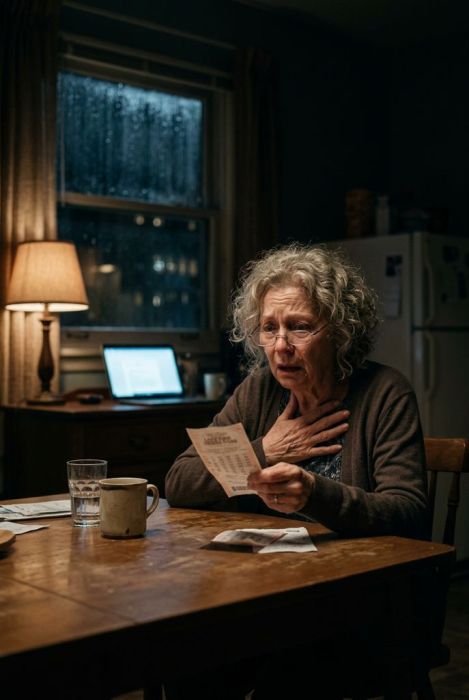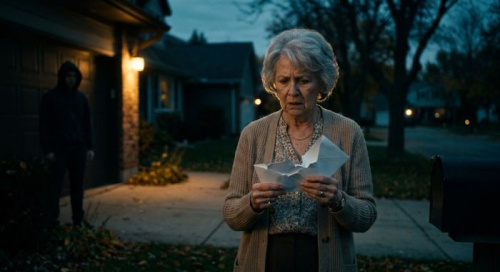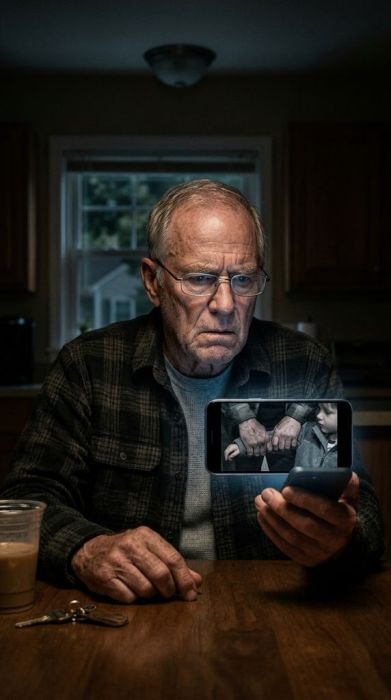
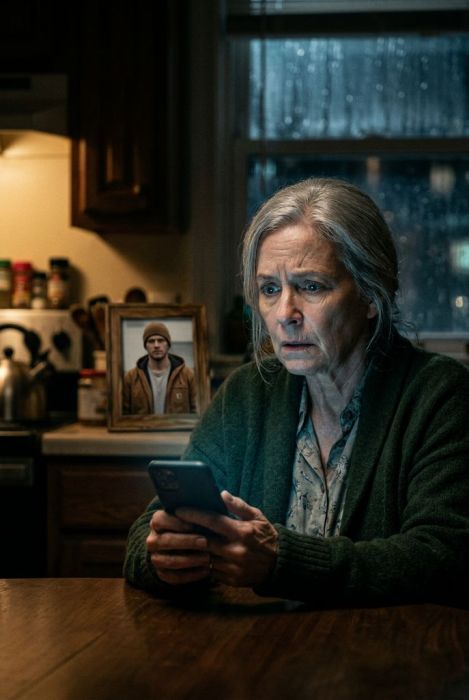
The text arrived at 9:14 on a Tuesday night, while Martha Ellison was drying the last dinner plate. Mom? It's Todd. Got a new number. Phone took a swim in a puddle at the site, long story. Save this one. She wiped her hands and read it three times.
Todd was thirty-nine, a safety supervisor on an oil rig in the Bakken, and he worked six weeks on and two weeks off in a stretch of North Dakota that swallowed cell service like quicksand. There were long, dark stretches when his texts didn't land for days. A new number didn't surprise her. What surprised her was how warm it made her feel to hear from him on an ordinary Tuesday, eleven years after her husband passed and the house on Pinecrest Street went quiet.
She saved the number under "Todd - NEW" and texted back: Hi sweetheart. Everything ok? The reply came in seconds, not hours. Yeah. Just tired. Miss your pot roast, Ma. She laughed out loud. Todd hadn't called her "Ma" since he was nine years old.
Over the next two weeks, those texts became the best part of her day. They asked about her knee, which she'd had surgery on in the spring. They asked about Bruno, the old yellow Lab who slept on the porch. They reminded her to take the statin Dr. Osei had prescribed, the one she always forgot. It was like having her son in the room, a voice at the end of a phone line that never went dead.
When her sixty-sixth birthday came, a bouquet of sunflowers appeared on her doorstep with a card signed "Love, Todd." A text followed an hour later: Wish I could be there, Ma. We'll celebrate proper when I'm home. She cried into the kitchen sink, the way she did over good things her husband never got to see.
Her daughter Jenna called on Friday nights, the way she always had, and Martha mentioned how chatty Todd had been lately. "He texted me three times yesterday," Jenna said, and there was a note of surprise in her voice. "He usually can't get a signal up there." Martha shrugged it off. "He must have found a good spot by the mess hall." She didn't mention the new number. She didn't want to make a fuss over a simple thing.
Nobody else looked at Martha Ellison's table that month. Nobody except Dustin Crenshaw.
Dustin was forty-six, a wiry man with a gentle voice and a gap in his smile. Five years earlier he'd walked out of a federal prison after serving time for mail fraud, and the jobs ministry at Martha's church had found him a bed, a toolbox, and a second chance. Martha had been the one to vouch for him, to sit with him in the fellowship hall and tell him that a man is not the worst thing he's ever done. "People deserve second chances," she told Jenna. "Your father believed that." Jenna, who had read every article about Dustin's case she could find, never quite agreed.
Dustin repaid the faith in small, honest ways. He replaced the rotting back steps on Martha's house. He fixed her garage door after the spring storm. He came to dinner on the first Sunday of every month and ate two servings of pot roast and told stories that made her laugh until her ribs hurt. He stood at her husband's grave with her on Memorial Day and didn't say a word, just stood there, and that was exactly right.
On the Tuesday after the sunflowers, Dustin came by to fix the latch on her screen door. He asked, with that soft voice of his, "You heard from Todd lately?" Martha beamed. "He got himself a new number. He texts me every single day now." Dustin nodded and smiled. "That boy loves you," he said. "You can hear it in the way he writes." She told nobody else. She had no reason to.
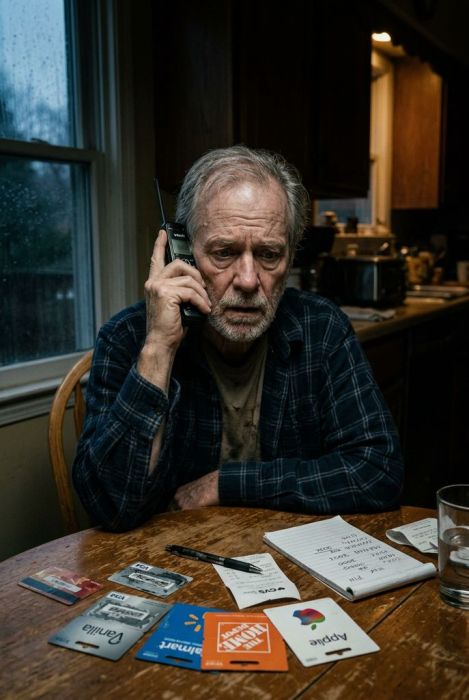
The first real text from "Todd" arrived on a Friday afternoon, and Martha's hands went cold before she finished reading it. Ma, don't tell anyone. Not even Beth. Please. He had gotten a DUI at a motel bar after a safety audit went bad, he said. If the company found out, he'd lose everything — his license, his job, his family. The lawyer had said that if the fines, the tow, and the breathalyzer install were paid before Monday, it would stay between him and the court. It was $3,200. He could pay her back on Friday when his per diem hit. I'm so ashamed, Ma. I just need help. Please don't tell anyone.
Martha sat at the kitchen table for a long time, Bruno's head resting on her slipper. Todd was the careful one, the one who lectured everyone else about seatbelts. But he'd carried his father's death on his back for eleven years, and grief does strange arithmetic to a person. She believed people deserved second chances. She'd believed it in that pew, in the fellowship hall, at the table where Dustin Crenshaw ate her pot roast. She believed Todd deserved one too.
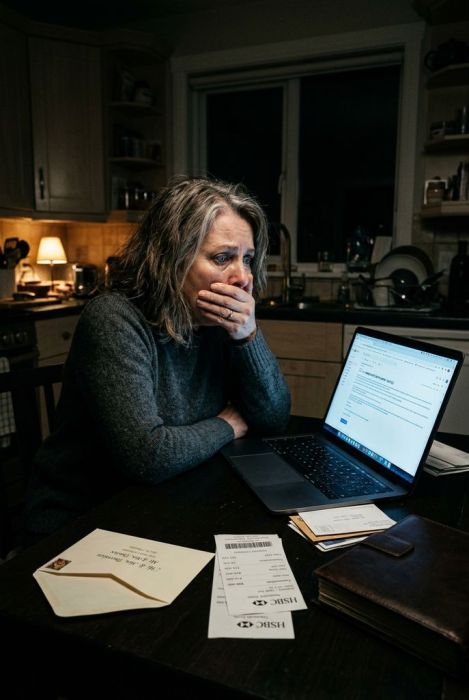
Saturday morning, she drove to the bank in a drizzle. Rosa, the head teller, raised an eyebrow at the wire transfer request. "That's a lot of love for a Saturday, Martha." Martha smiled and signed. She sent $1,500 — the most she could move without touching the joint account that held Todd and Beth's down-payment savings, which she was keeping safe for them. She'd send the rest on Monday, when the certificate matured. She texted "Todd - NEW" before she left the parking lot: It's done, sweetheart. Please be careful. I love you.
The reply came back in minutes. Thank you, Ma. I'll pay you back Friday. I promise.
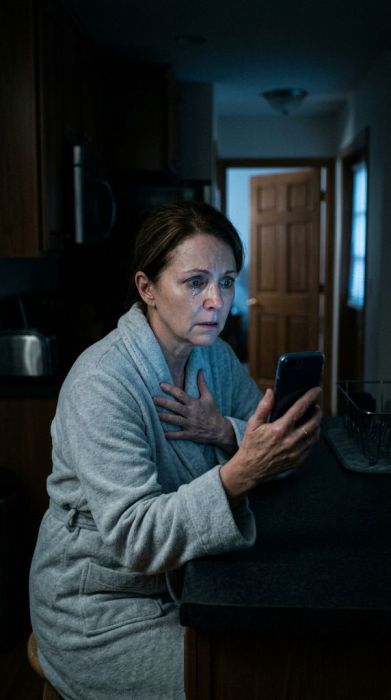
On Sunday, Jenna brought the grandkids over with a casserole, and somewhere between the mac and cheese and the spilled juice, Todd came up. "He ignored my texts all week, that turkey," Jenna said, and something cold slid across the back of Martha's neck. She told her daughter about the new number, then — a small thing, a simple thing, why did her hands shake when she said it?
Jenna's face went still. "Mom. Text that number. And call Todd's old number. Right now."
The old number rang to the same generic voicemail Todd had used for eight years. Jenna typed a message to it with trembling thumbs: Call me. Emergency. Twenty minutes later the phone rang, a crackling line from the rig's satellite office, rain on a tin roof. It was Todd. "Jenna? What's wrong? My phone died Tuesday night. I've been using the office line all week. What happened?"
Martha sank into the kitchen chair. She could hear his real breathing, the familiar rhythm of it, and she listened to the silence fill up with everything she had given away. Every morning text. Every memory she'd poured into a stranger like cream into coffee.
Detective Ray Delgado took the report that evening. The wire had traveled to an account opened nine weeks earlier at a bank in Gary, Indiana, under a name that matched no driver's license in any state. The money had been pulled out the same afternoon — not from a teller, but from a check-cashing counter across town, the kind of place that didn't ask questions if the ID looked right.
The security footage was grainy, shot from a ceiling corner in bad light. It showed a man in a John Deere cap and a flannel jacket, leaning on his right leg at the counter, holding an ID up to the glass. Martha watched it three times in the detective's office. She recognized the cap. She recognized the jacket, because she'd given it to him two Christmases ago, still in the bag from the farm store. And she recognized the hitch in his walk, the lean on the right leg, the souvenir of a motorcycle accident twenty years back, before she recognized anything else.
"That's Dustin," she whispered. "That's Dustin Crenshaw."
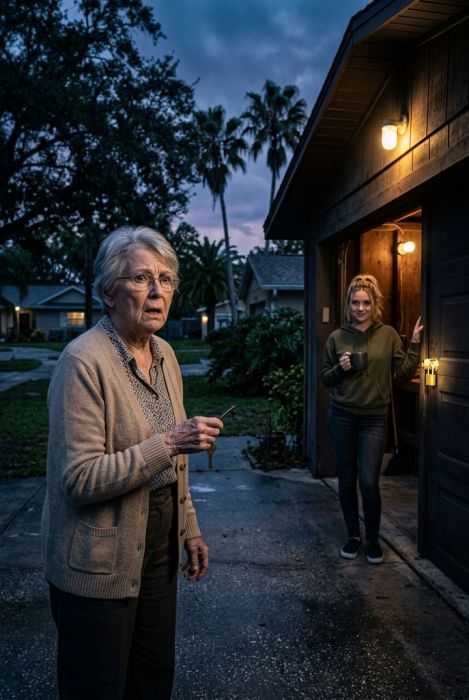
The drive out to the farmhouse on the edge of Kent County was the longest twenty minutes of her life. Detective Delgado and a deputy went up the porch steps first. Dustin came to the door in the same flannel, and when he saw Martha standing in the yard behind the officers, his face crumpled like paper in a fist. He told them everything, sitting on his own steps with his head in his hands.
Gambling. Two years of it, debts that doubled in the dark. Then a "friend" from Gary had offered him a way out — scripts to read and numbers to text. The new-number script. The DUI script. Scripts with every common kindness baked in, designed to sound like a son who missed his mother's pot roast. When the first payout sheet crossed the counter with the name "Martha E. Ellison, Grand Rapids" on it, Dustin said he could have walked away. He told himself he'd pay it all back. He told himself she'd understand, because she always understood. He wired most of it up the chain the same day.
The courtroom came three months later, in the fall, when the leaves outside the county courthouse were the color of old rust. Martha took the stand in a navy dress and told the jury about twelve pot roasts and a fixed screen door and a man who stood silent at her husband's grave. Then the judge asked if she had anything to say before sentencing, and she looked at Dustin — smaller in his orange clothes, the man she had fed and forgiven before he'd even asked — and she said she hoped he would use his time to become the man she had always believed he was. He was sentenced to three years. Restitution was ordered, a few dollars a month, pennies that would outlive them both.
Rosa called Martha that winter. There was a new class at the senior center called "Texts, Phones, and Wolves, Oh My," and they needed someone who could tell the truth about it without sugar. Martha agreed.
She stands in front of those folding chairs now, once a month, and she tells them what she learned. Call the old number. Ask a question only family could answer. Never wire money to a voice you cannot see. And remember that a scam does not start with a demand — it starts with kindness, with a remembered dog's name, with a question about your knee, with sunflowers on a doorstep.
Todd flew home that Christmas and brought her a new phone, and he showed her how to lock it, and he hugged her until she couldn't breathe. He never once said "I told you so." He didn't have to.
Martha Ellison still believes in second chances. She'll tell you that if you ask. But she knows now that hope needs a witness, trust needs a phone call, and even the warmest text can be wearing a stranger's mask. The sunflowers are gone, pressed flat in a book on her shelf — a reminder that the sweetest words sometimes cost the most, and that being wiser is the only real way to keep the people we love safe from the ones who know how to sound just like them.