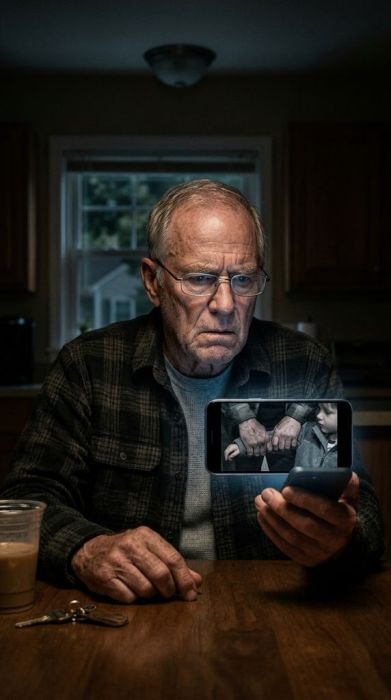
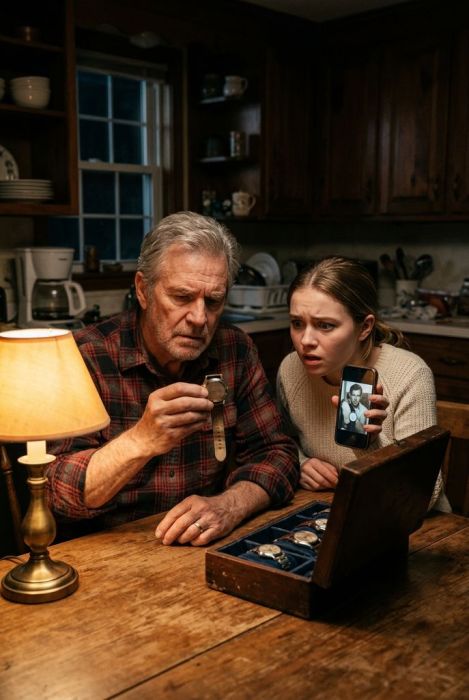
The watch was wrong. Ed Calloway knew it before he even picked it up, the way a man who has spent fifty years with his hands on machinery knows when a bolt has been turned by a stranger. The light caught the crown of the 1967 Omega in a way Lorraine's watch had never let it. The engraving on the caseback was there — H.V., for her father, Henry Voss — but the letters were too crisp, too new, cut by a machine that had never known the old watchmaker's trembling hand.
He told himself he was being a fool. The box had come back exactly on the day the appraiser promised, nestled in the same velvet inserts, wrapped in the same brown paper. Darren Cole had even included a handwritten note — "Enjoy, Ed! Appraisal cert enclosed. Call me Monday about the buyer." Politeness cost nothing, and Darren Cole was the politest man Ed had met since the pastor's wife at the church picnic.
Lorraine had been gone fourteen months. Pancreatic cancer took her in nine weeks, the way those things do, quietly and without negotiation. Ed still set two cups of coffee on the counter every morning, still caught himself saving the funny story for her, still slept on his own side of the bed because hers felt like trespassing. The wooden box in the drawer of Henry Voss's old workbench was the one piece of her family he had never been able to touch for long.
Henry had been a watchmaker in Louisville for fifty-one years, the kind of craftsman who could rebuild a chronograph movement from memory and who kept his own father's 1918 Longines wrapped in oilcloth inside a cigar tin. When Henry died in 2009, he left Lorraine the box — six watches, he'd written on the taped lid, every one a piece of the family story. Lorraine had catalogued them once, years ago, in her careful schoolteacher's hand: the Omega her father wore to her wedding, the Hamilton her mother's brother brought home from the Pacific, the pocket watch Henry's grandfather carried when he emigrated from Germany, and three others Lorraine called "the everyday ones," because some stories are told in workaday steel.
The appraiser arrived in Ed's life the way trouble usually does — in a mailer. GOLD & SILVER BUYERS, it said. ONE-DAY EVENT: FREE APPRAISALS, WE COME TO YOU. Ed had meant to throw it away with the credit card offers and the roofing coupons. But the return address was a post office box in a Louisville suburb, and the fine print mentioned estate jewelry, and Henry's watches had been sitting in that drawer for fifteen years, waiting for someone brave enough to decide what to do with them. Maya's tuition was due in August. Ed's pension would cover it, but just barely, and the words "just barely" kept him awake at night in a way Lorraine's memory no longer could.
Darren Cole came the following Tuesday, ten minutes early, dressed in a navy polo and khakis that looked ironed by someone who cared. He was maybe thirty-five, with the easy confidence of a man who had learned young that people over seventy will believe almost anything delivered with steady eye contact. He called Ed "sir." He asked about the framed photograph of Lorraine and Henry on the mantel, admired the oak workbench, said his own grandfather had been a machinist in Dayton, and for one dangerous moment Ed felt like he was talking to an old friend.
He didn't ask to see the watches right away. That was the genius of him, Ed would realize later. He told a story first — about a widow in St. Matthews who had paid off her mortgage with her husband's coin collection, about the satisfaction of helping families "close the chapter with dignity." He had the gift of making greed sound like kindness.
When Ed finally brought the box from the workshop, Darren went quiet in a way that felt professional. He put on cotton gloves. He lifted each watch with two hands. He turned the Omega over and examined the H.V. engraving through a jeweler's loupe, and something passed across his face — a fraction of a second, quickly smoothed — that Ed would replay a hundred times afterward and never quite name.
"Mr. Calloway," Darren said, "these are lovely. Genuine family pieces. The Omega is worth maybe eleven hundred on a good day. The Hamilton maybe eight hundred. The pocket watch? Honestly, six or seven hundred to the right collector." He set the box down gently. "I could have them cleaned and certified by our affiliate lab, free of charge. Ten days, back in your hands, with written appraisals you can take anywhere. Then, if you want, I have a buyer who pays cash for documented pieces like these."
Ed asked the question that should have ended everything. "What's the catch?"
"No catch, sir. We make our money on the buyer's premium when you sell. You don't owe us a penny unless you want to sell. That's the whole deal." Darren slid a one-page receipt across the workbench. "I just need you to sign that we took custody, and I'll be on my way."
Ed read the page. It was mostly what Darren said — a custody receipt for six watches, with a line at the bottom about a "consignment option" that Ed skimmed and didn't fully register. He signed it with Lorraine's old fountain pen, the one Henry had given her, and he walked Darren to the door feeling like a man who had just done something responsible.
Harriet McAllister, Lorraine's best friend since fourth grade, did not agree. She came by on Friday with a casserole she called "widower food" and a suspicion she called "respectful concern," and she told Ed the story of her cousin's neighbor in Owensboro who had let a free appraiser into her house and later found her grandmother's brooches replaced with look-alikes that only gave themselves away in direct light.
"Ed," Harriet said, pointing her fork at him, "you do not hand a stranger a box of heirlooms on a signature and a smile. You call me first. You call the pawn shop. You call anybody but a man whose business card says 'Buyers.'"
Ed defended Darren. The man had photographs of his own grandfather. The man had offered a written appraisal. The man had said, with his own mouth, that Ed could take the certificates anywhere.
"Did you photograph the watches before he left?" Harriet asked.
Ed had not. But that night, restless, he took out Lorraine's old phone — she had never stopped charging it — and looked at the photos Maya had taken of the collection the Christmas after Henry died. Maya had photographed every watch, front and back, including the serial numbers. "So I never forget them," she'd said.
That phone became the most important object in Ed's house, though he didn't know it yet.
The box came back on a Thursday, ten days later, exactly as promised. The watches gleamed with the shine of a professional cleaning. The appraisal certificate, with a gold seal, valued the entire collection at three thousand four hundred dollars. And Darren's note was as cheerful as the first one: "Call me Monday — my buyer will write you a check the same day."
Ed had almost picked up the phone when Maya walked in. Spring break had started that afternoon, and she had driven straight from Lexington to see him, as she did every break. She saw the wooden box open on the kitchen table and lit up.
"Papa," she said, "are those Grandpa Henry's watches?"
She was delighted. She put on her grandmother's reading glasses and lifted the Omega, cooing over the cleaning job. And then she stopped. She tilted the watch toward the window light, turned it over, and Ed saw her face change the way the weather changes in a movie — slow, and then all at once.
"Papa," Maya said slowly, "that's not the same watch."
She pulled out her own phone and scrolled to a photo taken eleven years ago. The Omega in the photo had a hairline scratch across the caseback, a scar Ed had seen a thousand times. The Omega in her hand had no scratch. The serial number in the photo — six digits, worn soft by forty years of wrist wear — did not match the crisp seven-digit number engraved on the watch in the box. Maya turned the watch over again, thumbed the crown, and her voice went flat. "This crown is wrong too. This is a fake, Papa. This is a really good fake."
They went through the box together, photo by photo, watch by watch. The Hamilton's dial was the wrong shade of ivory. The pocket watch was carrying a movement that had never once been inside Henry's grandfather's watch. Three of the "everyday ones" bore serial numbers that a quick internet search said belonged to modern replicas sold from a factory in Guangdong. Six watches had left the house. Six watches had come back. Not one of them was real.
Ed sat down at the kitchen table and did not get up for a long time.
Maya did not sit down at all. She looked up the company on her phone: Riverbend Estate Buyers, registered to a post office box, with a listed address on Dixie Highway that was, according to Street View, a shuttered laundromat. She found two complaints on a consumer site, both from Indiana, both from elderly sellers who said their jewelry was "polished and returned" — and both complaints ended the same way: "They offered to buy it after, but the pieces felt wrong." None of the complainants had kept photographs.
She called the Kentucky Board of Auctioneers and learned that Riverbend held no license to appraise or auction anything. In the morning she drove her grandfather to Louisville Metro Police headquarters, where they were eventually shown into the office of Detective Sergeant Walt Gallo, a man whose mustache had gone gray in the fraud unit and who listened to Maya's recitation of serial numbers without interrupting once.
"We've heard the name before," Gallo said finally, closing the folder. "Two complaints, eighteen months back. Elderly man in Clarksville, coin collection, same story — free appraisal, cleaning, certification. He didn't have photos. No serial numbers. Case died." He tapped the printouts. "This is the first file I've seen with documentation this good. You're telling me you kept photographs of the back of every watch?"
"Yes, sir," Maya said.
Gallo looked at Ed. "Mr. Calloway, here's what I want to do. Tomorrow, you call this man and you tell him you've decided to sell. You agree to meet his buyer at their office. You sign whatever they put in front of you, and you let them hand you a check. And then I walk through the door with a warrant."
Ed thought about the shuttered laundromat on Dixie Highway, about Henry's watchmaker hands. "What if they just pay me the three thousand dollars and it's a fair deal for the fakes they'd be buying back?" he asked.
"Then I arrest them for trafficking counterfeit goods and theft by deception," Gallo said, "and we find your watches in a desk drawer or a shipping box. But we need the door open."
The office on Dixie Highway was a strip mall unit with a freshly painted sign, a reception desk, and a conference room with a fake marble table. Darren Cole shook Ed's hand with both of his, called him sir, and introduced the buyer — a heavyset man with a briefcase who said very little and counted out three thousand dollars in hundreds on the table before Ed had even signed the consignment agreement.
That was when the door opened.
Detective Gallo came in first, badge out, two officers behind him. The heavyset man stood up and said the one word people in that room never expected to hear: "Lawyer." Darren Cole's smile did not so much disappear as curdle. And in the second office, through the open doorway, Ed saw the rest of his life laid out on a desk in plain view — the real velvet box, open, with all six of Henry Voss's watches inside, his inheritance, his marriage, his memory, waiting to be shipped in a padded envelope to a consignee in New York.
The arrest took nine minutes. The evidence took longer. In the drawer beneath the coffeemaker, officers found a brown envelope from an auction house in Geneva that made even Gallo go quiet. It was a pre-sale estimate, addressed to Riverbend Estate Buyers, for a single item: a 1918 Longines pocket watch, movements in original condition, with provenance — and the estimate, typed in clean Swiss formatting, was for one hundred and twelve thousand dollars.
Ed's knees buckled, and Maya caught him.
Henry's grandfather had not carried an ordinary watch through the German emigration. He had carried a chronograph so rare that collectors crossed oceans for it, and Henry, the watchmaker, had known it. He had written it into no will, told no one, only wrapped it in oilcloth and left it in a cigar tin under the workbench, trusting that the family would understand what it was without being told. Darren Cole's lab had understood in a heartbeat. The polite appraisal of "six or seven hundred to the right collector" was the most expensive sentence ever spoken in Ed's kitchen.
Darren Cole was convicted of theft by deception, trafficking in counterfeit goods, and forgery, and he is still serving time in a state facility in Kentucky. His lab partner, who had quietly switched the watches and prepared the replicas, pleaded guilty to the same charges and was ordered to pay full restitution. The heavyset man turned out to be Darren's own uncle, waiting for the signature on the consignment agreement to legally "buy" the fakes so the originals could be shipped overseas without a trace.
The real watches went home with Ed in a brown paper bag, which he carried on his lap in the front seat of Maya's car like a newborn.
What Ed learned in the months that followed became a second education, taught the hard way: take photographs of every piece, front and back, serial numbers included, before a stranger ever lays a hand on it; never hand over valuables for "free cleaning" or "certification" without a contract you can keep; check the state licensing board, not just a business card; get two appraisals from dealers with real street addresses; and understand that the friendliest sentence a con man can say is "we come to you." Politeness, Ed says now, is the most expensive thing a scammer sells.
The Longines sold through a licensed auction house in Louisville — for ninety-eight thousand dollars after commission. Maya's tuition was paid in full, and the remainder went into a fund Ed named the Henry Voss Memorial Trust. The Omega and the Hamilton came home to the wooden box, where Ed keeps them still, next to a laminated photograph of the serial numbers, so that if they ever leave the house again, the truth goes with them.
Harriet came over the Sunday after the trial with her casserole dish, empty, and she didn't say I told you so, because she didn't have to. She just sat at the kitchen table with Ed and the open box, and they drank Lorraine's favorite tea, and they talked about the people they had loved and the things those people had left behind.
Ed still sets two cups of coffee on the counter every morning. But now, when he opens the drawer in Henry's old workbench, he does not look away from the box. He lifts each watch, one at a time, into the kitchen light, checks the engravings with his own reading glasses, and says their names out loud, the way Lorraine used to. Some stories, he has learned, are told in workaday steel. And some are told in the quiet space between a signature and the serial number underneath it.