The doorbell rang at 10:47 on a Tuesday morning, and Doris Hartmann almost didn't answer it.
She was halfway through last Sunday's crossword, sipping coffee that had gone lukewarm, when the furnace coughed to life and the doorbell sang its two-note chime. The chime had been Paul's doing. He'd installed it in 1998 and always said the two notes meant somebody's here, which was exactly what a doorbell should mean. Paul had been gone six years now, and she still caught herself explaining his jokes to no one.
The house on Crescent Court was quiet in a way it had never been quiet while Paul was alive. Doris had learned to live with it. She had her bridge group, her church circle, her garden. She had Boots the tabby, who came and went through the back door whenever he pleased, which meant the back door was unlocked on most days. She had neighbors who waved. And in the master bedroom closet, she had a tan leather jewelry box that had belonged to her mother, holding a few things that mattered: her wedding set, her mother's brooch, and Paul's grandfather's watch.
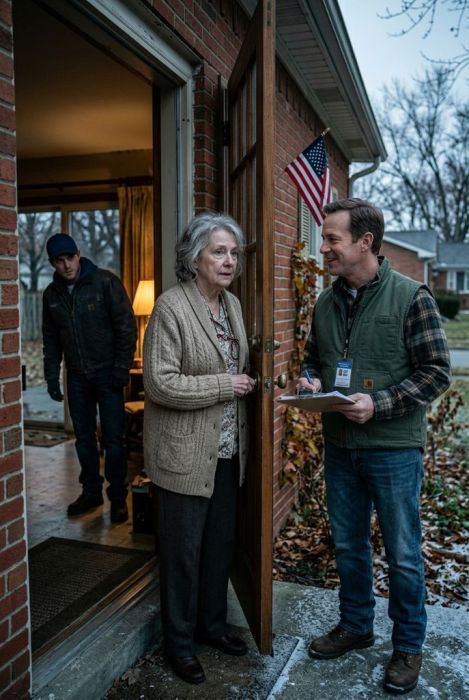
The man on her front porch was wearing a green vest.
County Energy Services, the badge read, and the photo looked like the face beneath it. Clipboard in hand, smile already in place, he stood there like he'd been sent by central casting — a man in his forties with kind eyes and a voice smooth as gravel on a radio spot.
Good morning, Mrs. Hartmann.
That stopped her cold. She hadn't given her name. The badge, the vest, the white van at the curb with the blue logo painted on the side — all of it could have been bought or borrowed or printed. But her name, spoken with the easy confidence of someone who already knew the answer...
We've had a report of a gas odor on this block, he said, tapping the clipboard. Furnace season. It's usually somebody's pilot light or a dirty burner. We're checking every home, just to be safe. Takes about ten minutes.
The cold air curled around her ankles. Ten minutes. It was mid-November, the man was polite, the van had the logo, and every detail of that moment said this was exactly the kind of thing that happened to other people — and those other people always had a good reason to let the nice man in.
Well, Doris said, I suppose there's nothing to find. But come in, it's cold.
She would replay that moment for the rest of the winter. The way she'd stepped back, the way her hand had opened the door wider, the way she'd invited a stranger inside without verifying a single thing he'd shown her. The whole game, as she would later understand it, was in the details you didn't check.
The man said his name was Troy. He walked through her kitchen with the easy confidence of a handyman, running a gloved hand along her baseboards, peering at the furnace in the utility closet with a small flashlight. He asked about the neighborhood. He admired the photographs on the mantel. He kept his voice cheerful and his questions endless, the way you would if you wanted to make sure she wasn't listening to anything else.
Because while Troy talked, someone else was listening.
Doris didn't hear the back door open. She didn't hear the soft footsteps cross the linoleum of the utility room, or the careful slide of the master bedroom door. She was in the kitchen, showing Troy the burner on her stove that sometimes smelled of pilot light, and he was nodding and asking if she'd noticed the smell in the basement too.
Let me just take a quick look down there, he said, and Doris, grateful for the thoroughness, said, Of course.
It was only later — hours later — that she realized he'd never once gone down those basement stairs.
At four o'clock that afternoon, Doris went to put on her mother's brooch. She was meeting the church circle at the Rossetti house at five, and the brooch was her going-out pin, the one she wore when she wanted to feel like her mother was with her. She opened the closet, reached for the tan leather box on the second shelf, and her hand touched nothing.
The shelf was bare.
For a long moment she stood there with her arm raised, as if the box might materialize if she waited. Then she pulled the closet apart with both hands, then the dresser drawers where Paul's grandfather's watch lived in a felt-lined tray. Nothing. She went to the pantry and lifted the sewing basket, and found that the envelope with the three thousand dollars she kept for emergencies was gone too — the money Paul had always said she should put in the bank, the money she'd kept because her mother had kept cash in a sewing basket and her grandmother before her.
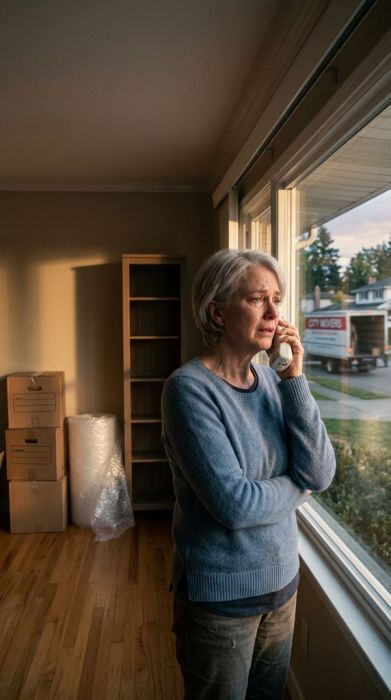
Doris sat down on the kitchen floor with her back against the cabinet and called her daughter in Phoenix.
Mom? Susan's voice was instantly wrong-side-of-awake, the way it always was when the phone rang early in Arizona. Mom, what happened? It's four in the morning here —
I've been robbed, Susan. Her voice came out flat, like she was reading a weather report. The man from the gas company. He was here this morning, and now my mother's brooch is gone.
The police came in forty minutes, which Detective Rosa Melendez later told her was fast for a Tuesday. Melendez was a compact woman in her fifties with a patient face and eyes that had seen every version of this story. She took the report, dusted what little could be dusted, and asked the questions Doris would hear again and again over the next three weeks. Did she get a clear look at his badge? Did she get a license plate? Did she call County Energy Services to confirm? Did she notice anything else missing?
No, Doris said each time. No. No. No.
The detective wrote it down without judgment. You'd be surprised how many people let them in, she said gently. They're very good at it. That's the whole point.
Across the fence, the neighbor, Ed Sutter, had heard the sirens and come over in his slippers, outraged on her behalf. He stood in her kitchen with his hands on his hips, shaking his head. I was home all morning, Doris, he said, and I didn't see a thing. These people, they watch houses. They know when to come. I tell you, I'd have liked to get my hands on him. He brought her iced tea and stayed until the police left, and then he walked home to his own dark house.
Doris thought, later, that she should have paid more attention to how fast Ed had arrived. How ready he was. How the outrage in his voice had come out a little too rehearsed, like a speech he'd practiced.
Three weeks passed. Thanksgiving came and went at Susan's insistence — Doris flew to Phoenix, but she couldn't enjoy it, couldn't stop picturing her mother's brooch in a stranger's hands. The Columbus police had the report. They had no van, no plate, no fingerprints, and no hope, or so it felt. Detective Melendez called her twice to say they were still looking, and Doris had begun to accept that the box was gone forever.
Then, on the second Monday of December, Melendez called with a voice Doris had never heard from her.
Mrs. Hartmann, can you come down to the station? We recovered your rings.
The rings sat at the property desk in a clear evidence bag, and they were unmistakable: her wedding set, the diamonds catching the fluorescent light, and inside the band, the engraving she and Paul had put there in 1969 — D & P, always.
How? Doris breathed.
Melendez slid a photocopy across the desk. It was a pawn ticket from a shop called Leon's Pawn in Groveport, filed two days after the burglary, as Ohio law requires — every pawnbroker in the state reporting transactions to local police. Description: gold wedding set, engraving D&P. ID on file: Edward Sutter.
Doris read the name three times.
Edward Sutter, she said slowly. That's — my neighbor. Ed. He's been my neighbor for twenty-two years. He waters my plants when I'm away. He has a key — She stopped. The blood had drained somewhere below her collarbone. He has a key to my house, Detective. I gave it to him in 2016 when I locked myself out. He's a locksmith. A retired locksmith. Ed taught Sunday school for thirty years.
Melendez just watched her. He pawned your rings for twenty-one hundred dollars. Said they were his late wife's. Lena passed four years ago — the pawnbroker didn't think to question it. But the engraving was in the report.
Doris thought about the iced tea. The outrage. The I'd have liked to get my hands on him. She thought about the afternoon at the mailbox last month, when she'd told Ed — just chatting, the way you do — that the jeweler had appraised her mother's brooch and the rings and said they were worth more than she'd ever imagined. She'd told him about the envelope in the sewing basket too, when he'd teased her about still keeping cash in the house. Old habits, she'd laughed, and Ed had laughed with her, his eyes fixed on hers like a man memorizing a recipe.
Troy, Doris said suddenly. The man at the door. He knew my name before I said it. How would he know my name? She looked up at Melendez with the full weight of it landing. Ed knew they'd ask the gas company first. He knew I'd never check the pawn shops. He knew because he's the one who told me, weeks ago, that pawn shops only give you half of nothing.
They arrested Ed Sutter at his kitchen table on a Tuesday night, three weeks to the day after Doris had let the nice man in.
Detective Melendez had a warrant and two patrol officers, and Doris stood on her own porch across the fence, watching through the windows of Ed's house as the lights went on and the shadows moved. She didn't want to watch. She couldn't stop. When they led him out in handcuffs, Ed looked up and saw her, and for a moment his face did something complicated — shame, then anger, then shame again, cycling like a broken appliance.
I'm sorry, Doris, he called across the fence, and his voice cracked in a way she'd never heard. I got in over my head. You don't understand what it's like — Lena's bills, and then the bookie, he came to my house, Doris, he threatened Carla in Knoxville. I thought I could pay him off and it would be over. I never wanted to hurt you. You're my friend. You've been my friend for twenty-two years.
Detective Melendez read him his rights over the top of it. The whole street heard — Hank Weller came out in his bathrobe, the Gordons' porch light went on, and somewhere a dog started barking. Doris stood on her porch with her arms crossed, and she thought about every favor Ed had ever done her: the driveways shoveled, the plants watered, the spare key held safe for a decade.
I gave you that key because I trusted you, Ed, she said, and her voice didn't crack at all. And you used it to give my mother's brooch to strangers.
Ed's nephew Troy was arrested in Groveport two days later, along with a friend of his named Vince. The vest and badge had been bought on a website and printed at a copy shop, and the van was a rental from a lot on the east side. Ed had drawn them a map of her house from memory — the closet, the sewing basket, the back door Boots kept unlocked. He'd timed the visit for mid-morning, after her coffee, when he knew she'd be home alone. He'd coached Troy to keep her talking in the kitchen, because the kitchen was the farthest room in the house from the master closet.
The pawn shop cooperated fully. The rings came home to Doris in an evidence bag with an inventory number, and the jeweler cleaned them for free when he heard the story. The three thousand dollars was gone — split three ways, spent on rent and a bookie and a week of bad decisions — but Doris was surprised to discover how little she cared about the money. What she cared about weighed less than a brooch and carved a deeper hole.
Ed Sutter pleaded guilty to burglary and theft. He was sixty-eight years old, and he went to prison for three years, and the judge said, You were his eyes and ears, Mr. Sutter. You are every bit as responsible as the men who walked through that door.
Doris didn't go to the sentencing. She had made her peace with it in a different way, on the morning she took the spare key back from the hook by Ed's back door — he'd asked, through his lawyer, if she could feed his cat — and stood in his empty kitchen, looking at the retirement magazines on the counter and the single place setting in the sink. Desperation didn't look like a monster, she realized. It looked like a man who'd forgotten to put away his cereal bowl.
She came home and made a list. The list went up on her refrigerator with a magnet shaped like a cardinal. It said: Call the number on the bill. Not the number they give you. Not the card they slip under the door. The number on the bill. And then: Ask for ID through the peephole. And then, in her own handwriting, underlined twice: If they're official, they'll wait.
Mother's brooch went back in the box, and the box went into a safe deposit box at the bank, and Susan bought her a ring camera for Christmas, and Doris learned to say to every uniformed stranger at her door the sentence that became her answer to everything: That's fine. I'll call the company and confirm. You can wait on the porch.
It was spring by the time she finally told the story out loud, at the neighborhood watch meeting in Hank Weller's rec room, with a plate of Hank's wife's brownies going around. She told it the way she would have told a cautionary tale at a church supper, without drama, without judgment. She told them about the green vest and the clipboard and the two notes of the doorbell, and about the kind neighbor who watered her plants. And when she finished, Hank Weller, who had lived across the street for thirty years, said, Doris, I've known Ed since he moved here. And I'd have handed that man my keys myself.
That's exactly it, Doris said. Kindness is real. So is desperation. And the two of them don't cancel each other out. They just sit there in the same man, waiting to see which one you're looking at.
That night, she sat on her porch with Boots on her lap, watching Ed's dark house and the For Sale sign that had gone up in his yard that afternoon. The ring was heavy and warm on her finger — the one with the D & P inside the band, the one Paul had put there in 1969, the one she had almost lost to a man with a spare key and a bookie's debt. She touched it once, twice, and then she went inside and locked the back door behind the cat.
Two notes of the doorbell meant somebody's here, she thought. They never meant somebody's safe.