I was twenty-eight years old, six months pregnant, and completely alone when I pulled into the driveway of 47 Magnolia Lane in Maple Ridge, Tennessee.
The house was a small Victorian cottage, painted pale yellow, with a wraparound porch and a garden that had seen better days. The woman who answered the door was seventy years old, with silver hair pinned into a loose bun and eyes that had clearly known their share of grief. Her name was Eleanor Cross.
"You must be Hannah," she said, wiping her hands on her apron. "Come in. I just took an apple pie out of the oven."
I did not know it then, but that apple pie would be the first of many. It would be the first meal shared, the first story told, the first step on a journey that would change both of our lives in ways neither of us could have predicted.
I had found the room on Craigslist two weeks earlier, in a desperate late-night search after my boyfriend Kyle had walked out. He had left a note on the kitchen counter — a note, not even the decency of a conversation — saying he "wasn't ready to be a father" and that he "needed space." I had read it seventeen times, each time hoping the words would rearrange themselves into something less cruel. They never did.
My own mother had passed away when I was nineteen. My father had remarried and moved to Florida. I had no siblings, no close friends who could take in a pregnant woman and her growing belly. I had been working as a waitress at a diner in Nashville, barely making enough to cover my share of the rent on the apartment Kyle and I had shared. The day after he left, I realized I could not afford to stay.
Eleanor's ad had read: "Room for rent in quiet country home. Garden views. Homemade meals included. No drama, please."
No drama. I had laughed when I read it, a hollow, exhausted laugh. I was six months pregnant and freshly abandoned. I was nothing but drama. But I called anyway, and Eleanor had answered on the second ring, and something in her voice had made me feel like maybe, just maybe, I could stop running.
That was three months ago.
The room Eleanor gave me was at the back of the house, overlooking a garden that she tended with the same care she gave everything — slowly, deliberately, with an attention to detail that spoke of a woman who had learned that small things mattered. There was a white iron bed with a patchwork quilt, a wooden rocking chair by the window, and a small desk with a vase of fresh flowers that she changed every Monday.
I unpacked my entire life in about twenty minutes. It did not take long. A few maternity dresses, some books, the ultrasound photographs I had tucked into my journal. I placed the photographs on the desk, next to the flowers, and I sat down on the edge of the bed and let the silence of the country settle around me.
That first evening, Eleanor knocked on my door and handed me a slice of apple pie on a china plate. "You need to eat," she said. "You're eating for two now."
I took the plate. The pie was still warm.
"Thank you," I said. My voice cracked on the second word.
Eleanor looked at me with those knowing eyes. "How far along are you?"
"Six months. Twenty-four weeks."
"And the father?"
I shook my head. I could not say the words out loud.
Eleanor nodded slowly. She did not press. She did not offer platitudes. She simply said, "I lost my daughter fifteen years ago. Sarah. She was twenty-three years old. A car accident on a rainy night."
I do not know why she told me that. Maybe she saw the grief in my eyes and recognized a fellow traveler. Maybe she wanted me to know that she understood loss, that she would not judge me for mine.
"I'm sorry," I whispered.
"So am I," she said. And then she smiled, a warm, tired smile that made her look both ancient and young at the same time. "But I have learned that grief and hope can live in the same house. They have to. Otherwise, the grief wins."
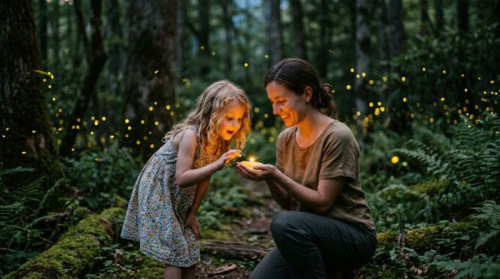
She left me alone with my pie and her words, and I sat in the rocking chair by the window, watching the fireflies blink in the garden, and I thought about what she had said. Grief and hope, living in the same house. I had not felt hope in a long time. But sitting there, in that quiet room, with the taste of warm apple pie on my tongue, I felt the smallest flicker of it — fragile and tentative, like a flame struggling to catch.
Over the next three months, Eleanor Cross became the mother I had lost at nineteen.
She came with me to every doctor's appointment, sitting in the waiting room with a book and a calm presence that steadied my nerves. She taught me how to knit, and though my first attempt at a baby blanket was a lumpy, misshapen mess, she hung it on the refrigerator and told me it was "character-building." She made me eat three meals a day, even when I was not hungry. She rubbed my swollen feet at night without being asked. She talked to my belly, reading passages from novels and poems, telling the baby about the garden and the birds and the way the morning light fell across the kitchen floor.
"She needs to know the world is beautiful," Eleanor said. "Even before she arrives."
I started to heal in ways I did not fully understand. The sharp edges of Kyle's abandonment softened into something I could carry without bleeding. The fear of becoming a mother alone began to transform into something quieter, something closer to anticipation. I started sleeping through the night. I started laughing at Eleanor's stories about her late husband Frank, who had proposed to her three times before she finally said yes.
"The first time, he asked me at a county fair," Eleanor told me one evening, as we sat on the porch watching the sunset. "I said no because I was nineteen and terrified. The second time, he asked me at a restaurant, and I said no because I thought I was too young. The third time, he did not ask at all. He just showed up at my door with a ring and said, 'Eleanor, I am going to keep asking until you say yes, so you might as well save us both the trouble.'"
"What did you say?" I asked.
She smiled, her eyes distant and warm. "I said yes. And I never regretted it for a single day."
She paused, looking at me with a tenderness that made my chest ache. "You will find someone who shows up at your door, Hannah. Someone who does not run when things get hard. Someone who stays."
I wanted to believe her. I was starting to.
The baby came on a cold January morning, three weeks early.
I woke at four in the morning to a pain that stole my breath. I lay in the dark, counting the seconds between contractions, trying to remember what the childbirth class had taught me. Five minutes apart. Then four. Then three.
I knocked on Eleanor's door at 4:30 AM. She opened it in her bathrobe, her silver hair loose around her shoulders, and the moment she saw my face, she shifted into action. She had been a nurse before she retired. She knew what to do.
"How far apart are the contractions?"
"Three minutes."
"Okay. We have time. Let me get dressed and start the car."
But when she opened the front door, a wall of white greeted us. An ice storm had swept through overnight, covering the roads in a sheet of black ice. Eleanor's old sedan sat in the driveway, its tires buried in a layer of freezing rain.
"I can't drive in this," Eleanor said, her voice tight. "The hospital is thirty minutes away. I'll never make it."
I felt the panic rising, hot and sharp. "What do I do? Eleanor, what do I do?"
She turned to me, and her face was calm — the calm of a woman who had faced worse than this and survived. "You breathe. And you trust me."
She called an ambulance, but the dispatcher said it could be over an hour before they arrived. The roads were too dangerous. Eleanor hung up the phone and looked at me with steady eyes.
"Well," she said, "it looks like I am delivering this baby."
The next four hours were the most terrifying and beautiful of my life. Eleanor boiled water, gathered towels, and set up a makeshift delivery station in my bedroom. She held my hand through every contraction, counting my breaths, wiping the sweat from my forehead, telling me I was strong, I was brave, I was doing this.
"You are doing this, Hannah," she said, her voice low and steady. "You are bringing a life into this world. You are the strongest person I have ever known."
I screamed. I cried. I told her I could not do it. And she held my hand and told me I could.
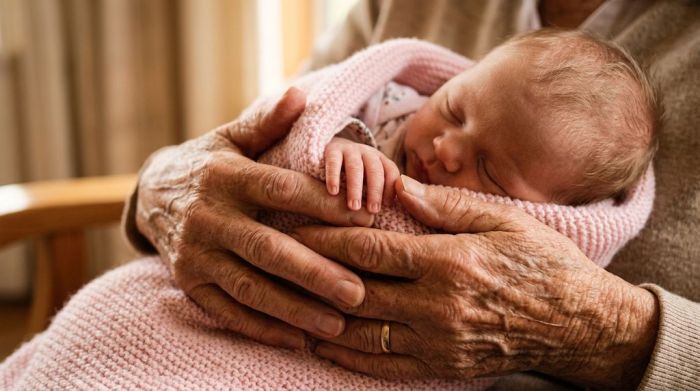
At 8:47 AM, with the winter sun struggling to break through the ice-covered windows, my daughter was born. Eleanor caught her with hands that were steady and sure, wrapped her in a clean towel, and placed her on my chest.
She was tiny and red and perfect, her eyes squeezed shut, her mouth opening in a cry that was the most beautiful sound I had ever heard.
I looked at Eleanor. She was crying, tears streaming down her face, her hands still covered in evidence of the miracle she had just helped bring into the world.
"You did it," she whispered. "You did it, Hannah."
"We did it," I said.
Eleanor reached out and touched the baby's cheek with one trembling finger. The baby turned her head toward the touch, and Eleanor let out a sob that seemed to come from somewhere deep and long-buried.
"She looks like Sarah," she said. "My Sarah. She had that same little chin, that same tiny nose."
I looked at my daughter, at the face I had been dreaming of for nine months, and I made a decision that I knew was right in every fiber of my being.
"Her name is Sarah Elizabeth," I said. "Sarah after your daughter. Elizabeth after my mother."
Eleanor looked at me, her eyes wide. "Hannah... you don't have to —"
"I want to," I said. "I want her to carry the names of the two women who made me who I am. My mother, who taught me to be kind. And your Sarah, who taught you to keep loving even after loss. And you, Eleanor, who taught me that family is not about blood. It is about who shows up."
Eleanor bent down and kissed my forehead, her tears falling onto my cheeks. "Thank you," she whispered. "Thank you for letting me be part of this."
The ambulance arrived an hour later. The paramedics checked us both and declared us healthy. But by then, it did not matter. The baby had already been born, in a yellow cottage on Magnolia Lane, into the hands of a woman who had lost a daughter and found a granddaughter.
---
Sarah Elizabeth is three years old now. She has Eleanor's silver hair — or at least, the baby version of it, a soft white-blonde that catches the light when she runs through the garden. She has my stubbornness and Kyle's laugh, though we do not talk about him anymore. He sends a birthday card every year, and I put it on the refrigerator for a week and then recycle it. Some doors close for a reason.
Eleanor and I bought the yellow cottage together last year. She sold it to me at a price that was far below market value, insisting that she did not need the money and that she "wasn't going anywhere." She is seventy-three now, and her steps are slower, and her hands are not as steady as they were the morning she delivered my daughter. But she still tends the garden. She still bakes apple pie. She still reads to Sarah every night, her voice soft and warm, the same voice that read to me on the nights when I could not sleep.
Last week, Sarah asked Eleanor, "Grandma, where did I come from?"
Eleanor looked at me, and I nodded.
"You came from love," Eleanor said, lifting Sarah onto her lap. "Your mama loved you so much that she drove all the way to Tennessee to find me. And I loved her so much that I helped her bring you into the world. And now we are a family. The three of us."
Sarah thought about this for a moment. Then she asked, "Can we have apple pie for dessert?"
Eleanor laughed, the same laugh that had welcomed me to Magnolia Lane three years ago. "We can have apple pie every single night, sweetheart. That is what grandmothers are for."
I sat in the rocking chair by the window, the same chair where I had sat on my first night in this house, watching the fireflies and wondering if I would ever feel hope again. And I looked at my daughter, sitting on Eleanor's lap, eating apple pie, and I realized that I had been wrong that night.
Hope had not just flickered back to life. It had grown roots. It had planted itself in the soil of this yellow cottage, in the garden that Eleanor tended, in the hands that had delivered my daughter into the world. It had grown into something so strong and so beautiful that I could not imagine my life without it.
Grief and hope can live in the same house. Eleanor had told me that on my first night here. And she was right. They can live in the same house, and they can grow together, and they can create something new.
They can create a family.
I am not alone anymore. I have a daughter. I have a mother. I have a yellow cottage on Magnolia Lane where the apple pie is always warm and the garden is always blooming and the love is so big that it fills every room.
I was twenty-eight years old, six months pregnant, and completely alone when I pulled into the driveway of 47 Magnolia Lane.
I am thirty-one now. And I have never been less alone in my entire life.