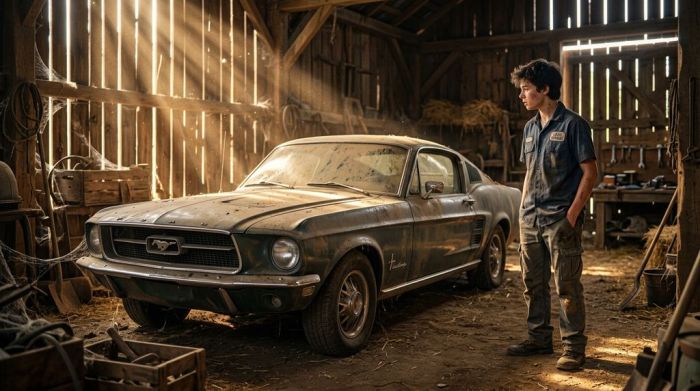
Leo Ramirez was sixteen years old when he learned that the loudest engines can carry the quietest secrets. He was a junior at Westbrook High School in a small town outside Indianapolis, a place where everyone knew everyone else's business and the most exciting thing that happened all year was the Fourth of July fireworks at the town park. Leo was not a bad kid. He was not a good student either. He was the kind of kid teachers described as "having potential" when they meant "needs to try harder."
He lived with his mother, a nurse's aide who worked double shifts at the county hospital, in a small rental house on the south side of town. His father had left when Leo was seven, and the only thing he had inherited from the man was a last name and a tendency to keep his feelings locked up tight. Leo spent most of his free time at Garcia's Auto Repair, a garage on Main Street owned by a former Marine named Carlos Garcia.
Carlos was a bear of a man with a shaved head and a voice like gravel rolling downhill. He paid Leo minimum wage to sweep floors, organize tools, and hand him wrenches. But the real payment was what Leo learned — how to rebuild a carburetor, how to listen to an engine and know what was wrong before the hood was even open, how to fix something broken until it worked again.
"You got a gift, kid," Carlos told him one afternoon, watching Leo rebuild a distributor from memory. "Don't waste it on video games and daydreams."
Leo shrugged. He did not know what his gift was worth. He did not know what anything was worth. He was drifting through life the way some kids do, waiting for something to happen, not knowing what that something was supposed to be.
Then Mrs. Eleanor Prescott walked into the garage.
She was eighty-two years old, small and silver-haired, dressed in a floral blouse and comfortable walking shoes. She walked with a cane, but her eyes were sharp and clear, the kind of eyes that had seen too much to be fooled by anything. She stood at the service counter until Carlos noticed her, and when he asked how he could help, she said something that made Leo look up from the engine block he was cleaning.
"I have a car in my barn. It's been sitting there for forty-two years. I want someone to make it run again."
Carlos raised an eyebrow. "What kind of car, Mrs. Prescott?"
"A 1967 Mustang. Fastback. Candy-apple red." She said the words the way someone might say the name of a lover they had lost. "It belonged to my husband. He passed away in 1983. I couldn't bear to sell it, and I couldn't bear to look at it. So I put it in the barn and closed the doors."
Carlos whistled low. "That's quite a car. It won't be cheap to restore."
"Money is not an issue," Mrs. Prescott said. "Time is."
Leo did not know what made him step forward. Maybe it was the way she said "forty-two years." Maybe it was the way she said her husband's name. Maybe it was the voice in his chest that whispered, this is the something you have been waiting for.
"I can do it," Leo said.
Carlos looked at him like he had just volunteered to fly to the moon. "Kid, that's a classic Mustang. You've never restored a car in your life."
"I can learn," Leo said. "You always said I had a gift. Let me use it."
Carlos studied him for a long moment, then turned to Mrs. Prescott. "He's sixteen. He's got more enthusiasm than experience. But he's the best kid I've got. If you're willing to give him a shot, I'll supervise."
Mrs. Prescott looked at Leo with those sharp, clear eyes. She seemed to see past his stained work shirt and his oil-blackened fingernails, past the awkwardness of a teenager who did not know how to stand or speak or be. She seemed to see something else, something Leo was not sure he believed existed.
"Alright, young man," she said. "Come see the car."
The Barn
The Prescott farm was on the outskirts of town, a hundred acres of land that had been in the family for five generations. The house was a beautiful old Victorian, painted white, with a wraparound porch and a garden that had clearly been loved once but was now overgrown. Mrs. Prescott led Leo past the house, past the empty chicken coop, past the old tractor that had rusted into the earth, to a barn that had not seen fresh paint in decades.
She pulled open the heavy wooden doors. Dust motes danced in the sunlight. And there, covered in a tarp that had long since faded to gray, was the shape of a car.
Leo walked forward slowly, the way you might approach something sacred. He pulled the tarp back, and the dust rose like incense, and the afternoon light fell across the most beautiful thing he had ever seen.
The Mustang was a mess. The tires were flat. The paint was faded and chipped, patches of rust spreading across the fenders like a disease. The windshield was cracked. The interior was torn and stained. But underneath all of it, Leo could see what it had been, what it could be again. The lines of the body were perfect, even under the grime. The shape of the hood, the slope of the fastback, the way the rear fenders flared just slightly — it was art. It was American muscle and elegance combined into something that took Leo's breath away.
"My husband Frank bought this car in 1967," Mrs. Prescott said, her voice soft. "He was a mechanic too, you know. He worked at the same garage where you work now, back when it was called Peterson's. He always said this car was his masterpiece. He rebuilt the engine himself, piece by piece, over the course of a year."
She paused, her eyes glistening. "He taught our son to drive in this car. We took it on our last vacation together, in 1982, to the Smoky Mountains. Frank died the next year. Heart attack. He was sixty-two years old."
Leo did not know what to say. He was not good at comforting people. He was not good with words at all. But he understood engines. He understood the language of things that could be fixed, of parts that could be replaced, of machines that could be brought back to life. And he understood that this car was not just a car. It was a monument. It was a love letter written in steel and rubber and gasoline.
The Restoration
Work began the following Saturday. Leo showed up at the Prescott farm at seven in the morning, armed with tools borrowed from Carlos and a notebook full of questions he had stayed up all night researching. Mrs. Prescott met him on the porch with a cup of coffee — black, no sugar — and a plate of toast.
"I'll be in the house if you need anything," she said. "There's lemonade in the refrigerator."
Leo nodded and got to work.
The first week was all assessment. He drained the oil, which looked more like tar. He checked the spark plugs, which were corroded beyond use. He tested the battery, which had been dead for so long it had become a paperweight. He catalogued every broken part, every rusted bolt, every piece that would need to be replaced. The list was long. But Leo did not feel discouraged. He felt excited. Every problem was a puzzle, and every puzzle had a solution.
Mrs. Prescott brought him lunch every day at noon. Sandwiches at first, then meatloaf, then her famous chicken and dumplings. They ate together on the porch, and Leo found himself talking to her in ways he had never talked to anyone. He told her about his father, about the way he had left without saying goodbye, about the anger he carried like a stone in his pocket. He told her about his mother, how tired she always was, how he wished he could do more to help. He told her about the dreams he had never told anyone — that maybe, one day, he could open his own garage.
And Eleanor Prescott listened. She listened the way old people listen, with the patience of someone who understands that most problems are not as urgent as they seem, and that the best gift you can give another person is the space to be heard.
The Story of Frank and Eleanor
One afternoon, when Leo was deep in the engine bay, wrestling with a seized bolts on the intake manifold, Mrs. Prescott came out and sat on an old milk crate nearby. She watched him work for a while, and then she began to talk.
"Frank proposed to me on the hood of this car," she said. "In 1968, a year after he bought it. He drove me to the top of Lookout Mountain, parked overlooking the valley, and got down on one knee right on the asphalt. I said yes before he even finished the question."
Leo paused, his wrench in hand. "That's pretty romantic."
"He was a romantic man," she said, smiling. "He used to write me poems. Terrible poems. Rhymes that did not rhyme and metaphors that made no sense. But I saved every single one of them. They are in a box in my bedroom."
"Do you still read them?"
"Every night," she said simply. "He has been gone for forty-one years, Leo. And I still read his poems every single night."
Leo felt something shift in his chest. He had never thought about love that way — as something that did not end when a person died, something that could be held onto through words and memories and a car covered in dust.
"The car was his dream," she continued. "He wanted to restore it completely, take it to car shows, win trophies. But life got in the way. The farm needed repairs. I got sick one winter. There was always something. And then he died, and I could not bear to look at it. I closed the barn doors and I did not open them again until you walked in."
"Why now?" Leo asked. "After all these years?"
Mrs. Prescott was quiet for a long moment. "Because I am eighty-two years old. And I realized that if I died without someone seeing this car run again, I would be failing Frank in the worst possible way. He poured his heart into this machine. I could not let it rust into nothing."
She looked at Leo, her eyes bright. "And then I saw you at the garage. The way you held that wrench, the way you listened to the engine. You reminded me of him."
The Turning Point
Three months into the restoration, Leo hit a wall. The engine would not turn over. He had rebuilt it from the ground up — new pistons, new rings, new valves, new everything. According to every manual he had read, every video he had watched, it should have worked. But when he turned the key, all he got was a sad, grinding click.
He sat in the driver's seat, his head resting on the steering wheel, fighting the urge to cry. He had spent every Saturday and Sunday at the Prescott farm. He had sacrificed his summer. He had believed, with the blind faith of a sixteen-year-old, that he could do this. And now the car was mocking him.
Mrs. Prescott appeared at the barn door. She did not ask what was wrong. She simply walked over, sat down in the passenger seat, and placed her hand on Leo's arm.
"Frank used to say that engines have personalities," she said. "You cannot just fix them. You have to understand them. You have to listen to what they are telling you."
Leo lifted his head. "I have done everything right. I followed every instruction. It should work."
"Maybe you missed something. Or maybe the car is testing you. Frank always said this car was stubborn, just like him." She smiled, a soft, knowing smile. "Go home. Get some sleep. Come back tomorrow with fresh eyes."
Leo went home. But he could not sleep. He lay in bed, staring at the ceiling, running through every step of the restoration in his mind. And then, at three in the morning, it hit him. The firing order. He had set the distributor cap one position off. It was a stupid mistake, a beginner's mistake, the kind that would make Carlos shake his head and say, "Pay attention, kid."
He was at the barn at six the next morning, before the sun was even fully up. He pulled the distributor cap, reset the wires, checked the timing, and took a deep breath. "You are hearing this, Frank," he whispered to the dashboard. "You and me. Let's go."
He turned the key.
The engine coughed. Sputtered. Caught. And then, with a roar that echoed through the barn and shook dust from the rafters, the 1967 Mustang came alive.
Leo sat in the driver's seat, his hands gripping the steering wheel, his heart pounding. He did not realize he was crying until the tears hit his hands.
Mrs. Prescott appeared in the barn door, still in her bathrobe, her hair uncombed, her eyes wide. She listened to the engine for a full minute, and then she crossed the barn and hugged Leo with a strength that surprised him.
"You did it," she whispered. "You brought him back."
The Drive
The first drive was on a Saturday afternoon in October. The leaves had turned, painting the Indiana countryside in shades of gold and orange and deep, burning red. Leo pulled the Mustang out of the barn for the first time in forty-two years. The tires were new. The paint had been restored. The interior had been reupholstered. The candy-apple red gleamed in the autumn sunlight like a jewel.
Mrs. Prescott sat in the passenger seat, wearing a dress Leo had never seen before — pale blue, the same color she had worn to her wedding, she told him. She had pinned a faded photograph to the dashboard: a young man in a mechanic's uniform, standing next to a brand-new Mustang, grinning like he had just won the lottery.
"That's Frank," she said. "1967. The day he drove it off the lot."
Leo nodded. He put the car in gear and pulled onto the dirt road that led away from the farm.
They drove for an hour. Past the old schoolhouse where Frank and Eleanor had met. Past the church where they had been married. Past the diner where they had shared their first date — a hamburger and a milkshake, two straws, one cherry. Mrs. Prescott directed him through the geography of her life, each turn a memory, each landmark a story.
They ended up at Lookout Mountain, the place where Frank had proposed. The valley spread out below them, a patchwork of farms and forests, the sun beginning to dip toward the horizon. Leo parked the Mustang at the overlook, just as Frank had done fifty-six years earlier.
Mrs. Prescott was quiet for a long time. Then she reached out and touched the photograph on the dashboard. "Thank you, Frank," she said softly. "For sending me this boy."
The Epilogue
Leo Ramirez is nineteen years old now. He works full-time at Garcia's Auto Repair, and on weekends, he takes on restoration projects of his own. He has a reputation in three counties as the kid who can bring any car back to life.
But the 1967 Mustang is still his masterpiece. Mrs. Prescott insisted that Leo keep it. "Frank would have wanted you to have it," she said. "You understood him. You understood the car. That's more than I could have asked for."
Leo drives it to school on warm spring days. He takes it to car shows and wins trophies. But the drives that matter most are the ones he takes on Saturday afternoons, when he picks up Mrs. Prescott from the farm and takes her for a ride through the countryside. She is eighty-seven now, and her steps are slower, and her voice is quieter. But her eyes are still sharp. And when that engine roars to life, she smiles the same way she smiled the day her husband showed her his brand-new Mustang fifty-nine years ago.
Before she passed away last spring, Mrs. Prescott gave Leo a box. Inside were Frank's poems — terrible poems, as she had promised, full of rhymes that did not rhyme and metaphors that made no sense. But Leo read every single one. And he understood that love does not have to be perfect. It just has to be real. It just has to be strong enough to last beyond a lifetime, strong enough to cross from one generation to the next, strong enough to arrive in the hands of a sixteen-year-old boy who needed to believe that broken things could be fixed.
Leo keeps the poems in the glove compartment of the Mustang. On the hard days, the days when he wonders if he is good enough, smart enough, worthy enough, he pulls one out and reads it. And he hears Frank's voice, and Eleanor's voice, and the voice of a car that refused to stay dead.
Because that is the truth about restoration. It is not about returning something to its original state. It is about taking something that has been broken and forgotten and making it beautiful again.
And that applies to cars. And to people. And to a sixteen-year-old boy who walked into a barn one summer and found a purpose he did not know he was looking for.
The road ahead is long. The engine is running. And Leo Ramirez is finally driving.