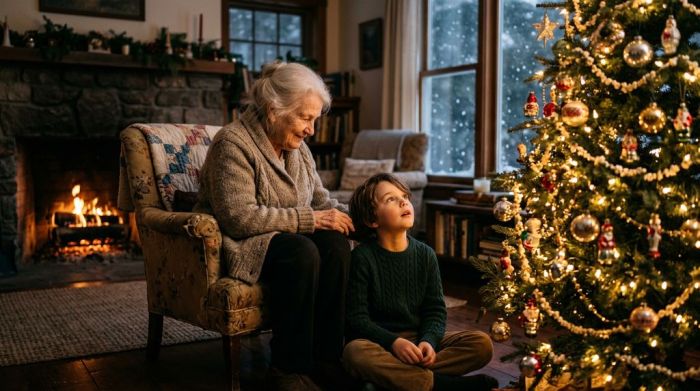
The first time I noticed the Christmas tree, it was June. Not December. June. The middle of a sweltering Vermont summer, with the heat pressing down on Maple Street like a damp blanket, and there it was — a full-sized spruce, decorated with tinsel and glass ornaments and white lights, glowing through the front window of the old Whitmore house.
I had just moved into the neighborhood with my wife and our son Leo. The moving truck was still half-unpacked in our driveway, and Leo — who was ten years old and had been diagnosed with autism when he was four — was sitting on the curb, rocking back and forth the way he did when the world became too much. He was staring at that Christmas tree through the window, his eyes wide, his body completely still for the first time all day.
That was how our story began. That tree, that house, and the woman who had kept her Christmas lights burning through five summers, five autumns, five winters, and five springs.
Her name was Margaret Whitmore, and she was eighty-two years old.
I did not know her story then. I only knew what the neighbors told me in hushed voices, the way people talk about someone they find both pitiful and fascinating. "She lost her husband five years ago," they said. "On Christmas Eve. And she never took the tree down. Not once. Some say she's lost her mind. Some say she's waiting for him to come back."
I will admit, I believed the first version. It seemed the most logical. An elderly widow, drowning in grief, unable to let go of the last physical remnant of her life with her husband. It was sad, certainly. But it was also the kind of sad that happens to old people in quiet towns — a slow, private tragedy that nobody wants to get involved in.
But Leo saw something different.
Leo did not see a crazy old woman clinging to the past. He saw a house with a tree that glowed in the dark, and to a boy who struggled to find patterns in a chaotic world, that tree was the most beautiful thing he had ever witnessed. It was consistent. It was predictable. Every single night, at exactly the same time, the lights would flicker on, casting their warm golden glow across the living room of the old Whitmore house. Leo would sit on the curb, wrapped in his favorite blue blanket, and watch. He never asked to go inside. He never tried to approach the door. He simply watched, the way someone might watch a sunset or a lighthouse beam cutting through fog.
Three weeks passed like this before Margaret appeared.
It was a Thursday evening, just as the sun was beginning to set. The lights had just come on — Leo had timed it to the second, as he did with everything — when the front door of the Whitmore house creaked open. An old woman stepped out onto the porch. She was small and thin, with white hair pulled back in a neat bun, and she was wearing a faded red cardigan that might have been new five years ago. She stood there for a long moment, looking at Leo the way you might look at a stray cat that has taken up residence on your lawn — wary, curious, uncertain.
Then she walked down the steps, across the lawn, and sat down on the curb beside him.
Neither of them spoke. They just sat there, side by side, watching the tree lights blink through the window. The crickets were starting their evening chorus. A dog barked somewhere down the street. The air smelled like cut grass and the particular stillness of small-town summer evenings.
"You're the new boy," Margaret said finally. Her voice was soft, the kind of voice that had once been strong but had grown fragile with age and disuse. "You've been watching my tree."
Leo did not answer. He rarely answered when strangers spoke to him. He just kept staring at the window, his fingers tracing patterns on his blanket.
"Do you like it?" Margaret asked.
Leo nodded. A small, quick nod.
"Why?"
Leo was quiet for a long moment. Then, in a voice so soft that Margaret had to lean in to hear it, he said, "Because it doesn't change."
Margaret let out a breath she had been holding for five years. "No," she said. "It doesn't. That's exactly why I keep it."
The Story of the Tree
Margaret's husband Thomas had been a high school English teacher in Burlington for thirty-eight years. He was a quiet man with a booming laugh and a love for everything Dickens. Every Christmas, he would go into the woods behind their house and cut down a spruce tree, dragging it back through the snow with a grin that made him look twenty years younger. He would spend an entire day decorating it, carefully placing each ornament in its proper spot, telling the story behind every single one.
"This one," he would say, holding up a chipped ceramic star, "was made by our daughter Sarah in the third grade. She gave it to me and said, 'Daddy, you're a star.' I've kept it ever since."
There was the wooden soldier from a trip to Germany in 1987. The glass snowflake that Margaret's mother had given them on their wedding day. The tiny handprint ornament that Sarah had made in kindergarten, now faded and cracked but still hanging in a place of honor near the top.
On Christmas Eve of 2020, Thomas had decorated the tree with extra care. He had seemed tired that year, more tired than usual, but he had insisted on doing it himself. "This might be my last tree," he had joked, the way old men joke about things they know are coming. "I want to make it a good one."
That night, after they had hung the last ornament and plugged in the lights, Thomas sat down in his armchair and took Margaret's hand. "I love you," he said. "I have loved you since the moment I saw you in the school library in 1965, holding a copy of 'A Tale of Two Cities.' You looked at me over the top of the book and said, 'It was the best of times. It was the worst of times. Which one are you?' I knew right then that I was going to marry you."
Margaret had laughed, the same laugh she had used for fifty-five years. "You've told me that story a hundred times."
"I know. I want you to remember it. I want you to remember that I chose you, every single day, for fifty-five years. And I would choose you again."
He fell asleep in his armchair that night, his hand still wrapped around hers, the Christmas lights casting their warm glow across his face. He never woke up.
The doctors said it was a heart attack. Peaceful. Painless. He simply stopped breathing in the middle of the night, surrounded by the twinkling lights of the tree he had decorated just hours before.
Margaret did not take the tree down the next day. She could not bring herself to do it. She told herself she would do it after New Year's. Then after spring. Then after the first anniversary. But every time she approached the tree, she would see Thomas's hands placing the ornaments, hear his voice telling the stories, feel the warmth of his hand in hers.
And so the tree stayed. The lights stayed on. Day after day. Week after week. Year after year.
The neighbors brought casseroles and concerned looks. Her daughter Sarah called from California and begged her to "move on." The mailman started leaving packages at the gate because he felt uncomfortable walking past the window where the Christmas tree glowed in July.
But Margaret did not care. The tree was not a decoration. It was a conversation with a man she had loved for fifty-five years. Every night, when she turned on the lights, she felt him standing beside her. She felt his hand on her shoulder, his voice in her ear. "It was the best of times, Margaret. It really was."
The Friendship That Changed Everything
Leo's mother — my wife, Rachel — was nervous about him spending time with Margaret at first. She was an old woman, a stranger, and Leo had trouble communicating when he was uncomfortable. But I told her about the way Leo looked at that tree, the peace in his eyes that we had not seen since his favorite therapist had moved away two years ago. "Let him go," I said. "I think she needs him as much as he needs her."
And so it began. Every evening, Leo would walk across the lawn and sit on Margaret's porch. She would bring out a glass of milk for him and a cup of tea for herself, and they would watch the tree lights come on together. Margaret talked. Leo listened. She told him about Thomas — about the way he laughed, the books he loved, the time he accidentally set the kitchen curtains on fire while trying to cook a romantic dinner. Leo did not respond with words, but he responded in other ways. He would lean in when her voice grew soft. He would nod at the funny parts. He would reach out and touch her arm when she started to cry.
One evening in early August, Leo spoke without being prompted. It was the first time he had initiated a conversation in months. "Why do you keep the lights on all year?" he asked.
Margaret looked at the tree, her eyes shining with tears she did not bother to wipe away. "Because," she said slowly, "Thomas is afraid of the dark. He always has been. When we were first married, he would leave the hallway light on every night. I used to tease him about it. But after he passed, I realized that the tree lights were the same thing. They are a light in the darkness. A light that says love does not end when someone dies. Love stays. Love keeps burning."
Leo considered this for a long moment. Then he said, "My dad says I'm afraid of change. He says I like things to stay the same."
"There's nothing wrong with that," Margaret said. "Sometimes change is hard. Sometimes things are beautiful exactly the way they are."
"Like your tree."
"Like my tree."
The Day the Lights Almost Went Out
It happened on a rainy Sunday in October. The old wiring in Margaret's house finally gave out. I was fixing a gutter on our roof when I heard her front door slam open and saw her standing on the porch, her face white with panic. "The tree!" she cried. "The lights! They went out!"
Leo heard her from inside our house. He ran out the door before I could stop him, his bare feet slapping against the wet pavement. He ran to Margaret's front door and stopped, looking at the dark window where the tree had glowed every night for five years.
Margaret was crying. Not the quiet, dignified tears of a composed widow, but the raw, heaving sobs of a woman who had just lost her husband all over again. "They're gone," she kept saying. "The lights are gone."
Leo did not say anything. He walked inside the house, through the dark living room, and stood in front of the tree. He looked at the dark bulbs, the tangled wires, the ornaments that hung in silent witness. Then he did something that made Margaret stop crying.
He reached into his pocket and pulled out a small flashlight — the one he carried everywhere, the one he used to read under his covers at night. He clicked it on and pointed it at the tree. The beam of light hit the glass ornaments, scattering tiny rainbows across the walls.
"It's okay," Leo said quietly. "I brought light."
Margaret looked at him through her tears. She looked at the little boy standing by her tree, holding up a flashlight as if it were the most precious gift in the world. And in that moment, something shifted inside her. The grief that had held her captive for five years loosened its grip, just slightly, just enough for her to breathe.
I fixed the wiring the next day. The tree lights came back on that evening, and Leo was there to watch them flicker to life. But something had changed. The tree was still there. The lights were still burning. But Margaret had learned something that Thomas had been trying to teach her all along — that love does not live in a tree or a house or a collection of ornaments. Love lives in the people who show up with flashlights when the lights go out.
Epilogue: A New Tradition
Margaret is eighty-seven now. The tree is still up, but it is not the same tree. Every year, Margaret and Leo go into the woods behind her house to cut down a new one. Leo picks it out with the same careful precision he applies to everything, circling each tree, studying its shape, running his fingers along its needles until he finds the perfect one.
They decorate it together, the same way Margaret and Thomas used to do. Margaret tells Leo the story behind each ornament, and Leo listens with the focused attention that only he can give. When they finish, they plug in the lights, and they sit on the porch swing, watching the glow spread across the living room.
The house on Maple Street still has a Christmas tree that stays up all year. The neighbors still whisper about it sometimes. But now they whisper with smiles, because they know the story. They know that the tree is not a monument to grief. It is a monument to love — the love of a woman for her husband, the love of a boy for consistency, and the love that grew between two unlikely friends who found each other in the glow of lights that never went out.
Last Christmas, Margaret gave Leo a small box. Inside was a chipped ceramic star — the one that Thomas's daughter Sarah had made in the third grade. "Thomas would have wanted you to have this," Margaret said. "You are a star, Leo. Never forget that."
Leo hung the star on his own tree that night. He keeps it there all year, even in June, even in the middle of summer, when the heat presses down on Maple Street like a damp blanket and the world feels too chaotic to bear.
Because some lights are not meant to go out. Some stars are not meant to be packed away. And some love stories do not end when the music stops — they keep playing, quietly, stubbornly, in the hearts of people who refuse to let the darkness win.
If you ever pass by a house with a Christmas tree glowing in June, do not assume the person inside is lost. Assume they are found. Assume they are holding onto something that the rest of the world has forgotten how to see — the quiet, persistent truth that love, real love, never has to end.
It just keeps burning. Light after light. Year after year. One small flashlight at a time.