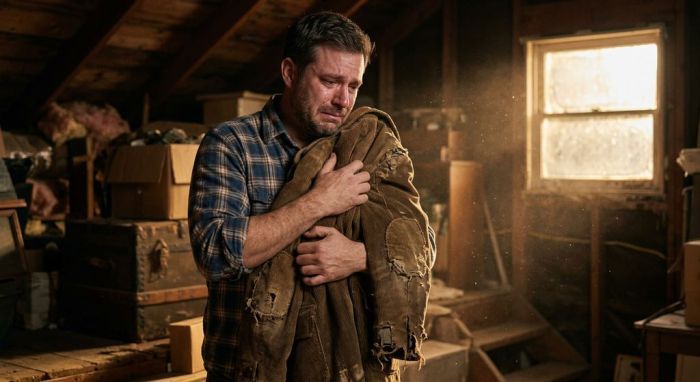
I was seventeen years old when I realized my father owned only one coat.
It was a brown corduroy jacket, the kind you could buy at any department store for twenty dollars. The elbows were patched with fabric that didn't quite match. The cuffs were frayed and threadbare. The buttons were mismatched — two brown ones on top, a black one in the middle, and a tan one at the bottom, as if he had replaced them one by one over the years without caring what they looked like.
I was ashamed of that coat. I was ashamed of the man who wore it.
And twenty-three years later, sitting alone in his empty house with that same coat in my hands, I realized I had never been more wrong about anything in my entire life.
A Father's Quiet Life
My father, Arthur Coleman, was a custodian at Jefferson High School in a small town in Ohio. Every morning at 4:30 AM, he would rise in the dark, pull on that brown coat, and walk the two miles to the school because we did not own a car that worked. He would clean the hallways, empty the trash cans, mop the cafeteria floors, and fix the broken heaters. He did this for thirty-one years.
I was a student at that same school.
Do you know what it feels like to see your father pushing a mop down the hallway while your friends are laughing behind their hands? Do you know what it feels like to hear someone whisper, "Hey, isn't that Tommy's dad?" and pretend you didn't hear? I did. Every single day for four years.
I never said anything to him about it. I never said, "Dad, I'm embarrassed." But he knew. Fathers always know.
He started leaving for work earlier so he would finish his shift before the first bell rang. He started taking the back hallways, the ones nobody used. He stopped coming to my basketball games because he didn't want me to suffer the humiliation of seeing him in that coat. He sacrificed his presence in my life so I would not have to suffer the humiliation of his.
And I let him.
The Years That Passed
My mother died when I was six years old. I do not remember much about her — just the smell of her lavender perfume and the way she laughed, a high, musical sound that filled our small house like sunlight. After she passed, my father did not remarry. He did not date. He did not go out with friends. He simply worked, came home, made sure I had dinner, helped me with my homework, and went to sleep. Every single day, the same routine, for twelve years.
I never once heard him complain.
When I was accepted to Ohio State University, he hugged me for the first time in years. I remember feeling the rough corduroy of that brown coat against my cheek and thinking, "I can't wait to get out of this town. I can't wait to get away from this coat."
I did not know, as I walked onto that campus as a wide-eyed freshman, that my father was working double shifts to pay for my tuition. I did not know that he had taken a second job — weekend maintenance at a local church — to cover my textbooks. I did not know that he was eating canned soup for dinner five nights a week so that I could have a meal plan.
I was too busy being successful to notice.
The Coat That Would Not Be Replaced
College led to law school. Law school led to a job at a firm in Chicago. I bought suits that cost more than my father made in a month. I wore thousand-dollar shoes and drove a German car. I sent my father a check every Christmas, which he never cashed. I called him once a month, on Sundays, and kept the conversations short because I was always busy.
And in every single photograph my father sent me — Christmas photos, birthday photos, photos of him standing in front of the house — he was wearing that same brown coat. Year after year. Decade after decade.
I bought him a new coat for his sixtieth birthday. A beautiful wool overcoat from a department store in Chicago, charcoal gray, with real leather buttons. He opened the box, smiled, and said, "This is too nice for me, Tommy. I'll wear my old one."
I thought he was being stubborn. I was angry, if I am being honest. I had spent three hundred dollars on that coat, and he would not even try it on. I did not understand. Not yet.
The Letter in the Pocket
My father was seventy-one when the cancer found him. Pancreatic. The kind that sneaks up on you and destroys everything before you even know it is there. I flew home the day he called me from the hospital. When I walked into his room, he was sitting up in bed, wearing a hospital gown, looking smaller than I had ever seen him.
And there, hanging on the back of the door, was the brown coat.
"Dad," I said, "you're in the hospital. You don't need a coat in here." He smiled his tired smile. "I know, son. It just felt wrong to leave it at home."
He lasted six more weeks. I took a leave of absence from work and stayed with him every day. We talked about things we had never talked about. He told me about my mother — how they met at a county fair, how he knew she was the one the moment she beat him at the ring-toss game. He told me about the night I was born, how he had held me in his trembling arms and promised God he would give me a better life than he had.
"I kept that promise," he whispered one evening, his voice thin as paper. "Didn't I, Tommy?"
"Yes, Dad," I said, holding his hand. "You kept it."
The Discovery
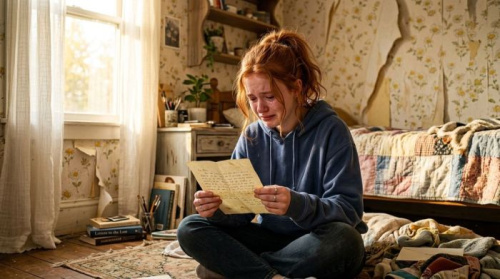
After the funeral, I went back to the house on Maple Street. I had to sort through his things. The coat was hanging in his closet. I took it down, planning to throw it away. The elbows were nearly worn through. The lining was torn. A button was missing. I was about to toss it in the trash bag when something fell out of the inner pocket.
A letter. Folded and refolded so many times that the creases had worn through, turning the paper into soft, fragile strips. It was addressed to me, in my father's handwriting, dated June 1998 — the summer before I started college.
Dear Tommy,
If you are reading this, I am gone. I hope you are not reading it for a long, long time. But I wanted to write this down so you would know, one day, the truth about something.
This coat your mother bought for me in 1983, at a JCPenney in Columbus. It cost eighteen dollars. She said it made me look handsome. I laughed and told her I could look handsome in a potato sack, and she swatted my arm and said, "Arthur Coleman, you are impossible."
She was right. I was impossible. But she loved me anyway.
When she passed, I wanted to buy a new coat. I needed one. This one was already falling apart. But I looked at you, six years old, sleeping in your bed, and I thought about your future. I thought about college. I thought about everything I could not give you because I never finished high school myself.
So I made a decision. Every time I wanted to buy a new coat, I would put that money into a jar instead. Five dollars. Ten dollars. Whatever I could spare. And over the years, that jar grew into something I never expected.
Twenty years, Tommy. That is how long I wore this coat. And every single time I put it on, I thought of you. Every patch on the elbow is a semester of your education. Every frayed cuff is a textbook you needed. Every missing button is a meal you ate while I was perfectly happy with my canned soup.
Do not be sad when you read this. Do not cry for the coat. I wore it with pride, son. Every hole, every stain, every worn-out thread — I wore them all with pride because they were proof that my son was going to have a better life than I did.
Now you are a man. A good man. A successful man. And all it cost me was one old brown coat.
Wear your own coat well, son.
All my love, Dad
The Coat That Became a Legacy
I do not remember how long I sat on the floor of his closet, holding that letter and that coat. All I remember is the profound, crushing weight of understanding — the moment when everything clicks into place and you realize that the person you thought you knew was so much bigger, so much braver, so much more loving than you ever gave them credit for.
I took the coat home to Chicago. I had it professionally restored — the elbows re-patched with matching fabric, the lining replaced, the missing button sewn back on. It hangs in my office now, in a glass case, next to my law degree.
Sometimes, when I have a hard day, I take it out of the case. I hold it in my hands. I feel the weight of twenty years of sacrifice pressed into its fibers. And I remember that my father wore this coat so I could wear a suit.
I am forty years old now. I have a son of my own. His name is Arthur, after my father. He is eight years old, and last week, he asked me why I have an old worn-out coat hanging in a glass case in my office. I told him it was a family treasure.
"Can I see it?" he asked. I took it out and handed it to him. He held it carefully, reverently, as if it were made of gold.
"It smells funny," he said. I laughed. "That's your grandfather's smell. That's the smell of love."
He did not understand. Not yet. But one day, when he is older, I will sit him down and I will tell him the story of the coat. I will tell him about a man who worked double shifts and ate canned soup and wore an eighteen-dollar jacket for twenty years so his son could have a better life.
And I will tell him that love is not measured in words or gifts or grand gestures. Love is measured in what you are willing to give up. Love is measured in patches on elbows and frayed cuffs and mismatched buttons. Love is an old brown coat that a father wore for twenty years so his son could walk into the world dressed like a king.
I wear that coat now, sometimes, on cold Chicago mornings. It fits me perfectly.