The first time I saw the dog, I almost ran him over with my pickup truck.
It was a cold November morning in 2018, the kind of morning that settles into your bones and stays there no matter how many layers you put on. I was driving into town, the way I did every Tuesday to pick up my Social Security check and a bottle of cheap whiskey. The road was empty, as it always was, stretching through the flat Ohio farmland like a gray ribbon unraveling across the earth.
And then suddenly, there he was. Standing in the middle of the road. Not moving. Just standing there, looking at me with eyes that seemed too old for a dog that young.
I slammed on the brakes. The truck skidded on the frost-covered asphalt and came to a stop about ten feet from where he stood. He didn't flinch. Didn't run. He just sat down, right there in the middle of the road, as if he had been waiting for me.
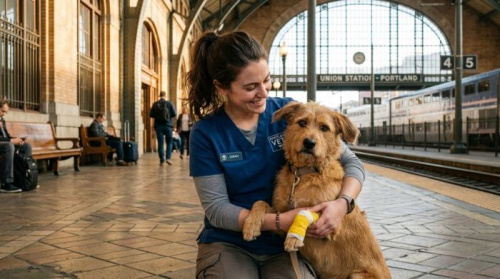
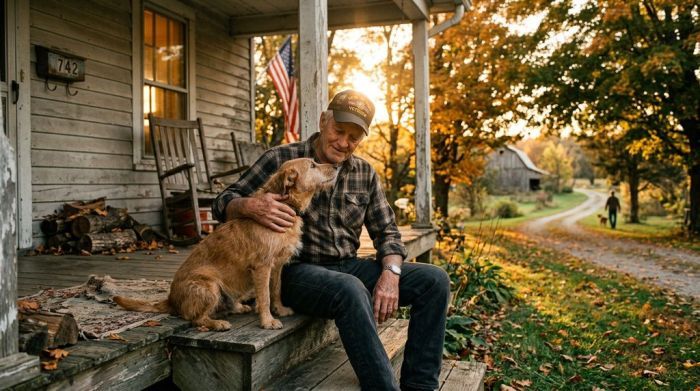
I got out of the truck, my knees cracking in protest. He was a mutt, some kind of shepherd mix with golden-brown fur and one ear that flopped down while the other stood straight up. He was thin. Too thin. His ribs showed through his coat, and there was a raw patch on his back leg where something had bitten him.
"Hey there," I said, my voice rough from years of cigarettes and silence. He wagged his tail once. Twice. Then he stood up, walked over to me, and pressed his head against my leg.
I had not touched another living creature in six years.
Not since the divorce. Not since Sarah, my daughter, stopped answering my calls. Not since I moved into that crumbling farmhouse on the edge of town where the only sounds were the wind through the cracks in the windows and the ticking of the grandfather clock my father had left me.
I stood there on that empty road, a seventy-two-year-old Vietnam veteran with a bad back and a worse heart, and I felt the warmth of that dog's head against my leg. It was the first time in years that something had asked nothing of me. It just wanted to be near me.
"Get in the truck," I said. And he did.
I named him Scout. Not for any particular reason. It just came to me as I was heating up a can of soup that evening, watching him curl up on the threadbare rug in front of the fireplace. He looked like he was scouting the place, taking inventory of his new surroundings. He looked like he belonged there.
The first night, I did not sleep. I lay in bed, staring at the ceiling, listening to the unfamiliar sound of breathing that was not my own. For eighteen years, I had lived alone. My wife Margaret left me in 2000, took Sarah with her, and moved to Columbus. The divorce was my fault. The drinking, the silences, the way I could not talk about what happened in the jungle in 1969, even when she begged me to.
I was a ghost of a man, haunting a house that had long since stopped feeling like a home.
But that first night with Scout, something shifted. At three in the morning, I heard him padding down the hallway. He pushed the bedroom door open with his nose, climbed onto the foot of the bed, and curled into a tight ball against my legs. He let out a long, contented sigh, the kind that seemed to come from somewhere deep in his chest, and fell asleep.
I lay there, feeling the weight of him, the warmth of him, and I thought about the last time I had felt anything like this. It was 1998, and Sarah was ten years old. She had crawled into bed with me after a nightmare, her small body trembling, and she had whispered, "Daddy, I had a dream that you went away and never came back."
I had held her that night. I had promised her I would never leave. Six years later, she was gone, and it was my fault.
I cried that night, for the first time in years. I cried silently, so I would not wake the dog. But I think he knew. I think he always knew.
Over the next few weeks, Scout changed my life in ways I did not think were possible anymore. He forced me to get out of bed in the morning because he needed to be fed. He forced me to go outside because he needed to be walked. He forced me to talk to people because he would pull me toward neighbors, toward strangers, toward anyone who would stop and pet him.
I started buying real food. Ground beef, chicken, vegetables — things I had not cooked for myself in years but suddenly needed to cook for him. I found myself standing in the grocery store aisle, reading the ingredients on a bag of dog food, and a woman my age smiled at me and said, "You've got a lucky dog."
"I think I'm the lucky one," I said. It was the first time I had said something kind about myself in two decades.
In December, I found Scout sitting at the living room window, staring out at the road. He did this every day around the same time, around four in the afternoon, just as the sun started to set. He would sit perfectly still, his ears perked up, his tail giving a little wag every few minutes, as if he was waiting for someone.
At first, I did not think much of it. Dogs do strange things. But after a week, I started to notice. He was not just looking out the window. He was waiting. Waiting for someone specific.
I walked over and stood beside him, looking out at the empty road, the bare trees, the gray December sky. "Who are you waiting for, boy?" I asked.
He looked up at me with those old eyes, and for a moment, I could have sworn he was trying to tell me something.
Then, on Christmas Eve, the doorbell rang.
I had not heard that sound in months. Nobody visited me. Nobody ever visited me. I opened the door, and standing on the porch was a young woman in a heavy winter coat, her breath fogging in the cold air. She was maybe thirty years old, with dark hair and eyes that looked achingly familiar.
"Can I help you?" I asked.
"Are you Frank O'Brien?" she asked.
"Who's asking?"
She looked past me, into the house, and her face broke into a smile. She pointed. "That's him. That's my dog."
I turned around. Scout was standing in the hallway, his tail wagging so hard his whole body shook. He whined, a high, desperate sound, and then he bolted past me, jumped up on the young woman, and licked her face like she was the answer to every prayer he had ever made.
I stood there, frozen, watching this stranger embrace my dog.
"I'm sorry," she said, laughing and crying at the same time. "I know this is strange. I'm Emily. I live about three miles down County Road 8. Scout — well, I called him Buddy — he got out of my yard about six weeks ago. I've been looking for him ever since. I put up flyers. I posted on every lost pet page I could find. I almost gave up."
I felt my chest tighten. "You came on Christmas Eve."
"I know. I'm sorry. But I saw him through your window when I was driving by. I had to check." She looked at me, really looked at me, and her expression softened. "He looks happy. He looks really happy."
I looked at Scout, now lying at Emily's feet, his head resting on her boots, his tail still wagging. And I felt something crack open inside me. Something I had kept sealed shut for so long that I had forgotten it was there.
"Take him," I said. My voice came out quieter than I intended. "He's your dog. You should take him home."
Emily looked at me, then at Scout, then back at me. "Mr. O'Brien... may I ask you something?"
"Sure."
"How long have you been living alone?"
The question hit me like a punch to the chest. I opened my mouth to answer, but no words came out.
She took a step closer. "I ask because... my father lives alone too. He's a Vietnam vet. He doesn't talk to me anymore. He hasn't spoken to me in eight years, not since my mother passed. I send him letters. I leave him voicemails. He never responds." Her voice cracked. "I don't even know if he reads them."
"What's your father's name?" I asked.
"Thomas. Thomas O'Brien. He used to live in Columbus, but I heard he moved somewhere around here a few years ago."
The world stopped spinning.
Thomas O'Brien was my brother.
I had not spoken to my brother in fourteen years. We had a falling out after our mother's funeral, over something so stupid that I could not even remember the details anymore. He had moved to Columbus. I had stayed here. We had let pride build a wall between us that neither of us had the courage to tear down.
"Emily," I said, my voice barely a whisper. "Thomas is my brother. You're my niece."
Her face went pale. "What?"
"I'm Frank. Frank O'Brien. Your father's older brother."
She stared at me for a long, long moment. Then she looked down at Scout — at Buddy — who was still lying at her feet, looking up at her with patient, knowing eyes.
"Oh my God," she whispered. "You found him."
It turned out that Emily lived three miles away. Three miles. My niece had been living three miles from me for two years, and I had never known. She had moved to this small Ohio town to be closer to her father, who had stopped answering her calls. She had adopted Scout — Buddy — from the local shelter about a year ago.
And Scout, somehow, had found his way to me.
Scout had found the one person in this town who was connected to Emily by blood. He had found the uncle she never knew she had. He had crossed three miles of farmland, gotten bitten by something in the darkness, and waited in the middle of a road until I showed up.
Emily came inside. We sat in my kitchen, and I made coffee for the first time in months. I told her about my daughter Sarah. She told me about her father, my brother, who was struggling with the same demons I had wrestled with for decades. We talked until the sun went down, and then we called Thomas.
He answered on the third ring.
"Emily? Is everything okay?"
"I'm with your brother, Dad."
There was a long silence. Then, in a voice I had not heard in fourteen years: "Frank?"
"Yeah, Tommy," I said, and for the first time in my adult life, I did not try to hide the tears. "It's me."
That was seven years ago. Scout is old now, nearly blind in one eye, his muzzle completely gray. He sleeps most of the day, curled up on the rug in front of the fireplace, dreaming whatever dogs dream about.
Thomas and I meet for breakfast every Sunday at a diner in town. We do not talk about the years we wasted. We talk about the years we have left.
Emily got married last summer. I walked her down the aisle.
And my daughter Sarah? She came to the wedding. Her mother told her about the dog, about the Christmas Eve visit, about the uncle she never knew she had. She drove six hours from Chicago to be there.
She sat next to me during the ceremony. She did not say much. But at the end, when Emily threw her bouquet, Sarah caught it. She laughed, the same laugh I remembered from when she was ten years old.
"I guess this means you're next," I said.
"Don't hold your breath, Dad," she said. But she was smiling.
We have dinner together once a month now. It is not much. It is not everything. But it is more than I had before Scout showed up on that cold November road.
I still think about that day sometimes. The way he sat in the middle of the asphalt, not moving, not afraid, just waiting. As if he knew that an old man with a broken heart was driving down that road, and that if anyone was going to save him, it would have to be a dog.
Because that is the thing about love, when you get to my age. It does not always come in the forms you expect. Sometimes it comes with four legs and floppy ears. Sometimes it comes as a stranger on your doorstep on Christmas Eve. Sometimes it comes as a phone call to a brother you have not spoken to in fourteen years.
The greatest journeys of our lives do not begin with grand plans or careful preparations. They begin with a single moment of grace — a dog sitting in the middle of a road, waiting for you to stop.
I stopped.
And it saved my life.