For thirty-seven years, Frank Mercer worked the assembly line at the Ford plant in Dearborn, Michigan. He started in the summer of 1969, an eighteen-year-old kid with a strong back and a simple dream — to give his future family everything his own father had failed to provide.
His father was a good man, but an unlucky one. A coal miner from West Virginia who had moved north during the war, he had worked himself into an early grave at fifty-three, leaving behind a widow, three children, and a mountain of unpaid medical bills. Frank watched his mother struggle, watched her work double shifts at the diner, watched her age twenty years in five. He swore he would never let that happen to the people he loved.
So when his son Jimmy was born in 1974, Frank made a promise to himself. He would work harder than any man in Detroit. He would save every penny. He would build a fortress of financial security around his family so that nothing — not illness, not recession, not bad luck — could ever touch them.
He kept that promise.
But fortresses have walls. And walls, as Frank would learn, keep things out. They also keep things in.
The Little League years were the hardest. Jimmy was good — really good. The kind of natural talent that coaches noticed and scouts whispered about. By the time he was nine, he was the starting pitcher for the Dearborn Dynamos, a team that went to the state championships two years in a row.
Frank never saw him pitch a single game.
Not one.
There was always a reason. A double shift that paid time-and-a-half. A weekend overtime that meant an extra two hundred dollars. A coworker who needed a swap because his kid was sick. Frank said yes to all of them because that was what good fathers did. Good fathers provided. Good fathers made sacrifices. Good fathers worked.
But late at night, after the dinner he had eaten alone, after the phone call with his wife where she told him Jimmy had struck out twelve batters, after he had hung up and sat in the silence of the empty kitchen, Frank would feel something gnawing at the edges of his chest. He would push it down. He would tell himself it was worth it.
He told himself that for thirty-seven years.
In 2006, Jimmy graduated from high school. He had a scholarship to play baseball at Michigan State. Frank took the day off for the graduation ceremony — one of the only times he had ever done so — and sat in the third row, watching his son walk across the stage in a blue cap and gown. Jimmy smiled and waved at him. Frank waved back, his chest swelling with a pride so fierce it hurt.
That night, Frank asked Jimmy if he wanted to go out for dinner to celebrate. Jimmy hesitated. "Actually, Dad, I was going to meet some friends. Maybe another time."
Frank said sure. He understood. Kids wanted to spend time with their friends on their big day.
He did not know that Jimmy had told his mother, years later, that he could not bear to sit across a table from his father and pretend everything was fine when he could not remember a single game his father had ever watched him play.
Jimmy went to Michigan State. He played two seasons before a shoulder injury ended his baseball career. He transferred to the business school, graduated with honors, and moved to Chicago for a job at an investment firm. He met a woman named Rachel. They got married. They had a son, whom they named Lucas.
Frank missed the wedding. He had promised to be there. He had even bought a plane ticket. But a week before the ceremony, the plant manager announced mandatory overtime for anyone who wanted to keep their pension. Frank chose the pension.
He told himself it was worth it.
In 2010, Frank's wife Margaret passed away. Cancer. The same disease that had taken his father. She was sixty-two years old. Frank took three weeks off work, the longest break of his entire career. He sat beside her hospital bed, held her hand, and watched her fade away the same way his mother had watched his father fade.
On her last night, Margaret looked at him with eyes that held no anger, only a deep, exhausted sadness. "Frank," she whispered, "you worked so hard. You gave us everything. But Jimmy didn't need everything. He needed you."
Frank opened his mouth to defend himself. To explain. To tell her about the promises he had made, the sacrifices, the long nights. But the words would not come. Because somewhere, in the deepest part of his heart, he knew she was right.
Jimmy came to the funeral. He stayed for three days. He was polite, distant, efficient. He helped with the paperwork. He sorted through his mother's things. And on the last day, as he was packing his suitcase to return to Chicago, Frank stood in the doorway of his son's childhood bedroom and tried to find the words he had never learned how to say.
"Jimmy," he said, "I know I wasn't there for a lot of your games."
Jimmy did not look up from his suitcase. "It's fine, Dad. You were working."
"I wanted to be there."
"Okay."
"I mean it, son. I wanted to be there more than anything."
Jimmy finally looked at him. His eyes were the same green as Margaret's, and they held the same exhausted sadness. "Then why weren't you?"
Frank had no answer.
Jimmy left that evening. He hugged his father at the door, a stiff, quick embrace that ended before it began. "Take care of yourself, Dad," he said. And then he was gone.
Frank retired from the Ford plant in 2007, at the age of fifty-six. The pension was secure. The house was paid off. The fortress was complete. He had achieved everything he had set out to achieve.
And he had never felt more empty in his entire life.
The first year of retirement was a fog. Frank wandered through the house on Michigan Avenue like a ghost, unsure of what to do with his hands, his time, his life. He watched television. He napped. He ate meals at the same diner where his mother had once worked, sitting alone in a booth, staring out the window at a world that had moved on without him.
In the second year, he started cleaning out the attic.
It was a cold February morning when he found the box. It was taped shut, marked "Jimmy's Things" in Margaret's handwriting. Frank carried it downstairs, set it on the kitchen table, and opened it with the care of a man handling something fragile.
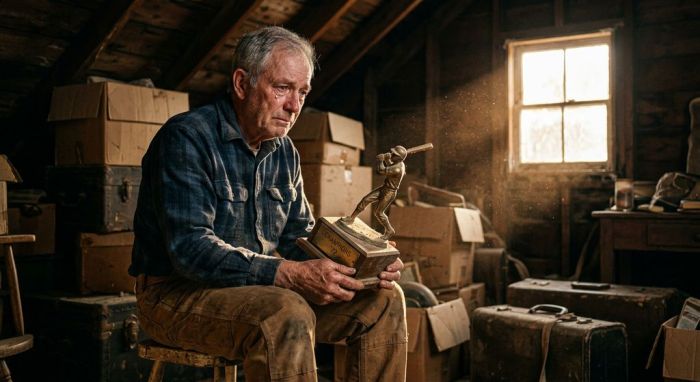
Inside were baseball trophies. Dozens of them. Little League, Pony League, American Legion. Gold figures of boys swinging bats, catching balls, crossing home plates. The bases were engraved: MVP, 1983. Most Improved Player, 1984. All-Star, 1985, 1986, 1987. Championship Team, 1985.
Frank picked up the MVP trophy from 1983. Jimmy would have been nine years old that year. He turned it over in his hands, ran his thumb across the engraving. He thought about the double shift he had worked that day, the one that had paid for... what? He could not remember.
He could not remember a single thing he had bought with all that overtime money. But he could imagine, with painful clarity, what he had missed. A nine-year-old boy, standing on a pitcher's mound, looking into the stands for his father. A nine-year-old boy, striking out the last batter, hearing the crowd roar, searching the faces for the one face that mattered most. A nine-year-old boy, holding an MVP trophy, walking to the car with his mother, asking, "Did Dad see it? Did he see me pitch?"
Frank sat at the kitchen table, surrounded by a decade of his son's achievements, and he wept.
He wept for the games he never watched, the catches he never saw, the home runs he never cheered. He wept for the boy who had become a man while his father was working double shifts. He wept for the thirty-seven years he had spent building a fortress that had kept out the only thing that ever mattered.
He called Jimmy the next day.
"I want to come to Chicago," Frank said, his voice rough, unsteady. "I want to see you. I want to meet Lucas properly. And I want to tell you something I should have told you a long time ago."
There was a long silence on the other end of the line. Then, quietly: "Okay, Dad. I'll pick you up from the airport."
The flight from Detroit to Chicago is forty-five minutes. It felt like forty-five years to Frank. He sat by the window, watching the patchwork of farms and cities pass beneath him, rehearsing the words he had been practicing for weeks. They all sounded hollow. They all sounded insufficient.
Jimmy was waiting at the gate. He looked older now, grayer, with lines around his eyes that had not been there the last time Frank had seen him. He was holding a sign that said "Welcome, Dad" in a child's handwriting — Lucas had made it, Jimmy explained.
They hugged. It was awkward, uncertain, the way two men hug when they have spent decades not knowing how to hold each other. But it was a start.
That evening, Frank sat in the living room of his son's Chicago home, watching his grandson Lucas play with a toy train on the carpet. Lucas was seven years old, the same age Jimmy had been when Frank missed his first Little League game. He had Jimmy's smile, Margaret's eyes, and a baseball cap that he wore backwards, just like his father used to.
"I'm sorry," Frank said. The words came out before he could stop them, raw and unpolished and absolutely necessary.
Jimmy looked at him from across the room. "I know, Dad."
"No, you don't know. You can't know. I spent thirty-seven years working myself to the bone, and I told myself it was for you. For this family. But the truth is, I was scared. I was scared of being like my father — of leaving you with nothing. And in trying to give you everything, I gave you nothing that mattered."
Jimmy sat down across from him. "I spent a lot of years being angry at you," he said slowly. "Angry that you weren't there. Angry that Mom had to come to all my games alone. Angry that you chose a pension over my wedding." He paused, his voice cracking. "But then Lucas was born. And I held him in my arms for the first time, and I realized something. You did what you thought was right. You made mistakes, just like I'm going to make mistakes. And I have a choice. I can stay angry, or I can forgive you."
Frank's hands were shaking. "Can you?" he whispered.
Jimmy stood up. He walked to the closet, pulled out a worn leather glove, and tossed it to his father. "Lucas has a game next Saturday. Little League. He's not very good yet, but he's learning. Do you want to come?"
Frank caught the glove. It was old, stained with sweat and dirt and decades of use. Jimmy's glove. The one he had used in 1983, the year he won MVP.
Frank looked at the glove in his hands. Then he looked at his son. Then he looked at Lucas, who was watching them from the carpet, his small face curious, his own mitt lying beside him.
"Try and stop me," Frank said.
The game was on a Saturday morning in April. The sky was clear, the air was crisp, and the field was covered in the bright green of early spring. Frank sat in the bleachers next to Jimmy, a cup of coffee in one hand, Lucas's glove in the other.
Lucas was not very good. He struck out twice. He missed a ground ball that rolled between his legs. He threw a wild pitch that nearly hit the batter.
But Frank cheered for every single moment. He clapped when Lucas struck out, shouted encouragement when he missed the ball, and laughed — a real, full laugh — when Lucas threw that wild pitch and the batter had to duck out of the way.
In the bottom of the fifth inning, Lucas stepped up to the plate. The count was full — three balls, two strikes. The pitcher wound up and threw a fastball, right down the middle.
Lucas swung.
The bat connected with a crack that echoed across the field. The ball sailed over the second baseman's head, bounced once, twice, and rolled all the way to the fence. Lucas ran. He ran with the desperate, joyful energy of a seven-year-old who could not believe what he had just done. He rounded first base, headed for second, and slid headfirst into the bag — a cloud of dust, a cloud of glory.
Safe.
Frank stood up in the bleachers, tears streaming down his face, and cheered louder than he had ever cheered for anything in his entire life.
And Jimmy, sitting beside him, put his arm around his father's shoulders and held on.
That was twelve years ago. Lucas is nineteen now, a freshman at the University of Michigan. He does not play baseball anymore, but he told his grandfather last Christmas that the day he hit that double was the best day of his life.
Frank is seventy-nine years old. He lives alone in the house on Michigan Avenue, but he is not lonely. He drives to Chicago every few months, stays in the guest room, and watches Lucas grow into a man. He goes to Jimmy's office for lunch sometimes, just the two of them, sitting in a diner that reminds Frank of the one his mother used to work in.
He still has that MVP trophy from 1983. It sits on his nightstand, right next to his alarm clock. He looks at it every morning before he gets out of bed, and he reminds himself of the lesson it took him sixty-six years to learn.
Love is not measured in overtime hours or pension plans or bank accounts. Love is measured in the games you show up for, the catches you make, the hands you hold. Love is showing up. Love is being there. Love is a boy rounding first base, looking into the stands, and finally seeing his father standing and cheering.
Frank Mercer never made it to that game in 1983. But he has not missed a single one since.
And that, he has learned, is the only thing that ever really mattered.