Evelyn Cooper was seventy-nine years old when her grandson Michael found the jar in the attic.
It was a warm Saturday in June, and Michael — twenty-two years old, fresh out of college, unsure of what to do with his life — had volunteered to clean out the attic of his grandmother's farmhouse in Lancaster County, Pennsylvania. The house had been in the Cooper family for over a century, and the attic was a museum of lives lived and forgotten. Old steamer trunks, yellowed wedding dresses, boxes of vinyl records, and a dozen other artifacts of a family history that Michael had never bothered to learn.
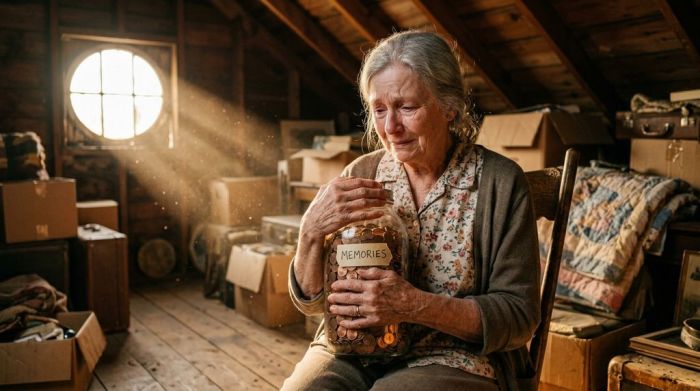
The jar was tucked behind a stack of National Geographic magazines from the 1970s, in the darkest corner of the attic. It was a simple glass pickle jar, the kind you might find in any kitchen, but it was filled to the brim with pennies. Thousands of them. They caught the light from the small attic window and glowed like copper coins at the bottom of a wishing well.
Michael carried the jar downstairs, the glass cool and heavy in his hands. He found his grandmother sitting in her favorite armchair by the window, a cup of chamomile tea cooling beside her. She was reading an old photo album, her fingers tracing the faces of people who had long since become memories.
"Grandma," Michael said, holding up the jar, "I found this in the attic. What is it?"
Evelyn looked up. When she saw the jar, her breath caught. Her hand flew to her mouth, and for a long moment, she did not speak. Michael watched as her eyes filled with tears — not the tears of surprise, but the tears of a memory that had been waiting years to be acknowledged.
"That," she said softly, "is forty years of prayer."
Michael set the jar on the coffee table and sat down across from her. "What do you mean?"
Evelyn took a long, slow breath. She picked up the jar, cradling it in her hands the way a mother might cradle a child. "Every single day for forty years, I put a penny in this jar. One penny for every day I prayed for your father to come home."
Michael's father — Evelyn's only son — was named Daniel. He had left home at eighteen, in the summer of 1984, after a fight that Evelyn still replayed in her mind like a song she could not stop hearing. It had been about something small — a missed curfew, a careless word, the kind of argument that happens a thousand times between mothers and teenage sons. But Daniel had packed his bag that night and walked out the door, and he had never come back.
Not for Christmas. Not for Thanksgiving. Not for his father's funeral in 1999.
He had called sometimes, in the early years. Brief, awkward phone calls where neither of them knew what to say. Evelyn would ask if he was eating enough, if he was warm enough, if he was happy. Daniel would answer in monosyllables, the silence stretching between them like a wound that had never properly healed. Eventually, the calls stopped altogether.
Michael barely remembered his father. He had been three years old when Daniel left — a toddler with a buzz cut and a love for toy trucks. His mother, Sarah, had raised him alone, working double shifts as a nurse at Lancaster General Hospital. Evelyn had helped when she could, babysitting Michael after school, making him dinner, reading him stories at bedtime. But the absence of Daniel was a shadow that fell across all of them, a silence that no one knew how to break.
"I started the jar the day after he left," Evelyn said, her voice steady but thin. "I was sitting at the kitchen table, crying, feeling useless. I had tried calling him, but he wouldn't answer. I had written letters, but they came back unopened. I didn't know what else to do. So I took a penny from the change jar on the counter, and I prayed. I prayed that God would keep him safe. I prayed that one day he would come home. And then I put the penny in an empty pickle jar."
She paused, her thumb tracing the rim of the jar. "The next day, I did it again. And the day after that. And the day after that. It became my ritual. Every morning, before I did anything else, I would take a penny, say a prayer for my son, and drop it in the jar."
Michael did the math in his head. Forty years. Three hundred and sixty-five days a year. That was over fourteen thousand pennies. Fourteen thousand days of a mother praying for a child who never called, never wrote, never came home.
"Did you ever tell anyone?" Michael asked, his voice barely above a whisper.
Evelyn shook her head. "Who would I tell? Your grandmother was a foolish old woman who couldn't let go of her son? No. I kept it to myself. It was between me and God."
Michael looked at the jar in his grandmother's hands, and for the first time in his life, he understood the depth of her love. It was not loud. It was not demanding. It was quiet and stubborn and patient — a love that showed up every single morning for fourteen thousand mornings, even when there was no answer, no acknowledgment, no hope.
"Do you know where he is?" Michael asked.
Evelyn hesitated. "I have an address. He moved to Arizona about fifteen years ago. I found out through a cousin who saw him at a gas station. I wrote him a letter, but..." She trailed off, the unfinished sentence hanging in the air like a question no one wanted to answer.
"Can I have the address?" Michael asked.
Evelyn looked at him sharply. "Michael, no. I don't want you to —"
"Grandma." Michael took her hands, the jar resting between them. "I'm not going to confront him. I'm not going to be angry. I just want to meet my father. I want to know who he is. And I want to tell him about the jar."
Evelyn was silent for a long time. The grandfather clock in the hallway ticked away the seconds. The afternoon sun crept across the floor, casting long shadows across the worn wooden planks.
"He lives in a small town outside of Tucson," she said finally. "His name is Daniel Cooper. He works at a hardware store. At least, he did the last time I checked."
Two weeks later, Michael landed in Phoenix. He had never been to Arizona before. The heat hit him like a wall as he stepped off the plane, a dry, relentless heat that felt nothing like the humid summers of Pennsylvania. He rented a car and drove two hours north to a town called Jerome — a small, quiet place nestled in the mountains, the kind of town where everyone knew everyone else's business.
The hardware store was on Main Street, a red-brick building with a faded sign that said "Jerome Hardware & Supply." Michael parked across the street and sat in the car for ten minutes, his hands gripping the steering wheel, his heart pounding so hard he could feel it in his throat. He had rehearsed this moment a hundred times on the flight over. He had planned what he would say, how he would say it, how he would keep his emotions in check. But now that he was here, all his rehearsals evaporated, leaving only the raw, uncertain truth of the moment.
He walked into the store. The bell above the door jingled. A man behind the counter looked up from the newspaper he was reading, and Michael felt the air leave his lungs.
The man was in his late fifties, with graying hair and a beard that was more white than brown. He was thinner than the photographs Michael had seen, and there were deep lines around his eyes that suggested a life of hard work and harder silences. But his eyes — Michael knew those eyes. He had seen them in the mirror every morning of his life.
The man stared at him. And then, slowly, without any prompting, he said, "Michael?"
Michael nodded, not trusting his voice.
Daniel set down the newspaper. He took off his reading glasses. He stood up from behind the counter, his movements slow and uncertain, as if he were approaching a wild animal that might startle and run. "You look like your mother," he said. "You have her eyes."
"I have your chin," Michael said, a shaky smile crossing his face.
Daniel laughed — a short, surprised laugh that sounded like it had not been used in a long time. "Yeah. You got that from me. Sorry about that."
The silence that followed was not uncomfortable. It was the silence of two people who had spent too many years apart to know how to begin, but who both wanted to try.
"I came because of Grandma," Michael said finally. "She has a jar. A jar of pennies."
Daniel frowned. "A jar of pennies?"
Michael told him the story. He told him about the jar in the attic, about the fourteen thousand pennies, about the prayer that had been said every single morning for forty years. He told him about the way Evelyn had held the jar, the way she had spoken about him — not with anger, not with bitterness, but with a love so deep and so patient that it had outlasted four decades of silence.
Daniel listened without interrupting. When Michael finished, he turned away, his shoulders shaking. He leaned against the counter, his hand covering his face, and he wept the way men weep when they have been holding something in for far too long.
"I thought she hated me," Daniel said, his voice breaking. "I thought after all the things I said, all the years I stayed away... I thought she had given up on me. I thought it was too late."
"It's not too late," Michael said. "She's been waiting for you. She's been waiting for forty years."
Daniel drove back to Pennsylvania with Michael the next day. It was a cross-country journey that took three days, two thousand miles of highways and diners and motels, and for the first time in their lives, father and son talked. Really talked. Daniel told Michael about the night he left — how he had been too proud to go back, how the years had slipped away, how every passing year made it harder to pick up the phone because the guilt had grown too heavy to carry. Michael told Daniel about his childhood, about his mother Sarah, about the grandmother who had raised him with a love so steady that it had become the foundation of his entire life.
When they pulled into the driveway of the farmhouse on a Tuesday evening in July, Evelyn was sitting on the porch. She was wearing her favorite blue dress, the one she reserved for special occasions. Her hair was pinned up neatly. And in her hands, she was holding the jar of pennies.
Daniel got out of the car. He stood in the driveway, looking at the house where he had grown up, at the porch where he had learned to ride a bike, at the woman who had prayed for him every single day for forty years.
"Hello, Mom," he said.
Evelyn stood up. She walked down the steps slowly, the jar still in her hands. She stopped in front of her son, looking up at his face, at the gray in his hair, at the lines that forty years of life had carved into his skin.
"I have something for you," she said. She held out the jar. "Fourteen thousand, six hundred pennies. Every single one was a prayer. Every single one was a day I loved you."
Daniel took the jar. He looked at the pennies, thousands of them, gleaming copper under the July sun. And then he set the jar down on the porch step, wrapped his arms around his mother, and held her for the first time in forty years.
They stood like that for a long time, mother and son, united by a love that had never wavered, a love that had filled a jar one penny at a time, a love that had waited forty years for this moment.
---
That was three years ago. Daniel moved back to Pennsylvania and now lives in the farmhouse with Evelyn. He works at a local hardware store in Lancaster, and every Sunday, he drives his mother to church, where she sits in the front pew with her son beside her and a smile that has not faded since the day he came home.
The jar of pennies sits on the mantle in the living room. Evelyn still adds a penny every morning. But now, the prayer is different. Now, she prays for grandchildren she hopes to see, for more years with her son, for the simple joy of waking up in a house that is full again.
And Daniel? Every morning, before he leaves for work, he walks to the mantle. He picks up the jar. He looks at the pennies — fourteen thousand, six hundred prayers that brought him home. And he says a prayer of his own.
"Thank you, Mom. For never giving up. For filling a jar with love when there was nothing else you could give. For teaching me that it is never, ever too late to come home."
Because that is the truth about a mother's love. It does not keep score. It does not hold grudges. It does not give up when the silence stretches too long or the years pile up too high. A mother's love is patient and persistent and stubborn. It fills jars with pennies. It says prayers in the dark. It waits at the door with a cup of tea and an open heart, believing that one day, the door will open, and the child she never stopped loving will walk through it.
Evelyn Cooper is eighty-two years old now. She still keeps pennies in a jar on the mantle. But she does not need them anymore. Her prayer was answered.
Her son came home.