The summer I turned twelve, I hit my first home run. I remember the crack of the bat, the way the ball sailed over the left fielder's head, the roar of the crowd. I remember scanning the bleachers, looking for my father's face. I never found it.
That was the moment I decided he didn't love me.
His name was William. William Henry Coleman. To the town of Oakridge, he was the quiet carpenter who built the most beautiful furniture in three counties. To me, he was the ghost who lived in our house. He woke before dawn, worked until dusk, and when he came home, he sat in his worn leather chair with the evening paper and said almost nothing.
My mother tried to bridge the gap between us. "Your father loves you, James," she would say, her hand on my cheek. "He just has a hard time showing it." I was too young to understand. Too angry to listen.
I remember the night of the championship game. State finals. Bottom of the ninth, two outs, bases loaded. I was up to bat. The whole town was there. I could feel the weight of every eye on my shoulders. I stepped into the batter's box, took a deep breath, and searched the stands one more time.
He wasn't there.
I struck out. We lost. And I cried not because we lost, but because I finally knew the truth. My father didn't care enough to come.
Years passed. I went to college on a partial scholarship. I didn't make the team. My dream of going pro died somewhere between freshman algebra and a broken heart. I stopped playing baseball altogether. I stopped talking to my father, too, except for the obligatory phone calls on holidays. "Yes, Dad. No, Dad. I'm fine, Dad." Three-minute conversations that felt like hours.
My mother passed away when I was thirty-two. The funeral was a blur of black dresses and casseroles. My father stood at the grave site, his face like stone. He didn't cry. At least, not where anyone could see. I shook his hand afterward. It felt like shaking hands with a stranger.
I didn't visit him for the next twenty years.
Not once.
I told myself I was busy. I had a wife, two kids, a mortgage, a career in sales that demanded all my time. But the truth was simpler and uglier: I didn't want to see him. I didn't want to sit in that quiet house with that quiet man and pretend we were a family.
My wife, Sarah, never pushed. But I could see the sadness in her eyes when I talked about my childhood. One evening, after the kids were asleep, she took my hand and said, "James, your father is eighty-three years old. He won't be here forever."
I knew she was right. I just didn't care. Or so I thought.
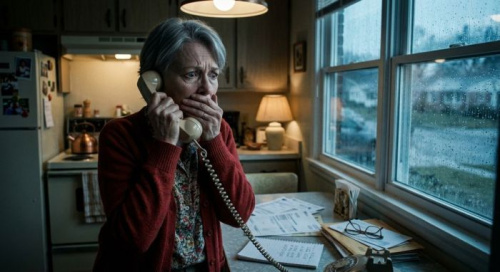
Three months ago, Sarah got a call. My father's neighbor had found him wandering down Main Street in his pajamas at three in the morning. He didn't remember where he lived. The diagnosis came quickly: Alzheimer's. Early to moderate stage. He could still recognize faces, sometimes. But the fog was rolling in, and it wouldn't lift.
I drove to Oakridge the next weekend. I told myself it was obligation. Nothing more.
The house smelled the same. Sawdust and coffee and something faintly floral from the dried lavender my mother used to keep in a vase by the window. My father was sitting in the same leather chair, smaller than I remembered, his hands folded in his lap, staring at nothing.
"Hi, Dad," I said.
He looked up at me, and for a moment, his eyes cleared. "James," he said. Just my name. But it was enough.
I spent the weekend cleaning out the garage. Sarah said it would help, keeping my hands busy. I found boxes of old tools, stacks of National Geographic magazines from the 1970s, a collection of rusted nails in mason jars. And then I found the workbench.
It was in the back corner, covered in a white sheet. I pulled the sheet away and felt my breath catch. The workbench was immaculate. Every tool hung in its place. A half-finished rocking horse sat in the middle, waiting for hands that couldn't hold a chisel anymore.
And in the corner, a small wooden box.
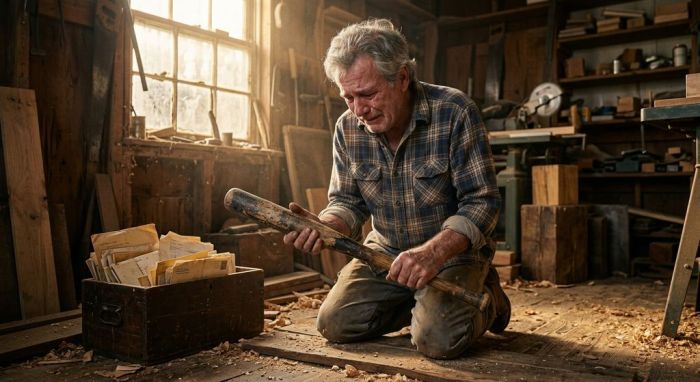
I opened it with trembling hands. Inside lay a baseball bat. Hand-carved, polished to a deep mahogany glow. On the barrel, in careful, painstaking lettering, were the words: "To James. My Greatest Hit."
I sat down hard on the dusty floor.
Beneath the bat, there were letters. Dozens of them. Yellowed envelopes tied with white string. I pulled one out. The return address was my high school baseball coach's house.
I opened it.
March 14, 1982
Dear Mr. Coleman,
Thank you for your letter. Yes, James had a great game last night. Two hits and a walk. He's been working hard on his swing, and it shows. I told him you asked about practice times, and he said to tell you not to worry. But between us, I know he'd love to see you in the stands.
Best, Coach Rivers
I opened another. And another. Each one was a small piece of a puzzle I never knew existed.
April 2, 1982 — James hit a double today. Game winner. You'd have been proud.
May 18, 1983 — James made the All-County team. He doesn't know yet. I thought you should be the one to tell him.
September 9, 1983 — I've never seen a kid work so hard. He's got real talent, Mr. Coleman. With the right support, he could go far.
Twenty-three letters. Twenty-three updates from my coach. Twenty-three conversations my father had about baseball that I never knew about.
I found more in the box. Letters my father had written but never sent. Drafts in his shaky handwriting, full of crossed-out words and misspellings.
Dear James, I saw your game last night. You were good. Real good. I was standing behind the fence in left field. I always stand there so you don't get nervous. I don't want to embarrass you. I just want you to know I'm watching.
I love you, son. I know I don't say it. I don't know how.
I sat on the floor of that garage for what felt like hours, reading those unfinished letters, tears streaming down my face. He had been there. Every single game. Standing behind the left-field fence, hidden in the shadows, cheering me on in silence.
He never missed a single game.
I staggered into the living room. My father was still in his chair, watching the afternoon light move across the wall. I knelt in front of him and took his hands in mine.
"Dad," I said. "I found the bat."
He looked at me. His eyes were cloudy, distant. "James," he said again, but I could tell he wasn't sure who I was.
"Dad, I found the letters. I know you were there. I know you came to every game."
He tilted his head, a faint smile crossing his lips. "Baseball," he whispered. "My boy... he could hit."
"Yes, Dad. I could hit. Because of you."
His eyes searched my face, and for just a moment, they cleared. He squeezed my hand. "I was there," he said. "I was always there."
Then the fog rolled back in, and he looked away.
I stayed in Oakridge for two weeks. I talked to him even when he didn't know who I was. I read him the letters. I held his hand. I told him I loved him, words I had never said in my entire adult life. And even though he couldn't always remember my name, I know some part of him heard me.
Before I left, I took the bat from the box. I held it in my hands, feeling the weight of it, the care in every curve and carve. My father had made it. For me. Forty years ago.
I walked to the backyard, to the old oak tree where I used to practice as a boy. I found a tennis ball in the grass. I tossed it up, took a breath, and swung.
The crack of the bat echoed through the quiet afternoon.
And I swear, I heard him cheer.
If there is one thing I want you to take from this story, it is this: Love does not always speak in words. Sometimes, it shapes itself into wood and silence. Sometimes, it stands behind a fence in the dark, hoping you will never see it, because that is not the point.
The point is showing up.
My father showed up. Every single time. I just never knew to look behind the fence.
Do not wait until it is too late. Go find your father. Ask him the questions you have been too afraid to ask. Listen to the things he cannot say. Because the love that is hardest to see is often the love that runs deepest.
And if your father is already gone, know this: he was there. He was always there.
You just never knew to look behind the fence.