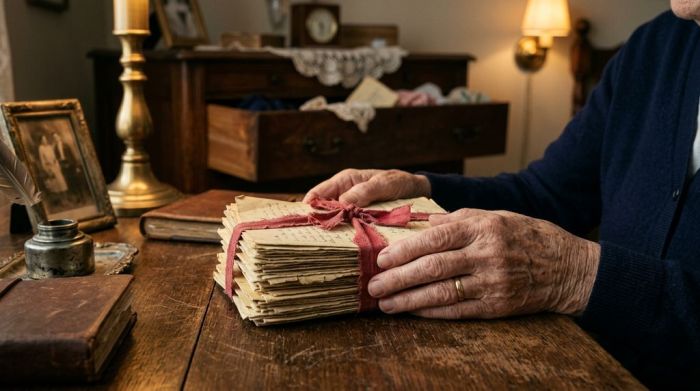
The day we buried my mother, I found a shoebox at the back of her closet that held three hundred and forty-seven letters — all of them addressed to me, none of them ever sent.
I was fifty-three years old when Helen Archer passed away. She was seventy-nine, and for the last twelve years of her life, she had lived in a small apartment on Murray Avenue in Pittsburgh, just a few blocks from the house where I grew up. Heart failure, the doctors said. Quiet. Peaceful. She went in her sleep, with a half-finished crossword puzzle on her nightstand and a cup of cold tea beside her bed.
I stood in her bedroom three days after the funeral, surrounded by boxes and the particular smell of old wood and lavender that had defined my mother's presence for as long as I could remember. My husband Tom had offered to help, but I needed to do this alone. I needed to feel her things with my own hands, to touch the fabric of a life I suddenly realized I had never truly understood.
The shoebox was tucked behind a stack of winter sweaters, pressed against the wall as if she had hidden it on purpose. It was an ordinary white shoebox, the kind that held the orthopedic walking shoes she wore during her last years. But when I lifted the lid, I found something that stopped my breath cold.
Letters. Dozens of them. Neatly folded and stacked in careful rows, each one placed inside its own envelope. And every single envelope bore my name — Margaret — written in my mother's familiar cursive handwriting. The dates on the envelopes spanned from 1989 all the way to 2022.
Thirty-three years of letters. Three hundred and forty-seven of them. And she had never sent a single one.
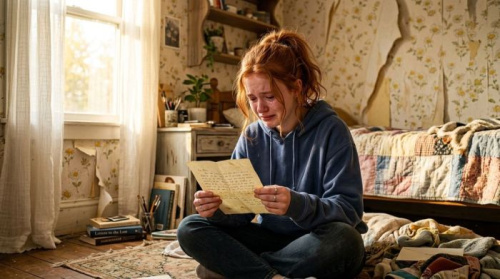
I sat down on the floor, my legs unable to hold me any longer. The first envelope was dated March 14, 1989. I was twenty years old that year, a junior at Penn State, majoring in journalism against my mother's quiet wishes. I remembered that year well. It was the year I stopped coming home for holidays because I was too busy, too important, too caught up in my new life to drive five hours back to Pittsburgh.
My hands trembled as I opened it.
Dear Margaret,
I hope this letter finds you well. I called your dormitory tonight, but the girl who answered said you were at the library. I wanted to tell you that your father and I are proud of you. I know I don't say it enough. I know I am not good at saying the things that matter. But when I saw your byline in the campus newspaper last week — the article about the elderly woman who adopted three cats after her husband passed — I clipped it and put it on the refrigerator. I showed everyone who came to the house. I told them, "My daughter wrote this. My daughter is going to be a writer."
I wish I could tell you these things in person. But the words get stuck somewhere between my heart and my throat. So I am writing them instead. Maybe one day I will find the courage to send you one of these letters.
All my love, Mom
I read the letter twice. Then a third time. I did not remember writing that article. I did not remember my mother ever mentioning it. What I remembered was the phone call we had that same week — a tense, five-minute conversation where she asked if I was eating enough, and I snapped at her for treating me like a child.
I had no idea she had clipped my article and put it on the refrigerator.
I opened the next envelope. January 1990. Then another. June 1992. Then another. December 1995. Each letter was a window into a version of my mother I had never known — a woman who felt too much and said too little, who wrote down every word she could not speak aloud.
October 1997: Dear Margaret, I know you are busy with your career at the Philadelphia Magazine. I understand. You have built a beautiful life for yourself. But I wonder if you remember the summer we planted tomatoes together in the backyard. You were seven years old, and you insisted on naming each plant. You called them Henry, Charles, Beatrice, and Little Fred. Your father laughed so hard he nearly fell off his chair. I think of that summer often. I think of your tiny hands covered in soil, and the way you looked at me and said, "Mommy, we made something grow." You are still making things grow, Margaret. I just want you to know that I see it.
April 2001: Dear Margaret, Your father passed away this morning. The cancer took him quietly, just as the doctor said it would. I held his hand until the very end. He asked about you in his final hours. He said, "Tell Maggie I love her. Tell her I always knew she would do something special." I did not call you until after he was gone because I did not want you to rush. I did not want you to see him like that. I hope you can forgive me for that. I hope you can forgive me for many things.
I sobbed when I read that one. I remembered the phone call. I remembered the cold, clinical way my mother had delivered the news — "Your father passed this morning" — and I had interpreted it as emotional distance. I had thought she was being cold. I had no idea she was protecting me from the sight of our dying patriarch.
Letter after letter revealed the same pattern. My mother had spent her entire adult life loving me from a distance, writing letters she was too afraid to send, expressing emotions she had never been taught how to share. She was born in 1943, the daughter of an ironworker and a housewife who believed that children should be seen and not heard. She had learned that love was something you showed through actions — through clean laundry, hot meals, and silent presence — not through words.
But in these letters, she was a different woman. She was poetic. She was vulnerable. She was everything I had desperately needed her to be, and she had been that woman all along. I just never knew.
June 2005: Dear Margaret, I saw your photograph in the Pittsburgh Post-Gazette. You were at some charity gala in Philadelphia, wearing a beautiful blue dress. You looked so happy. You looked so successful. I cut out the photograph and framed it. It sits on my nightstand now. I tell everyone who visits, "This is my daughter." I do not tell them that we have not spoken in six months. I do not tell them that the last time I heard your voice was a voicemail you left wishing me a happy birthday, and I have replayed that voicemail forty-seven times. I do not tell them that I listen to your voice every night before I fall asleep.
I had to put the letter down. Forty-seven times. She had replayed my voicemail forty-seven times. And I had been so busy, so consumed by my own life, that I had not called her back for three weeks after that birthday message.
The guilt was a physical weight in my chest.
October 2012: Dear Margaret, I have been diagnosed with something called atrial fibrillation. It is not serious, the doctor says. But it has made me think about time. About how much of it I have left. I do not want to die with these letters still hidden in my closet. I want to send them all to you in one big box. I want you to know everything. But I am afraid. I am afraid that if you read them, you will feel guilty. And that is the last thing I want. I want you to be happy, Margaret. That is all I have ever wanted. That is what I wrote in every single one of these letters, even when I was angry, even when I was hurt. I love you. That is the only thing that has never changed.
But she never sent them. The letters remained in the shoebox, hidden behind winter sweaters, waiting for a courage that never came.
I found the last letter at the bottom of the box. It was dated November 2, 2022 — just three weeks before she passed.
Dear Margaret,
I am tired tonight. More tired than I have ever been. The doctor says my heart is getting weaker. I told him my heart has been weak for a long time, but not in the way he means.
I want to tell you something I have never told anyone. When you were born, I held you in my arms for the first time, and I was terrified. Not because I did not know how to be a mother — I learned that quickly enough. I was terrified because I loved you so much it felt like my chest would crack open. I looked at your tiny face, your clenched fists, your barely open eyes, and I thought, "This is it. This is the moment my heart leaves my body and starts walking around in the world without me."
And that is what happened, Margaret. You walked around in the world without me. You built a life, a career, a family. You did everything I ever hoped you would do. And I watched it all from a distance, not because I did not care, but because I cared so much that I did not trust myself to speak without crying.
I am crying now, writing this. I have cried writing every single one of these letters. Three hundred and forty-seven times I have cried for you, Margaret. Three hundred and forty-seven times I have written the words I was too afraid to say.
I am sending this one. I promise myself I will send this one. I will walk to the mailbox tomorrow morning, before I lose my nerve. I will put a stamp on it. I will finally let you know that your mother, who seemed cold and distant and hard, spent thirty-three years writing you love letters she was too scared to mail.
But I am sending this one. I promise.
I love you, Margaret. I have loved you since the moment I first held you. I will love you until my heart stops beating. And even after that, I think, I will find a way to keep loving you.
All my love, Mom
I checked the envelope. There was no postmark. She had never mailed it.
I sat on the floor of my mother's apartment, surrounded by three hundred and forty-seven pieces of her heart, and I wept the way I had not wept since I was a child. I wept for the letters she never sent. I wept for the years we wasted. I wept for a woman who loved so deeply and so silently that the world had mistaken her quietness for coldness.
But most of all, I wept because I finally understood her. After fifty-three years of misunderstanding, I finally knew who my mother really was — a woman who loved so fiercely that she could not put it into spoken words, so she filled shoeboxes with written ones.
I took those letters home with me. I read one every night before bed. It took me nearly a year to read them all. And when I finished the last one, I wrote my own letter. I wrote it to my mother, even though she was gone. I told her everything I should have told her when she was alive. I told her that I understood. I told her that I loved her. I told her that the tomatoes we planted that summer were still the best tomatoes I had ever tasted.
I placed my letter inside the shoebox, on top of her three hundred and forty-seven.
And then I started writing letters to my own daughter, who lives in Chicago now and is too busy to call as often as I would like.
I have sixty-three of them so far.
I am still trying to find the courage to send the first one.