Henry Mitchell woke at 5:47 AM every single morning, the way he had done for the past eighty-two years. His body, worn and weathered by time, refused to sleep past six o'clock even when there was nowhere to go and nothing to do. But Henry had somewhere to go. He always did.
He swung his legs over the side of the bed, felt the familiar ache in his knees, and reached for his trousers. They were pressed and ready, hanging on the same hook he had used since 1965. His best white shirt followed, then his tie — the navy blue one with the faint silver stripes that Rose had bought him for their fortieth anniversary. He put it on every single day, even though she could no longer see it. Even though she could no longer tell him he looked handsome.
At sixty-eight, Henry made his way down the stairs of the small Portland bungalow he had shared with Rose for fifty-eight years. The house was quiet now, the way houses get when the person who filled them with sound has gone. The grandfather clock in the hallway ticked steadily, marking time that seemed to have lost its meaning. He put on his coat, picked up his keys, and walked out the door.
The florist on Main Street opened at seven. Mario, the owner, already had the rose ready — a single red bloom, wrapped in brown paper, the stem trimmed and placed in a small vase of water to keep it fresh.
"Morning, Mr. Mitchell," Mario said, handing him the rose the way he had done every morning for the past three years.
"Morning, Mario," Henry replied, placing a ten-dollar bill on the counter. Mario always tried to refuse it. Henry always insisted.
The drive to Briarwood Nursing Home took exactly eleven minutes. Henry knew this because he had timed it every day for three years, and it never varied. He pulled into the parking lot, parked in the same spot — third row, second from the left — and walked through the automatic doors at exactly 7:30 AM.
The nurses at the front desk smiled when they saw him. They always smiled. A man who visited his wife every single morning for three years, rain or shine, through snowstorms and heatwaves, deserved a smile.
"Good morning, Mr. Mitchell," said Nancy, the head nurse. "She's having a good day today. She ate her breakfast."
Henry nodded, the small relief settling into his chest like a familiar weight. Some days Rose refused to eat. Some days she did not recognize the food, or the room, or the face of the woman bringing it to her. But today, she had eaten. That was a victory.
He walked down the hallway, past the common room where residents sat in armchairs staring at a television that no one was watching. The walls were painted a cheerful yellow that could not hide the institutional smell of antiseptic and cafeteria food. Room 207 was at the end of the hall, the last door on the left.
Henry stopped outside the door the way he always did. He took a breath. He adjusted his tie. He smoothed his white hair with the palm of his hand. And then he pushed the door open.
Rose was sitting in her armchair by the window, looking out at the garden where the azaleas were beginning to bloom. She was wearing a pale pink cardigan, the one he had bought her for Christmas two years ago. Her white hair was neatly brushed — the night staff always made sure of that. She was humming a tune he did not recognize.
"Hello," Henry said softly.
Rose turned. Her eyes, still the same bright blue they had been when he first saw her in the library in 1962, met his. She studied his face for a moment, the way she studied every new face that came into her room. And then she smiled.
"Hello," she said.
Henry walked toward her, his heart beating the way it had beaten the first time he saw her standing in the fiction aisle of the Multnomah County Library, holding a copy of Steinbeck's "East of Eden." He knelt beside her chair — a movement that took effort, that sent a protest through his knees, but a movement he refused to skip.
"My name is Henry," he said.
"Hello, Henry. I'm Rose."
"It's very nice to meet you, Rose."
"It's very nice to meet you too."
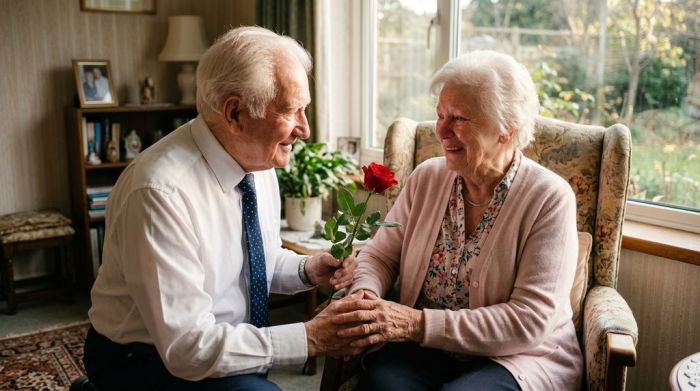
He held out the rose. She looked at it, her brow furrowing in that way she had when something stirred deep in the recesses of her memory. She reached out and took it, bringing it to her nose, inhaling the scent.
"It's beautiful," she said.
"You're beautiful," Henry replied. And he meant it. He had meant it every single day for fifty-eight years.
They sat together by the window, Henry holding her hand, Rose holding the rose, watching the morning light paint shadows across the garden. He told her about his day — about Mario at the florist, about the neighbor's cat that had gotten stuck in the oak tree again, about the weather forecast that promised rain by evening. It did not matter that she would forget what he said within minutes. It mattered that he said it.
This was Henry Mitchell's daily ritual. He had been doing it for three years, ever since Rose's Alzheimer's had progressed to the point where she could no longer live at home, where she no longer recognized the face of the man who had loved her since 1962.
Every morning, he introduced himself to his own wife.
Every morning, he watched her fall in love with him all over again.
The Story of How They Met
The story of how Henry and Rose met was the kind of story their daughter Karen had rolled her eyes at during family gatherings. It was 1962, and Henry was a twenty-two-year-old graduate student at Portland State, working part-time at the public library to pay for his tuition. Rose was twenty, a nursing student who had come in looking for a specific book on anatomy.
She had asked him for help finding the book. He had walked her to the right aisle, pointed to the shelf, and then, with a courage that surprised even himself, asked if she would like to have coffee sometime.
"You don't even know me," she had said, smiling.
"I know you read Steinbeck," he had replied. "That's enough for me."
They were married six months later.
Over the next five decades, they built a life together. Henry taught history at Lincoln High School for thirty-seven years. Rose became a registered nurse, working the night shift at Providence Hospital for twenty-five of those years. They bought the bungalow on Maple Street in 1965, raised their daughter Karen in its warm, cluttered rooms, and filled it with books and photographs and the sound of laughter.
They were not a perfect couple. They argued about money, about vacations, about the correct way to load a dishwasher. But they never went to bed angry. That was a rule Rose had insisted on from the very beginning. "Life is too short," she would say, "to wake up with unspoken words between us."
And then the words started disappearing.
The Diagnosis
It began in small ways — a forgotten name, a misplaced key, a story told twice in the same conversation. Henry noticed before Rose did, because husbands always notice the things their wives try to hide. He took her to the doctor. The diagnosis came on a gray Tuesday afternoon in October 2019, delivered by a kind-faced neurologist who used words like "progressive" and "irreversible" and "I'm so sorry."
Rose cried that night for the first time in years. Henry held her and told her they would face it together, the way they had faced everything else. He did not cry until she fell asleep, because he was a man from a generation that had been taught to be strong. But when she was asleep, he sat in the kitchen and let the tears come, silent and steady, falling into a cup of coffee that had gone cold.
The progression was slow at first, then devastatingly fast. By 2022, Rose could no longer recognize their home. She would wander into rooms and look around with confusion, not knowing where she was or how she had gotten there. She asked about her mother, who had died in 1995. She asked about Karen, who had not visited in two years. She looked at Henry sometimes with recognition, sometimes with curiosity, sometimes with the polite distance of a stranger.
The hardest day was the morning she looked at him and said, "You seem like a very nice man. Have we met before?"
Henry smiled. His heart cracked. But he smiled.
"Yes," he said. "I'm Henry. And I think we were supposed to meet."
The Daughter Who Stayed Away
Karen was their only child, born in 1970 after years of trying. She had inherited her mother's blue eyes and her father's stubbornness, a combination that had made her teenage years a battlefield. She had moved to Boston after college, married a man named Stephen, divorced him five years later, and rebuilt her life as a marketing executive. She called on holidays and birthdays, sent gifts that arrived a week late, and visited once a year if Henry was lucky.
He did not blame her. He told himself that young people had their own lives, their own struggles, their own ways of coping with the slow tragedy of watching a parent fade. But some nights, sitting alone in the house on Maple Street, he wished she would call more often.
The Morning She Remembered
On a cold February morning, three years into his daily ritual, Henry walked into Room 207 and found Rose sitting up in her chair, her eyes clearer than they had been in months. She looked at him the way she used to look at him — with recognition, with warmth, with the full force of fifty-eight years of love.
"Henry," she said.
His breath caught. He dropped the rose. "Rose?"
"You're late," she said, a ghost of her old smile playing on her lips. "I've been waiting for you."
He crossed the room in three steps, fell to his knees beside her chair, and took her hands in his. "You remember?"
"Of course I remember, you silly man. I remember everything." She reached up and touched his face, her fingers tracing the lines that fifty-eight years of life had etched into his skin. "You're older."
"So are you."
"Still handsome, though."
Rose laughed — a genuine, full laugh that Henry had not heard in years. The sound filled the room like sunlight. "Henry Mitchell. You have proposed to me every morning for three years, and I have fallen in love with you every single time."
"It's the only way I know how to love you," he said, his voice breaking. "I tell you our story every day because I am terrified that if I stop, you will truly be gone. As long as I am telling it, you are still here. As long as I am proposing, we are still married."
She pulled him close, her arms around his neck, her lips against his ear. "Marry me," she whispered.
"What?"
"Marry me. Again. Right now. I want to marry you again."
Henry pulled back and looked at her. Her eyes were shining — those bright, impossible blue eyes that had first seen him in a library aisle sixty-two years ago. "We're already married, Rose."
"Then marry me again. I want to hear you say the words. I want to say yes one more time."
And so Henry Mitchell, eighty-two years old, took his wife's hands in his, looked into her eyes, and said the words he had said once at a small church in Portland in 1963, and had been saying every single day since in a thousand different ways.
"I, Henry, take you, Rose, to be my wedded wife. To have and to hold, from this day forward, for better or worse, for richer or poorer, in sickness and in health, to love and to cherish, till death do us part."
And Rose, her voice steady and sure, said, "I do."
The door to Room 207 opened. Karen stood in the doorway, her coat still wet with February rain, her eyes wide with shock.
"Dad? What's going on?"
Henry turned. His daughter was standing there, a woman in her early fifties, looking older than he remembered, looking more tired. She had flown all the way from Boston after the nursing home had called to say her mother's condition was deteriorating.
"Your mother just agreed to marry me," Henry said, a tearful smile spreading across his face.
Karen looked at her mother — who was sitting in her chair, holding a rose, looking more lucid than she had in years. "Mom?"
"Karen," Rose said, her voice soft but clear. "My beautiful daughter. You came."
Karen crossed the room in three quick strides and knelt beside her mother's chair. "Mom, I'm so sorry. I'm so sorry I haven't been here. I'm so sorry for everything."
Rose placed her hand on Karen's cheek. "You're here now. That's all that matters."
"I love you, Mom. I never said it enough. But I love you."
"I know, sweetheart. I've always known."
Rose looked from Karen to Henry, her eyes moving between the two people she loved most in the world. "Take care of your father," she said to Karen. "He proposes to me every morning. He tells me our story every day. Make sure someone tells his story when he can't tell it anymore."
Her eyes were growing heavy. The moment of clarity was passing, the fog beginning to roll back in. But she held on for one more breath, one more sentence, one more gift to the man who had loved her through forgetting.
"Henry," she whispered.
"I'm here, Rose. I'm right here."
"Thank you," she said. "For remembering for both of us."
She smiled. Her eyes closed. And the moment was gone.
The Days That Followed
Rose lived for another three weeks. She did not have another moment of lucidity after that day. But Henry did not stop visiting. He came every morning, with a single red rose, in his best white shirt and navy blue tie. He introduced himself. He told her their story. He proposed.
And every morning, Rose smiled at him like he was the most interesting stranger she had ever met.
Because that is what love is, when you strip away all the pretense and the poetry and the promises. Love is showing up. Love is introducing yourself to the same person every single day, even when they do not remember your name. Love is telling the same story over and over, because the story is worth telling, and the person is worth remembering.
Henry Mitchell still wakes at 5:47 every morning. He still puts on his best shirt and his navy blue tie. He stops at Mario's for a single red rose. And he drives to Briarwood, where he walks into Room 207 and introduces himself to an empty chair by the window.
The nurses have told him he does not need to come anymore. Rose passed away peacefully three weeks after that February morning, with Henry holding her hand and Karen holding his.
But Henry still comes. He sits by the window. He looks out at the garden where the azaleas bloom. He tells the story of a twenty-two-year-old graduate student who fell in love with a nursing student in the fiction aisle of the Multnomah County Library in 1962.
Because as long as he remembers, she is not really gone.
And as long as he tells the story, their love will never die.