Mark and I had been married for six years, and for the first time in our relationship, I was afraid we would not make it to seven.
It was not one big thing that broke us. It was a thousand small things — a forgotten anniversary, a dinner left uneaten, a text message that went unanswered for too long. It was the way he left his dirty socks on the bathroom floor even though I had asked him a hundred times to put them in the hamper. It was the way I snapped at him for it, the sharp edge in my voice that I did not recognize as my own. It was the silence that followed, the kind of silence that fills a house like smoke, seeping into every room until you cannot breathe without tasting it.
We were both exhausted. Mark worked sixty-hour weeks as a software engineer at a startup in Austin, coming home at nine or ten most nights, eating dinner alone in front of his laptop. I was a fourth-grade teacher at a public school in Round Rock, spending my evenings grading papers and preparing lesson plans and falling asleep on the couch before he got home. We passed each other like ships in the night, exchanging brief, functional conversations about groceries and bills and whose turn it was to walk the dog.
We had stopped talking about the things that mattered. We had stopped laughing. We had stopped touching each other — not just the intimate kind of touching, but the small, unconscious touches that had once defined our marriage. A hand on the shoulder. A kiss on the forehead. Fingers intertwined on the armrest during a movie. Somewhere between the mortgage and the car payments and the endless, grinding exhaustion of two careers and one small life, we had lost the ability to reach for each other.
I remember the night it came to a head. It was a Thursday in February, cold and gray, the kind of Texas winter that fools you into thinking the sun has abandoned the earth forever. I had come home at five, made dinner — a stir-fry that Mark had always loved — and put it in the oven to keep warm. I had set the table, lit a candle, put on the record we had danced to at our wedding. I had waited.
At seven, I texted him: "Dinner's ready. Coming home soon?"
At eight, he replied: "Sorry, stuck in a meeting. Go ahead without me."
I ate alone at the table I had set for two. The stir-fry was cold by then, but I ate it anyway, chewing mechanically, staring at the candle flame as it flickered and died. I did not cry. I was too tired to cry.
When Mark came home at ten-thirty, I was sitting on the couch in the dark, the television off, the house silent except for the hum of the refrigerator. He stopped in the doorway, his tie loosened, his face pale with exhaustion.
"Hannah," he said. "I'm sorry. The meeting ran —"
"I know," I said. My voice came out flat, hollow. "You said."
He stood there for a long moment, and I could feel him trying to find the right words. But the right words had been used up months ago, worn thin by repetition, and neither of us had the energy to invent new ones. He walked past me, kissed the top of my head — a brief, absent gesture — and went upstairs to shower.
I sat in the dark until midnight. And then I made a decision.
The next morning, I called my mother. I did not tell her what I was planning. I just asked if she could take the dog for a few days. She said yes, the way mothers always say yes, without asking questions, because they know that their children will tell them when they are ready.
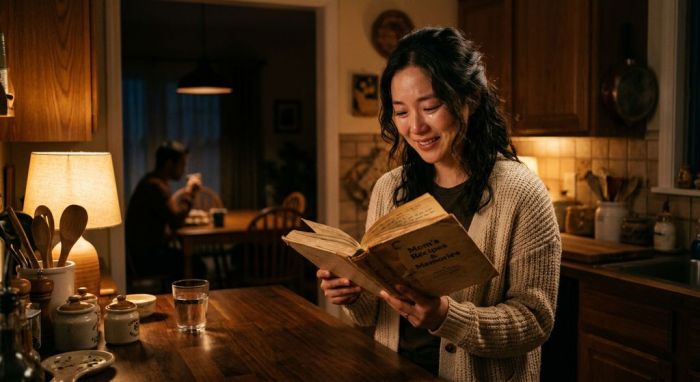
I packed a bag. Not much — just enough clothes for a week, my laptop, and an old recipe box that had belonged to my grandmother. I do not know why I packed the recipe box. It was heavy and impractical and I had not opened it in years. But something about the weight of it in my hands felt grounding, like holding onto a piece of a life that had been simpler, when love was measured in handwritten cards and Sunday dinners and the smell of kimchi simmering on the stove.
My grandmother was born in Seoul in 1935. She came to America in 1965 with my grandfather, a young soldier she had met during the war, carrying nothing but a suitcase and a wooden box of her mother's recipes. She settled in a small town in Texas, where she opened a Korean restaurant that became the heart of the community. She cooked for fifty years, until her hands were too arthritic to hold a knife. And when she passed, she left me the recipe box — a collection of worn, stained cards written in her careful handwriting, some in Korean, some in English, all of them filled with the kind of love that could only be expressed through food.
I had never cooked from that box. I had been too busy, too modern, too disconnected from the world my grandmother had built. But on that Friday morning, as I sat in my car in the driveway, the engine running, the recipe box on the passenger seat beside me, I felt a pull I could not explain.
I opened the box. The first card was for kimchi jjigae — kimchi stew. My grandmother's specialty. The one dish that had filled our family gatherings with warmth and laughter and the particular joy of people eating together. I read the ingredients: kimchi, pork belly, tofu, garlic, gochugaru, sesame oil. Simple things. Things I could buy at the H-Mart on the north side of town.
I did not go to my mother's house. I went to the grocery store instead. I bought everything on the card, plus a few things I thought my grandmother would approve of — fresh green onions, a block of extra-firm tofu, a jar of the good gochujang that cost twice as much as the regular kind. I drove home, my hands trembling on the steering wheel, and I walked into the kitchen with my arms full of groceries.
Mark was at work. The house was empty. I set the recipe card on the counter and began to cook.
I do not know if you have ever cooked a dish that your grandmother used to make. There is something sacred about it. The way the garlic smells when it hits the hot oil. The way the kimchi sizzles and softens. The way the broth turns a deep, rich red as it simmers. Every step felt like a conversation with a woman I had loved and lost, a woman who had known how to love through food because she had not always known how to love through words.
I cried while I cooked. I cried for my grandmother, who had crossed an ocean with nothing but recipes. I cried for Mark and me, for the two people we had become, for the distance that had grown between us like a weed we had been too tired to pull. And I cried because, for the first time in months, I felt something. The numbness was cracking, and underneath it was a pain so sharp and so real that it took my breath away.
I was still crying when Mark walked through the door at six o'clock. He stopped in the doorway, the same doorway where he had stood the night before, and he stared at me. At the pot on the stove. At the steam rising from the bubbling stew. At the tears on my face.
"Hannah?" His voice was uncertain, afraid. "What's going on?"
I wiped my face with the back of my hand. "I made dinner," I said. "My grandmother's kimchi jjigae. The one she used to make for us when we were little."
He did not move. He stood in the doorway, his work bag still on his shoulder, and something in his face shifted. The exhaustion was still there, but underneath it, I saw something else — a flicker of the man I had married, the man who had stood beside me in a small church in 2018 and promised to love me for the rest of his life.
"I thought you were leaving," he said quietly. "I saw your bag by the door this morning. I thought... I thought you were going to your mother's. I thought you were not coming back."
I had not realized he had seen the bag. I had not realized he had been carrying that fear all day, the way I had been carrying my own.
"I was going to leave," I said. "I had it all planned. I was going to drive to my mother's house and figure out what to do with the rest of my life. But then I opened the recipe box. And I remembered something my grandmother used to say."
Mark stepped closer. "What did she say?"
"She said that love is not a feeling. It is a choice. You choose it every single day, in the small things — in the meals you cook, in the hands you hold, in the forgiveness you offer even when you do not feel like offering it. She said that the secret to a long marriage is not finding the right person. It is being the right person, over and over again, even when it is hard."
I ladled the stew into two bowls. I set them on the table, the same table where I had eaten alone the night before. I pulled out a chair and sat down.
Mark dropped his bag. He walked to the table, pulled out the chair across from me, and sat down. He picked up his spoon. He looked at the stew, at the steam rising from the deep red broth, at the green onions floating on top.
"This smells like your grandmother's house," he said. His voice cracked on the last word.
"It is her recipe," I said. "I have never made it before. I was scared I would ruin it."
He took a bite. He chewed slowly, his eyes closed, and when he opened them, they were wet. "You did not ruin it," he said. "It is perfect."
We ate in silence. Not the cold silence of the past months, but a different kind of silence — the quiet of two people who have been through a storm and are finally allowing themselves to rest. When we finished, Mark reached across the table and took my hand. His fingers were warm and familiar, and I realized how long it had been since I had felt them.
"I am sorry," he said. "I am sorry for the meetings. For the late nights. For the dirty socks. For all of it. I got so caught up in providing for us that I forgot to provide the one thing that actually matters — my presence. I forgot to be here."
"I am sorry too," I said. "I forgot to be kind. I forgot that we are on the same team. I forgot that the person I married is still in there, even when he is exhausted and distracted and forgets to put his socks in the hamper."
He laughed, a wet, shaky laugh that sounded like relief. "I am never going to remember the socks, Hannah. You have to accept that."
"I know," I said, laughing too. "I am working on it."
We sat at the table for a long time that night, talking the way we had not talked in years. We talked about our childhoods, about our dreams, about the things we were afraid to admit even to ourselves. Mark told me that he had been terrified of failing, of not being enough, of letting me down the way his father had let down his mother. I told him that I had been lonely, not just in our marriage, but in my own life — that I had forgotten how to be happy outside of my role as a wife and a teacher.
It was not a perfect conversation. We did not solve everything. But we started. And sometimes, that is all a marriage needs — a starting point, a crack in the wall, a pot of kimchi jjigae simmering on the stove.
That was three years ago. Mark and I are still married. We are not perfect, and we never will be. He still leaves his socks on the bathroom floor, and I still get annoyed about it. But I have learned to laugh about it, and he has learned to pick them up when he sees me reaching for the broom. We have date nights now — real ones, with no phones and no laptops. We cook together every Sunday, working through my grandmother's recipe box one card at a time. We have discovered that there is something healing about cooking together, about the rhythm of chopping and stirring and tasting, about the way food can say things that words cannot.
Last week, we made my grandmother's bulgogi. Mark burned the garlic. I added too much soy sauce. The meat was slightly overcooked. But we sat at the table, the same table where we had almost given up on each other, and we ate every bite. And when we finished, Mark took my hand and said, "This is the best meal I have ever had."
He was not talking about the food. And I knew it.
Because that is the truth about love. It is not about grand gestures or perfect moments. It is about showing up, again and again, even when you are tired and scared and not sure if you have anything left to give. It is about choosing each other, every single day, in the small things — in the meals you cook, in the apologies you offer, in the forgiveness you extend when it would be easier to walk away.
My grandmother knew this. She crossed an ocean with a box of recipes and built a life from scratch, not because it was easy, but because she believed that love was worth the work. She was right.
And now, every time I open that recipe box, I think of her. I think of the hands that wrote those cards, the hands that cooked those meals, the heart that loved so fiercely that it left behind a legacy of flavor and memory. I think of the night I almost gave up, and the pot of kimchi jjigae that brought us back to each other.
I think of Mark, sleeping beside me, his hand resting on my hip the way it has done every night for nine years. I think of the work we still have to do, the storms we still have to weather. And I think of my grandmother's voice, the one I hear every time I stir a pot of her stew: "Love is not a feeling. It is a choice. Choose it. Every single day."
So we do. One meal at a time. One apology at a time. One sock at a time.