Piper Sullivan was eleven years old when she wrote a letter to a soldier she had never met. It was a simple school project — a thank you card for deployed troops organized by her fifth-grade teacher, Mrs. Patterson, at Mountain View Elementary in Bozeman, Montana. Every student in class was assigned a name from a list provided by a nonprofit that connected kids with service members overseas.
Piper's assigned name was Sergeant James Morrison, U.S. Army, stationed at Ramstein Air Base in Germany. She did not know that this name, written in her clumsy eleven-year-old handwriting on a piece of construction paper decorated with crayon drawings of mountains and horses, would become one of the most important threads in the fabric of her life.
This is a story about the quiet courage it takes to reach out to a stranger. It is about the unexpected friendships that grow across oceans and years. It is about a girl who learned that bravery is not just for soldiers — it is for anyone who dares to say thank you and mean it. And it is about a soldier who discovered that hope can arrive in the smallest of packages: a crayon drawing from a girl he had never met.
The First Letter
The instructions from Mrs. Patterson were simple: write a letter thanking a service member for their sacrifice. Tell them a little about yourself. Ask them a question to start a conversation. Keep it appropriate. Keep it kind. Piper took the assignment seriously, the way she took most things seriously. She was a quiet child, small for her age, with a mess of red hair she kept in a braid and a constellation of freckles across her nose. She lived on a small ranch outside Bozeman with her father, a Vietnam War veteran who did not talk much about his time in the service, and her mother, who worked as a receptionist at the local veterinary clinic.
Piper's world was small: the ranch, the horses, the wide Montana sky that stretched forever in every direction. She had never been on an airplane. She had never seen the ocean. She had never met a soldier. But she wanted to get this right.
She spent an entire afternoon on the letter. She drew a picture of a horse on the front — a palomino with a golden mane, the same color as her own horse, Dusty. Inside, she wrote in careful cursive:
Dear Sergeant Morrison,
My name is Piper Sullivan. I am eleven years old. I live in Bozeman, Montana. My teacher said we should thank you for serving our country, so thank you. I think it is brave that you are so far from home. I get homesick when I go to my cousin's house for a weekend, so I cannot imagine how you feel being in another country.
I have a horse named Dusty who is a palomino. She is fourteen years old and very gentle. She lets me braid her mane. I also have a dog named Hank who is a mutt. He chases squirrels and never catches them, but he never gives up. I admire that about him.
My dad was in the Army too, a long time ago. He does not talk about it much. He says some things are hard to put into words. But I know he is proud of his service because he keeps his old uniform in the closet and sometimes I catch him looking at it.
I hope you are safe wherever you are. I hope you have someone to talk to when you are lonely. If not, you can write to me. I am a good listener.
Your friend,
Piper Sullivan
She mailed the letter at the Bozeman post office with her mother, watching the envelope disappear into the blue mailbox with a sense of ceremony she could not explain. It felt important. It felt like she was sending a piece of herself across the world.
The Reply That Changed Everything
Three weeks later, a letter arrived at the Sullivan ranch. Piper's mother brought it in with the mail, a yellow envelope with German stamps and a return address that read "SGT James Morrison, Unit 43210, APO AE 09123." Piper tore it open on the kitchen table, her hands shaking with the same excitement she felt on Christmas morning.
Inside was a photograph of a man in his early thirties, standing in front of a C-130 cargo plane. He was tall and lean, with close-cropped brown hair and a smile that crinkled the corners of his eyes. He was holding a stuffed animal — a small German shepherd puppy — and grinning like he had just pulled off the best prank in the world.
The letter was typed, but at the bottom, he had added a handwritten note:
Dear Piper,
Thank you so much for your letter. It made my week. I have been stationed in Germany for eight months now, and I won't lie — it gets lonely. Mail call is the best part of the day, and your letter was the best one I have gotten in a long time.
I have to tell you something funny. Last week, we had a training exercise in the field, and I was carrying your letter in my pocket. We were doing a night maneuver, and I tripped over a root and fell flat on my face. Your letter fell out of my pocket and landed in a puddle. I dried it out in the sun the next day, and it is a little wrinkled, but I still have it. I figured it deserved to survive — after all, it traveled all the way from Montana to Germany. A little water was not going to stop it.
I loved the drawing of Dusty. I have never been to Montana, but I hear it is beautiful. I grew up in a small town in Iowa called Newton. My parents still live there. My mom sends me care packages every month with homemade chocolate chip cookies. I share them with my unit. They disappear fast.
You said you are a good listener. That is a rare gift, Piper. Most people know how to talk. Very few know how to listen. Hold onto that.
Write back if you want. I would like that.
Your friend,
SGT James Morrison
Piper wrote back the next day. And that was how it began — a friendship carried by envelopes and stamps, spanning 4,800 miles and an ocean.
Three Years of Letters
Over the next three years, Piper and James exchanged letters regularly. Not every week — the mail was unpredictable, and deployments made consistency difficult — but often enough that Piper started checking the mailbox before she did her homework. She wrote to him about her life on the ranch: the time Dusty got out of the pasture and she had to chase her down Main Street; the coyote she spotted at dawn, standing at the edge of the property like a ghost; the day her father finally opened up about Vietnam, sitting on the porch at sunset, telling her about a friend he had lost named Bobby.
James wrote to her about Germany: the Christmas markets in December that smelled like roasted almonds and mulled wine; the time his unit had a snowball fight in the middle of a training exercise and got yelled at by their commanding officer; the stray cat that had adopted their barracks and was now officially named "Sergeant Whiskers." He sent her postcards from Paris, from Rome, from a small village in the Swiss Alps where the mountains looked, he said, a little bit like Montana.
When Piper turned twelve, James sent her a German teddy bear wearing a tiny leather vest. When she turned thirteen, he sent her a compass — "so you always know which way is home," he wrote. When she turned fourteen, his letters stopped.
The Silence
At first, Piper was not worried. Mail was unpredictable. Deployments happened. She waited a week. Then two. Then a month. She wrote three letters in that month, each one a little more anxious than the last. She asked if he was okay. She asked if he had been transferred. She asked if he had received her last letter.
No reply came.
By the third month, Piper had stopped checking the mailbox with the same eagerness. She would bring in the mail, flip through it quickly, and set the bills and catalogs on the kitchen counter. Her mother noticed. Her father noticed. But neither of them knew what to say.
Piper's father sat her down one evening, the old soldier who had taught her how to ride a horse and how to change a tire and how to be brave even when you were scared. He looked at her with his tired, knowing eyes and said, "Sometimes, sweetheart, people disappear. It does not always mean they stopped caring. Sometimes it just means they are fighting a battle we cannot see."
Piper nodded. She understood. But understanding did not make the silence hurt any less.
The Truth
James Morrison had not forgotten Piper. He had not lost her letters. He had carried every single one of them with him through three deployments, through a transfer to Fort Bragg, North Carolina, through the darkest period of his life.
What Piper did not know was that six months after his last letter, James had been involved in a training accident at Grafenwöhr Training Area in Germany. A vehicle rollover during a night exercise. Two soldiers were killed. James survived, but his right leg was crushed below the knee. Surgeons fought to save it. They could not. His leg was amputated three days after the accident.
He spent four months at Walter Reed National Military Medical Center in Bethesda, Maryland, learning to walk with a prosthetic. He went through physical therapy, occupational therapy, and the slow, grinding work of accepting a body that would never be the same. He struggled with depression. He struggled with anger. He struggled with the feeling that he had let his unit down, even though everyone told him he had not.
And through it all, he kept Piper's letters in a box beside his hospital bed. He read them on the bad nights, the ones where the pain was too much and the future felt too uncertain. He read about Dusty the palomino, about the coyote at dawn, about the girl who believed that bravery came in all shapes and sizes. He wanted to write back. He wanted to tell her what had happened. But the words would not come. He did not want to burden her. He did not want her to see him as broken. He did not want to disappoint the girl who had once told him he was brave.
So he stayed silent. And the silence grew longer.
The Letter That Traveled 4,800 Miles
Piper was fifteen years old when Mrs. Patterson called her into the classroom after school one day. Mrs. Patterson had retired from teaching two years ago, but she still volunteered at the nonprofit that coordinated the letter-writing program. She had an envelope in her hand, worn and creased, addressed to Mountain View Elementary in a handwriting Piper recognized immediately.
"This came to the nonprofit's office last week," Mrs. Patterson said softly. "It was forwarded to me. I think it is for you."
Piper opened the envelope with trembling hands. Inside was a single sheet of paper, written in James's familiar handwriting — shakier now, but unmistakably his.
Dear Piper,
I am sorry I stopped writing. I am sorry for the silence. I owe you an explanation, and I have been too afraid to give it. But I am writing now because I finally understand something that your eleven-year-old self taught me, even if you did not know it at the time.
You said in your first letter that bravery is being far from home and still doing your job. But I have learned that bravery is also asking for help when you cannot do it alone. Bravery is admitting when you are scared. Bravery is writing a letter even when you are not sure you deserve to be forgiven.
I was in an accident, Piper. I lost my leg. I spent a long time being angry and sad and convinced that I had nothing left to offer the world. But I kept your letters. All of them. I read them in the hospital when I wanted to give up. I read them when I was learning to walk again. I read them when I finally understood that being a soldier is not about the body you have — it is about the heart you carry.
You told me once that your dog Hank never catches the squirrels, but he never gives up. I have been thinking about that a lot. I have been thinking about how Hank is probably the bravest creature you know, not because he wins, but because he keeps trying.
I am learning to walk again. It is hard. Some days I fall. But I get back up. And I think about Hank.
I would like to write to you again, if you will let me. I would like to tell you about my new prosthetic leg (I named it "Dusty Jr." in honor of your horse). I would like to hear about the ranch and the coyotes and whether Hank has finally caught a squirrel.
I would like to be your friend again, if that is still possible.
Your friend,
James
Piper read the letter three times in the empty classroom, tears streaming down her face. She wrote back that same night, a letter that was longer than any she had written before. She told him about the new foal that had been born on the ranch. She told him that Hank still had not caught a squirrel. She told him that she was proud of him — not because he was a soldier, but because he was still fighting.
And she told him that yes, of course, they could still be friends. They had been friends for four years. An ocean and a war and a lost leg could not change that.
The Graduation
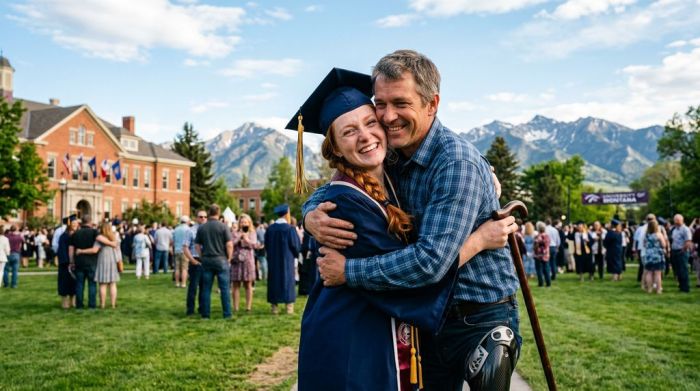
Piper Sullivan graduated from Montana State University with a degree in veterinary science on a warm June morning in Bozeman. The sky was the kind of blue you only see in Montana — vast and endless, with clouds that drifted like slow ships across an ocean of light. Piper wore her cap and gown, her red hair spilling out from under the mortarboard, the same constellation of freckles still scattered across her nose.
Her parents sat in the third row, her mother crying openly, her father holding her mother's hand and pretending he was not crying too. Hank the dog was long gone, buried under the big cottonwood tree at the edge of the property, but Piper liked to think he was watching from somewhere, wagging his tail.
And in the back row, leaning on a cane, a man in his late thirties sat quietly, watching the ceremony with a smile that crinkled the corners of his eyes. He had driven from Iowa, where he now taught high school history, to see a girl he had never met in person graduate from college.
After the ceremony, Piper found him in the crowd. She knew him from the photograph he had sent thirteen years ago — the one of him standing in front of the C-130, holding a stuffed German shepherd puppy. He looked older now. His hair was grayer. His face had lines that had not been there before. And he leaned on a cane, a carbon-fiber prosthetic visible below the cuff of his jeans.
But his smile was the same. It crinkled the corners of his eyes the exact same way.
"Sergeant Morrison," Piper said, and she was crying, and she did not care who saw.
James shook his head. "It's just James. I've been out of the Army for six years." He opened his arms, and she stepped into them, hugging a man she had known for almost half her life but was meeting for the very first time.
"Thank you," he whispered, his voice thick. "For writing that first letter. For not giving up on me. For showing me that bravery is not about never falling — it is about getting back up."
Piper pulled back and looked at him, at the cane, at the leg he had lost, at the life he had rebuilt. "You taught me that," she said. "Every time you wrote back. Every time you kept going. You taught me that the bravest people are not the ones who never get hurt. They are the ones who keep writing, keep hoping, keep showing up — even when it would be easier to stay silent."
James reached into his jacket and pulled out a small box. Inside was a worn, wrinkled piece of construction paper, faded and creased, protected by a sheet of plastic. It was Piper's first letter, the one with the crayon drawing of a palomino horse.
"I carried this with me through every deployment," he said. "Through the hospital. Through every hard day. This letter saved my life, Piper. I needed you to know that."
Piper took the letter in her hands, touching the crayon drawing she had made when she was eleven years old, and she understood something profound — that the smallest acts of kindness can echo across years and oceans, that a single letter can become a lifeline, that connection is the most powerful force in the universe.
Epilogue: The Letters That Keep Going
James Morrison still teaches history at Newton High School in Iowa. On his desk, framed, is the crayon drawing of a palomino horse. His students ask about it sometimes. He tells them the story — about a girl in Montana, about a letter, about the day he learned that bravery is not about the battles you fight, but about the connections you keep.
Piper Sullivan is a veterinarian now, working at a clinic in Bozeman, not far from the ranch where she grew up. She keeps a box of letters under her bed — every single one James ever sent her, including the postcards from Paris and Rome and Switzerland. On hard days, she reads them. She reminds herself that the world is full of people who care about each other, even when they have never met.
And sometimes, when the mail comes, there is a letter from Iowa. Written in familiar handwriting, with stories about his students, his garden, the stray cat he adopted that he named Dusty. Piper writes back. She always writes back.
Because that is what they do. That is who they are. Two people from different worlds, connected by a school project and a crayon drawing and the quiet, stubborn belief that a single letter can change everything.
The letters we write do not always reach their destination in the way we expect. Sometimes they arrive wrinkled, water-stained, delayed by years and distance. Sometimes the reply takes longer than we hoped. But connection is worth waiting for. Connection is worth the silence, the uncertainty, the faith that somewhere on the other side of the world, someone is reading our words and finding hope in them.
If you have ever wondered whether your small act of kindness matters — whether a thank you note, a care package, a simple letter can make a difference — let this story be your answer.
It can. It does. It will.
All it takes is the courage to write the first word.